Paddle Explore lets founders break down revenue, conversion and MRR changes by product, country and billing frequency inside the billing system, avoiding spreadsheet exports before deeper analysis or product changes.
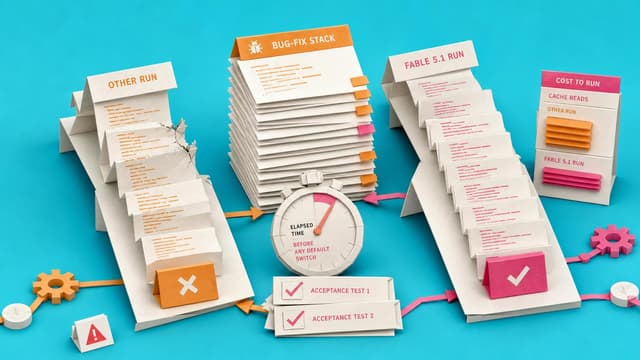
Anthropic released Claude Fable 5.1 for coding and longer-running work, with unchanged input/output prices and lower cache-read costs. Small teams should compare one bounded job against their current model on time, tokens, fixes, and scope drift before changing defaults.
PostNitro’s founder replaced a single welcome email with a 30-day onboarding path—first value in week one, education, then conversion—and reported MRR rising from about $4.5k to $5.4k amid other product changes.
Self-reported founder posts describe reaching about $10k MRR in six months without ads or investors. Common threads: waitlist validation, founder content, SEO or community, and a narrow offer before large builds. Unverified practitioner signal on demand-first sequencing.
August 2026 solo SaaS launch teardowns show polished products stalling on weak proof, generic positioning, and poor waitlist-to-paid conversion. With AI cutting build time, distribution and offer clarity bind outcomes more than missing features.
Small firms adopt generative AI for marketing, support, and coding faster than they track ROI. Pilots are common while conversion and support metrics lag, so measurement—not model access—is the main constraint.
Notion’s mid-August updates simplify AI model picking and adjust databases and permissions. Founders already running docs and light ops in one workspace get lower friction to draft and query if pages stay current and paid AI seats stay controlled.
OpenAI removed detailed cost lines from Enterprise API invoices from April 2026. Cost and activity exports from the API Usage dashboard replace them. One shared project hides which feature drove spend; separate projects or keys shrink the next cost check.
New n8n releases add node, security, and execution fixes. Solo founders running unattended support, billing, or CRM pipelines should stage upgrades and review breaking changes before production.
Makers still package templates, prompt packs, and mini-courses as low-ticket paid products to test willingness to pay before heavier SaaS builds, gaining clearer demand signals than waitlists alone.
Variable inference costs push small AI SaaS products toward credit bundles, hard usage caps, and hybrid subscription-plus-usage plans. Packaging now guards contribution margin as much as conversion when third-party model bills swing with volume.
OpenAI’s Ultrafast preview runs GPT-5.6 Sol on Cerebras at up to 750 output tokens per second, up to 14x Standard, for limited API customers. No price, regions, or uptime SLA—treat it as a capacity signal, not a rebuild trigger, unless mid-response drop-off is real.
Microsoft reports ChainDrop compromised over 400 npm packages with a self-propagating worm. A malicious preinstall hook stole npm, GitHub and cloud credentials, then republished infected versions through trusted publisher identities.
OpenAI refreshed API pricing and rate-limit docs with GPT-5. Model-specific token costs and tiered caps set the baseline for cost and capacity planning. Founders must recheck unit economics and throttle risk on every revenue-critical LLM call.
2026 comparisons show n8n and Zapier diverging on AI agents around billing, control, and failure modes. For solo product founders, unattended agents add uneven cost and babysitting when error paths and human judgement are missing.
n8n held cloud prices at €24/€60/€800 and raised AI Workflow Builder credits. Solo founders face execution caps and workflow discipline as the real constraint, not sticker price, when running agent-style automations on cloud plans.
Claude voice mode can now run Opus and Sonnet, matching text-chat model access. Spoken turns still count against normal message quotas. Founders can keep higher-quality reasoning in walking or chores contexts without switching interfaces.
Cursor launched a router that inspects each coding request and routes it to a fitting model. Auto offers Intelligence, Balance, and Cost modes. Tests kept frontier outcomes at roughly 60% lower cost, helping solo builders stop paying frontier prices for routine work.