I can't hand off AI work without it falling apart
A non-technical mid-career manager can get a useful AI result once, but cannot reliably turn it into work the team can repeat. The prompt is only one part of the job. The real handoff also needs the source inputs, accepted examples, edge cases, stakeholder context, and quality checks the manager used without writing them down. Without that handoff pack, the manager either keeps running the AI task personally or spends the saved time reviewing and rewriting other people's attempts.
Blocker Reviewed by Helen Jones
Reviewed by Helen JonesContext
The blocker, in a nutshell
If this blocker is unfamiliar, start here.
Mid-level managers coordinate teams of 4-12 people inside larger organizations. They translate senior leadership goals into daily work, review output quality, and manage time allocation across projects. Many spend much of the week in meetings, email, status reviews, and stakeholder updates.
AI tools are now used for summaries, reports, drafts, data pulls, and planning support. The problem is that a successful AI result often depends on the manager's unstated context: which inputs to include, what the stakeholder cares about, what a good answer sounds like, and which mistakes must be caught before the work is shared.
That makes AI useful for the individual but fragile for the team. Unless the working approach becomes a handoff pack with inputs, examples, and checks, the manager stays the bottleneck.
Key Terms
Industry jargon explained
Click any term to see its definition.
The Reality
A day in their life
Non-technical mid-career manager
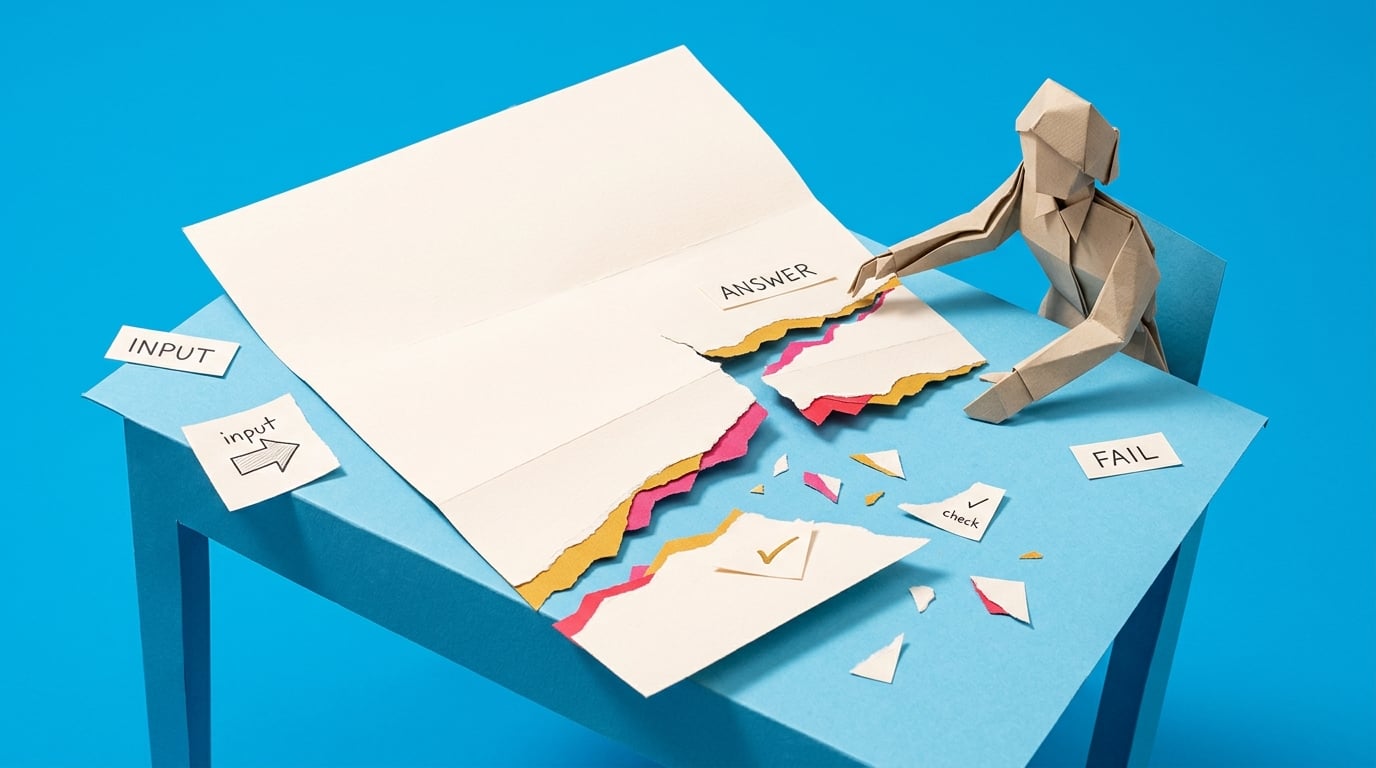
I start the morning with a familiar request: a stakeholder needs the monthly competitor summary updated before the afternoon meeting. I know the AI chat that worked last time, so I find it, copy the prompt, swap in the latest source notes, and get a draft that is close enough to be useful.
The small win is real. In twenty minutes I have a better first draft than I would have produced from scratch. But then the hidden work starts. I check which numbers came from which source, rewrite the caveats, remove a confident claim that feels too strong, and adjust the tone so it sounds like something our team would actually send.
After lunch, a team member asks if they can take this task next month. I send them the prompt and talk through the basics, but I can feel the gaps as I explain it. I have not written down which sources count, what to do when the AI guesses, which format the stakeholder expects, or the standard I use before I call the answer good.
By late afternoon they try a version and send it back. It is not careless. It just misses the judgment I never gave them. I spend another half hour rewriting it, and the task quietly comes back to me.
What I wish I had is not another prompt library. I want a simple way to turn the good chat into a handoff pack: the inputs, one accepted example, the checks I use, and a small test that proves someone else can run it before I let go.
The People
Who experiences this blocker
Non-technical mid-career manager
38-45 • 12-18 years in operations or marketing roles, promoted into people management without technical training
Skills
Stakeholder communication
Budget oversight
Process coordination
Performance reviews
Frustrations
- Every useful AI result stays tied to one chat window
- Team members produce inconsistent output when they try the same task
- Junior staff still need oversight after a walkthrough
Goals
- Create work that runs without the manager present
- Reduce repeated review and rewriting of AI-assisted outputs
- Build team capability that survives holidays, staff changes, and workload spikes
Direct report or junior analyst
Tries to repeat the AI-assisted task, but lacks the manager's source choices, review criteria, and stakeholder context.
Also affected by this blocker. Often shares the same frustrations or creates additional pressure.
Top Objections
- This will break like the last workflow doc we tried to hand off
- I don't have time to document every decision rule my team needs
- My team won't follow a checklist if it feels like admin work
- How do I know the quality checks actually catch bad output
- This sounds like more work than just doing the AI task myself
How They Talk
Use These Words
hand offcheck the outputmake sure it doesn't go sidewayswhat good looks likerun it by me firstteam capacityrepeatable
Avoid
prompt engineeringcontext windowfew-shotchain of thoughttoken limitsystem prompt
Learning Pathway
Delegable AI Workflows for Managers
Turn personal AI wins into repeatable team work without pretending the AI can replace judgment.
Showing 2 of 2 recommendations
Course
Course Built
◆◆◆◆◆Excellent Fit
Build One AI Task Handoff Pack
The learner moves from personally running or rescuing a recurring AI-assisted task to owning a clear handoff pack another person can attempt while they are away or busy.
7 lessons125 minbeginner
You'll build: Create a one-task AI handoff pack with a cover sheet, task choice card, request-to-finished-output map, prompt or prompt sequence, source and output rules, quality checks, stop-and-ask rules, runner/reviewer boundaries, cover-test notes, and a final status of Keep, Revise, Do not delegate, or Not tested yet.
Includes: AI Task Handoff Workbook · Finished Example: Monthly Competitor Update Procedure · Task choice card · Request-to-finished-output map · Prompt improvement worksheet · Source and output rules page · Quality checks and stop-and-ask rules · Cover-test notes and final status sheet
AI task handoff packsTask documentationPrompt improvement+4 more
Standard paid micro-course or toolkit pricing; no ROI claim until validation confirms willingness to pay and time saved.
Briefing
Briefing Built
◆◆◆◆◇Good Fit
Why Sharing The Prompt Is Not The Same As Handing Off The Work
The reader moves from treating a prompt as the handoff to seeing the whole job that must travel with it: sources, examples, steps, checks, and stop rules.
You'll build: Use the checklist to decide whether one AI-assisted task is safe to delegate with a prompt, needs prompt-plus-notes, needs a handoff pack, or is too complex or sensitive to delegate yet.
Includes: Prompt-versus-handoff option table · Five-part handoff pack checklist · AI delegation readiness checklist
Prompt-only delegation riskHidden work around AI chatsHandoff pack basics+2 more
Root Cause
Finding where this blocker actually starts
We traced backward through five layers of "why" until we hit the source. Here's what's really driving this.
1
Why is this painful?
A manager gets a useful AI result once, but the task falls apart when a team member tries to repeat it.
2
Why does the work collapse when handed off?
The working result lives inside one chat session, while the source files, assumptions, accepted examples, and quality checks are not packaged for reuse.
3
Why is there no input-example-check structure?
The manager is relying on tacit decision rules: what to include, what to ignore, how the output should sound, and which mistakes would make the work unsafe to send.
4
Why have those rules stayed unwritten?
Their expertise has usually been judged by the finished output, not by whether another person could reproduce the intermediate decisions.
5
Why does this persist at the market level?
Organizations are still learning how to redesign AI-assisted work as a shared operating practice, so many useful AI workflows remain personal habits rather than team capability.
Root Cause
The root cause is not poor prompting alone. It is uncaptured professional judgment: the manager knows what good looks like, but the team only sees the chat output, not the choices and checks that made it usable.

The Numbers
How this stacks up
Editorial assessments based on the available evidence. Scores do not establish demand, purchases or measured financial impact.
Overall Impact Score
68/100
Urgency
7/10
Moderate pressure to solve
Build Difficulty
8/10
Complex, needs deep expertise
Market Size
7/10
Moderate estimated reach
Competition Gap
9/10
Larger assessed gap
"If I delegate work to AI? I have to fix it."
Reddit practitioner comment in discussion of AI-generated workslop, 2025-09-23
More Evidence
What others are saying
"Basically, you have to teach your pattern recognition before you can delegate it."
Attribution — Reddit practitioner discussion about delegation and knowledge transfer, 2026-05-14
"Right now, your team is trying to copy your words instead of how your brain works."
Attribution — Reddit practitioner discussion about exporting thinking before delegation, 2026-05-14
The Landscape
What solutions exist today?
Current market solutions and where there are opportunities.
Leader
A
Asana AI / AI Studio
Approach: AI-enabled work management with projects, workflows, task tracking, AI Studio, and AI teammate features for coordinating work.
Pricing: Starter listed at $10.99/user/month billed annually or $13.49 billed monthly; AI Studio Basic included with credit limits as of June 2026
Weakness: Useful for managing tasks and automations, but the pricing page verifies product capability rather than proving that it captures a manager's tacit source choices, accepted examples, and pass/fail criteria for a specific AI handoff.
Challenger
C
ClickUp AI
Approach: All-in-one productivity platform with AI for querying workspaces, generating summaries, writing assistance, task automation, and duplicate detection.
Pricing: Pricing and AI packaging should be rechecked before publication
Weakness: Can help create and manage work, but the current evidence does not prove it solves the specific handoff problem of externalizing the manager's judgment into examples and checks.
Challenger
W
Wrike AI Agents
Approach: Work management with AI and agentic features for multi-step workflows, analytics, and resource allocation.
Pricing: Pricing and AI packaging should be rechecked before publication
Weakness: Agentic execution may reduce manual steps, but a team still needs explicit inputs, standards, review gates, and escalation rules for ambiguous outputs.
Niche
M
Motion
Approach: AI task and calendar manager focused on scheduling, prioritization, and workload planning.
Pricing: Pricing should be rechecked before publication
Weakness: Primarily addresses time and task prioritization rather than documenting reusable AI task handoffs with examples and quality checks.
The Gap
Why existing solutions keep failing
The pattern they all miss — and how to beat it.
Common Failure Mode
Most solutions treat AI output as a one-off productivity gain or a task-management event. They do not give a non-technical manager a simple way to convert the hidden parts of their judgment into a reusable handoff pack with inputs, examples, decision rules, and pass/fail checks.
How to Beat Them
Teach a repeatable handoff-pack process: capture the successful AI task, identify the hidden choices the manager made, add one accepted example, write pass/fail checks, and run a supervised handoff test before the task becomes team-owned.
The Fix
What a solution needs to succeed
The non-negotiables and nice-to-haves for any product or service tackling this blocker.
The 3 Wishes
Give the manager a simple handoff pack that turns one successful AI chat into a repeatable team task: source inputs, accepted example, decision rules, pass/fail checks, and a supervised test run.
Must Have
A way to identify the exact repeatable AI task and the stakeholder outcome it serves
A handoff pack containing inputs, accepted example, quality checks, and exception rules
A small supervised test where someone else runs the task and the manager records what failed
A proof boundary that treats the pack as a quality-control aid, not a guarantee of perfect AI output
Nice to Have
Templates for report, email, summary, and spreadsheet-update handoffs
A simple review rubric for source checks, tone, missing context, and unsupported claims
A lightweight team log of accepted outputs and common failure cases
Out of Scope
Building a full workflow platform
Automating confidential or regulated decisions without human review
Replacing manager accountability for final output quality
Claiming a specific annual ROI before primary validation
Success Metrics
The handoff pack includes source inputs, accepted example, pass/fail checks, and escalation rules
A team member can complete one test run from the pack without asking for missing context
The manager's review notes shrink from a rewrite to a short list of specific corrections
The final output is labelled as review-ready, not automatically approved
Solution Strategy
Which approach fits you?
Prompt libraries help people start, and work platforms help teams track tasks. This problem needs a bridge between the two: a practical artifact that packages the manager's working example, source choices, decision rules, and checks so another person can repeat the task safely.
What we recommend
Create a course-led handoff-pack workflow first. A blueprint or software tool may become useful later, but the immediate bottleneck is the manager's ability to externalize judgment and run a supervised handoff test.
The Future
What might make this blocker obsolete
Technologies and trends that could disrupt this space. Factor these into your timing.
high probability
2026-2027
Agentic workflows raise the standard for task specifications
Teams may delegate more complete tasks to agents, but the need to define inputs, expected output, quality checks, and escalation rules remains. This makes handoff-pack thinking more important, not less.
SaaS: Opportunity
Course: Opportunity
Consulting: Opportunity
Content: Opportunity
high probability
2026-2028
AI governance pushes informal prompts into documented workflows
Internal AI governance may require documented review criteria for customer-facing, financial, HR, or compliance-sensitive outputs. Managers who already package AI tasks with checks will be easier to support.
SaaS: Opportunity
Course: Opportunity
Consulting: Opportunity
Content: Opportunity
medium probability
2027-2028
Work platforms auto-capture AI task history
Work platforms may auto-capture prompts, source files, and outputs, reducing some manual documentation. They still may not capture the manager's tacit judgment unless the workflow asks for examples and acceptance criteria.
SaaS: Medium risk
Course: Low risk
Consulting: Low risk
Content: Low risk
medium probability
2026-2027
AI output auditing becomes easier to run
Automated output scoring may catch some consistency problems, but the first accepted examples and rejection criteria still need human ownership.
SaaS: Medium risk
Course: Low risk
Consulting: Low risk
Content: Low risk
For Creators
Content Ideas
Marketing hooks, SEO keywords, and buying triggers to help you create content around this blocker.
Buying Triggers
Events that make people search for solutions
- A team member sends AI-assisted work that looks polished but contains errors or misses the stakeholder's real question
- The manager prepares for time off and realizes no one else can safely run the repeatable AI tasks
- A stakeholder asks how AI-assisted work is being checked before it is shared
- A direct report asks again how to generate a report, summary, or update the manager previously created with AI
Content Angles
Attention-grabbing hooks for your content
- Why one good AI chat rarely becomes work someone else can run
- The hidden review tax when AI work stays trapped in one person's head
- How to turn a useful AI result into a repeatable team handoff
- Why sharing the prompt is not the same as delegating the work
Search Keywords
What people type when looking for solutions
delegate AI tasks to teamhand off AI work managerAI output inconsistent teammanager AI workflow documentationteam AI quality checkcan't delegate AI promptsAI task handoff failsAI workslop rework coworkers
The Evidence
Where this came from
Every claim in this report is backed by public sources. Verify anything.
67 sources referenced
Source note
Blocker published by Collab365 Spaces, reviewed by Helen Jones on . Cite as "I can't hand off AI work without it falling apart", Collab365 Spaces. 67 sources referenced.
Have a question or correction?
No comments yet