My team uses different AI tools and nothing matches
A non-technical mid-career manager is responsible for client-ready work, but the team now drafts, rewrites, researches, and edits with a mix of AI tools. One person gets polished bullets, another gets long generic paragraphs, another pastes too much context, and another forgets to check the source. The manager is left fixing tone, reconciling facts, and answering data-handling questions without a shared rulebook. The evidence supports a real consistency and rework problem; the exact annual cost should be treated as a team-specific estimate until the hours and salary assumptions are validated.
 Reviewed by Helen Jones
Context
The blocker, in a nutshell
If this blocker is unfamiliar, start here.
Mid-career managers in marketing, operations, client services, and similar delivery teams are now reviewing work created with a mix of ChatGPT, Claude, Gemini, Copilot, Notion AI, Grammarly, and other assistants. The visible problem is not simply that AI outputs vary. It is that each person brings a different tool, prompt habit, source-checking habit, tone preference, and privacy assumption to the same client brief. The manager then becomes the person who has to make the work sound consistent, check whether the facts still line up, and answer awkward questions about how sensitive information was handled.
Key Terms
Industry jargon explained
Click any term to see its definition.
The Reality
A day in their life
Non-technical mid-career manager
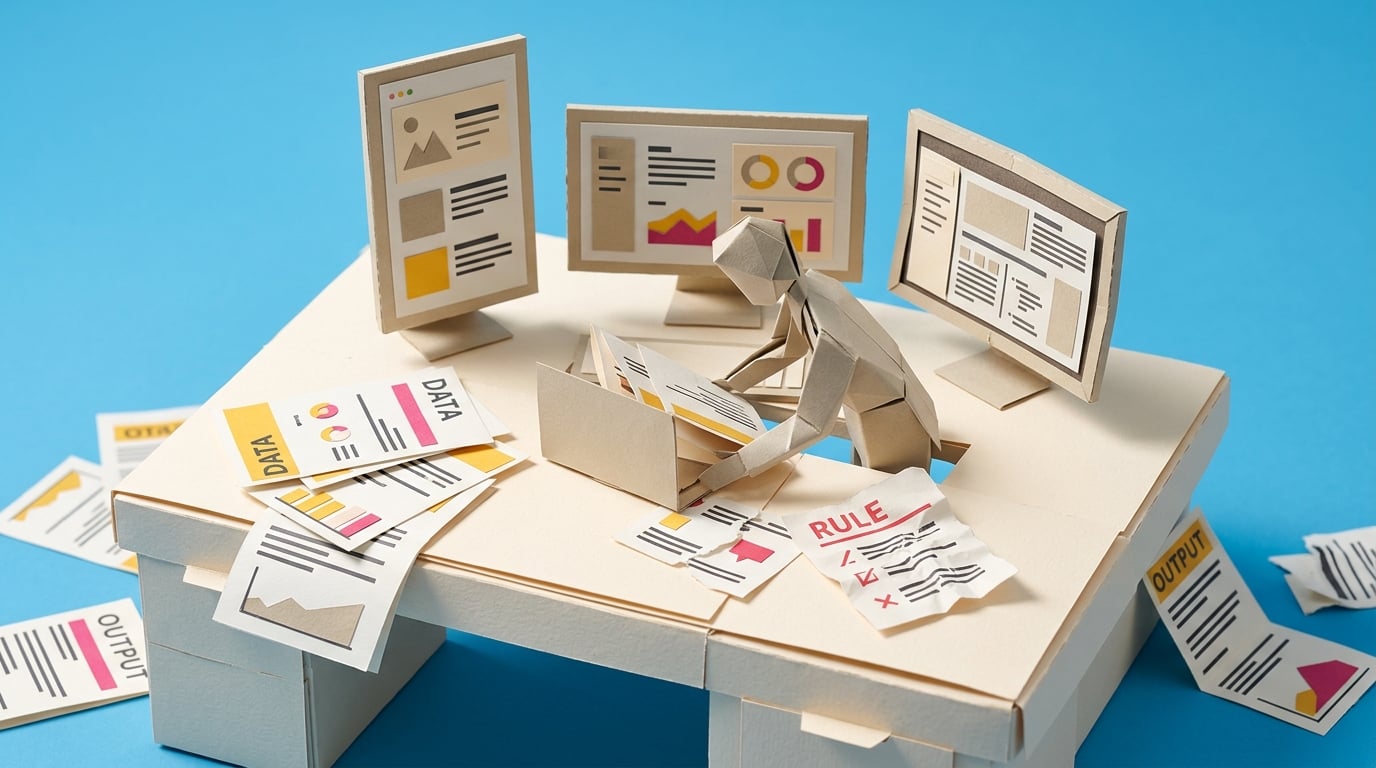
I start the morning by opening the latest client brief and immediately see the problem. Three people helped draft it yesterday, and all three used AI. One section is sharp and structured. One reads like a generic blog post. One includes a table with figures I do not recognise. The work is faster than it used to be, but it does not yet feel like one team produced it.
By mid-morning I am comparing the draft against last month's approved example, rewriting headings, and asking people which sources they used. There is a small win: one teammate has clearly found a useful prompt for summarising meeting notes, and that section gives me something to build from. But the rest of the file still needs too much judgement from me before I can send it anywhere.
After lunch, a compliance question lands in my inbox. It is not dramatic, but it is uncomfortable: did anyone paste customer information into an AI tool, and which tool was used? I can ask the team, but I do not have a simple record. Everyone was trying to help. Nobody was trying to be careless. We just never agreed what information was safe, what needed anonymising, or what had to stay out of public tools.
Later, a new hire messages me and asks whether we have an AI template for client work. I nearly send them three old examples and a note saying 'copy this style,' then realise that is exactly how the problem keeps repeating. They need a clear rulebook, not another vague example to interpret.
By the end of the day, the brief is good enough to send, but only because I absorbed the inconsistency. What I want is simple: people can keep using AI, but every draft should arrive with the same source pack, data boundary, brand example, structure, and final check so I am reviewing the thinking instead of repairing the process.
The People
Who experiences this blocker
Non-technical mid-career manager
42 • 14 years managing client deliverables across marketing and operations teams
Skills
project coordination
client communication
budget oversight
hiring and onboarding
Frustrations
- Every team member produces different tone and structure
- No written rules for what can be pasted into which AI tool
- New hires take too long to match existing output quality
Goals
- Deliver consistent client work without extra hours of rewriting
- Reduce brand and privacy risk from mismatched AI habits
- Give new hires a clear way to use AI at the team's standard
Compliance or risk lead
Asks the manager to explain which AI tool handled sensitive data and whether privacy rules were followed, creating pressure to produce documentation that may not yet exist.
Also affected by this blocker. Often shares the same frustrations or creates additional pressure.
Top Objections
- This will break like the last time we tried to standardize tools and half the team ignored it
- No time to learn another tool on top of the five we already juggle
- My team won't adopt this if it feels like extra process instead of saving time
- Seems too good to be true that we can keep using different AIs and still get matching outputs
- Compliance will still flag us if the rules aren't written down somewhere official
How They Talk
Use These Words
brand voiceclient deliverablereworkrisk exposurenew hire rampsign-offversion controlapproved sourcereview checklist
Avoid
APIwebhookschematoken limitsfine-tuningembedding
Learning Pathway
Team AI Consistency System
Turn scattered AI habits into shared rules, source packs, templates, and review checks that make team outputs easier to trust.
Showing 1 of 1 recommendation
Briefing
Briefing Built
◆◆◆◆◆Good Fit
A copy-ready one-page AI rulebook plus a one-test decision for a single recurring deliverable, delivered as a member Briefing rather than a course.
The manager moves from personally absorbing inconsistent AI habits to giving the team a practical rulebook that makes each draft easier to check, compare, and trust.
You'll build: Copy and test a one-page one-deliverable AI rulebook for one recurring team deliverable, covering approved AI use cases, three-column data boundaries, a named source pack, an approved example, output structure, a contributor AI use record, a manager review checklist, and an adopt/adjust/abandon decision.
Includes: One-Deliverable AI Rulebook workbook · Filled weekly client campaign update example · 15-minute contributor test message · Contributor AI use record · Manager review checklist · Adopt, adjust, or abandon decision rule
mixed AI tool inventoryteam AI rulesdata-handling boundaries+5 more
Course pricing to be decided separately; no vendor/product pricing belongs in the recommendation promise.
Root Cause
Finding where this blocker actually starts
We traced backward through five layers of "why" until we hit the source. Here's what's really driving this.
1
Why is this painful?
Client deliverables come back with mismatched tone, structure, source quality, and data-handling assumptions, so the manager has to reconcile them before anyone outside the team sees the work.
2
Why do outputs never match?
Each team member is using a different mix of AI tools, prompts, examples, review steps, and privacy assumptions for the same kind of work.
3
Why is there no common reference point?
The team has not translated brand voice, approved sources, sensitive-data rules, and quality checks into a shared AI workflow that people can reuse.
4
Why has no shared operating rule been created?
That coordination work sits between delivery, marketing, operations, IT, and compliance, so nobody naturally owns it unless the manager creates a small practical system.
5
Why does this coordination gap persist?
AI tools spread through individual experimentation faster than many teams created day-to-day rules, leaving managers to retrofit consistency after the tools are already in use.
Root Cause
The root cause is not simply tool choice. It is unmanaged variation across prompts, examples, source material, review habits, and data boundaries after AI adoption has already spread through the team.

The Numbers
How this stacks up
Editorial assessments based on the available evidence. Scores do not establish demand, purchases or measured financial impact.
79
7
8
8
9
"I tested multiple AI tools using one document today. The responses were not the same."
User testing different AI tools on the same document and noting varying responses. Direct practitioner evidence, but access/date should be verified before publication. — Facebook group post, February 28, 2026 (human verification needed)
More Evidence
What others are saying
"If the way your team works is inconsistent, AI will just produce inconsistent outputs faster and at scale"
Marketing/practitioner commentary connecting inconsistent team processes with inconsistent AI output. Keep as visible evidence only after confirming author/date in LinkedIn. — LinkedIn post surfaced in search results, May 2026 approximate; exact post date needs verification
"I have found running the same prompt on the same requirements can give you different results, which probably would slow you down!"
Practitioner discussing AI for manual testing and team use of Copilot/Rovo; adjacent workflow evidence for same-prompt inconsistency and review drag. — Ministry of Testing community forum, December 2, 2025
"Even when you set parameters to make them more deterministic like temperature to 0, you can still get different results for the same prompt."
SDET practitioner explaining non-determinism in AI-generated work and the need to verify outputs. — Tricentis ShiftSync practitioner blog, February 9, 2026
The Landscape
What solutions exist today?
Current market solutions and where there are opportunities.
Leader
C
ChatGPT Business
Approach: Centralized workspace with admin controls, shared billing, usage visibility, and standard ChatGPT seats for teams using OpenAI models.
Pricing: For most countries, $25/user/month monthly or $20/user/month annually for standard ChatGPT seats; minimum 2 standard seats, per OpenAI help page updated June 2026
Weakness: Useful when a team can standardize on ChatGPT, but it does not by itself define brand examples, source-checking rules, or data-handling habits across Claude, Gemini, Copilot, Grammarly, and other tools already in use.
Challenger
N
Notion AI
Approach: AI features embedded in a Notion workspace for docs, wikis, and team knowledge.
Pricing: Pricing should be checked on Notion's live pricing page before publication
Weakness: Helpful if the team's work already lives in Notion, but it does not cover email, client files, Microsoft/Google docs, or external AI tools unless the team changes workflow.
Niche
A
AIPRM
Approach: Prompt marketplace and prompt-management extension for people who want reusable prompts.
Pricing: Pricing should be checked on AIPRM's live pricing page before publication
Weakness: A prompt library can improve one part of the workflow, but this problem also needs source packs, data rules, brand examples, review criteria, and adoption habits.
Challenger
G
Grammarly Business
Approach: Writing assistant with team features for brand tone, style guidance, and communication quality.
Pricing: Pricing should be checked on Grammarly's live pricing page before publication
Weakness: Useful for editing and tone consistency, but it does not govern upstream AI prompting, research sources, tool choice, or sensitive-data decisions.
The Gap
Why existing solutions keep failing
The pattern they all miss — and how to beat it.
Common Failure Mode
Most available fixes solve one slice of the problem: a better prompt, a single vendor workspace, an editing assistant, or an enterprise governance platform. The gap for this avatar is a lightweight, tool-agnostic operating layer that tells a small team what to paste, what not to paste, which examples to use, how to check facts, and what a finished deliverable must contain before it reaches the manager.
How to Beat Them
Create a lightweight, tool-agnostic team AI operating rulebook: approved use cases, data boundaries, source packs, brand examples, output templates, and a short review checklist. It should let people keep their preferred tools where appropriate while making the final work checkable and consistent.
The Fix
What a solution needs to succeed
The non-negotiables and nice-to-haves for any product or service tackling this blocker.
The 3 Wishes
Give the manager a lightweight, tool-agnostic team AI rulebook that makes every contributor use the same data boundaries, source pack, brand examples, output template, and final review checklist for one recurring deliverable.
Must Have
A simple inventory of which AI tools are actually used by the team
Clear data-boundary rules for what can be pasted, anonymised, summarised, or kept out of AI tools
Approved brand voice examples and anti-examples
Reusable output templates for the team's most common client or internal deliverables
A source-checking and fact-checking step that works regardless of AI tool
A lightweight record of tool used, source pack used, and final human reviewer
Nice to Have
A one-page manager dashboard or tracker for AI-assisted deliverables
Examples for new-hire onboarding
A short escalation path for sensitive-data or compliance questions
Before/after examples showing the same brief handled with and without the rulebook
Out of Scope
Enterprise-wide AI policy approval
Legal or compliance sign-off
Forcing the team onto one AI vendor
Guaranteeing identical AI outputs
Building a full governance platform
Success Metrics
One recurring deliverable type has a completed AI use rulebook
Each contributor can show which tool, source pack, and data boundary they used
The manager can review against a shared checklist instead of rewriting from scratch
A new hire can follow the same workflow without private explanation from the manager
Solution Strategy
Which approach fits you?
A briefing would help explain the risk, and a software build could later track AI usage, but the first bottleneck is behaviour and shared working standards. The manager needs to create and test a rulebook before buying or building enforcement.
What we recommend
Start with a practical course that produces a Team AI Rulebook and review checklist for one recurring deliverable. Consider a later build_spec only if teams repeatedly need tracking, approvals, or audit trails across many deliverables.
The Future
What might make this blocker obsolete
Technologies and trends that could disrupt this space. Factor these into your timing.
high probability
12-18 months
Enterprise AI governance becomes easier to buy
Large enterprises may gain centralized rule enforcement across major AI tools. Mid-market teams without IT support may still need lightweight local rules and training.
SaaS: Medium risk
Course: Low risk
Consulting: Opportunity
Content: Opportunity
medium probability
6-12 months
Each tool adds stronger style controls
Teams using a single model family may see partial improvement, but mixed-tool environments will still need shared examples, data rules, and review habits.
SaaS: Medium risk
Course: Opportunity
Consulting: Low risk
Content: Opportunity
medium probability
18-24 months
More ready-made AI usage templates appear
Associations, consultants, and vendors may publish more AI usage templates. This could reduce the need for generic guidance but increase demand for practical adaptation to a team's actual workflow.
SaaS: Low risk
Course: Medium risk
Consulting: Opportunity
Content: Opportunity
low probability
24-36 months
Models become more predictable, but context still matters
Technical consistency may improve across providers, but brand voice, source choices, and data boundaries will remain company-specific.
SaaS: Low risk
Course: Low risk
Consulting: Opportunity
Content: Opportunity
For Creators
Content Ideas
Marketing hooks, SEO keywords, and buying triggers to help you create content around this blocker.
Buying Triggers
Events that make people search for solutions
- A client or leader points out that sections of one deliverable sound inconsistent
- Someone asks which AI tool handled sensitive or customer-related information and the manager cannot answer confidently
- A new hire asks for the AI template or rulebook and discovers it does not exist
- The manager spends several hours in one week rewriting, checking, or merging AI-assisted work
Content Angles
Attention-grabbing hooks for your content
- The hidden rework tax of letting every team member prompt AI alone
- Why AI makes inconsistent team habits visible faster
- How to keep mixed AI tools without mixed client deliverables
- The manager's rulebook for AI-assisted work that actually matches
Search Keywords
What people type when looking for solutions
team AI tools inconsistent outputsdifferent AI tools different results teamAI output inconsistency managershared AI rules for teamAI governance for non-technical teamsshadow AI data privacy habitsAI rework checking outputs
The Evidence
Where this came from
Every claim in this report is backed by public sources. Verify anything.
88 sources referenced
Source note
Blocker published by Collab365 Spaces, reviewed by Helen Jones on . Cite as "My team uses different AI tools and nothing matches", Collab365 Spaces. 88 sources referenced.
Have a question or correction?
No comments yet