My new website is live, but Google does not seem to know it exists
A solo founder can publish a useful website but cannot tell whether search engines have discovered, crawled, or indexed it. The founder needs a plain-English discovery sequence and evidence log before they can judge backlinks, rankings, authority scores, or AI citations.
Context
The blocker, in a nutshell
If this blocker is unfamiliar, start here.
A website being online only means a browser can open it. Search engines first need to discover the address, visit the page, decide whether to store it, and then decide whether it is relevant enough to show for a search. Links and sitemaps can help with discovery. Webmaster tools help the owner observe parts of the process. None of those steps guarantees ranking or citation.
Key Terms
Industry jargon explained
Click any term to see its definition.
The Reality
A day in their life
Solo or two-person bootstrapped founder building SaaS, AI tools, courses, templates, or information products
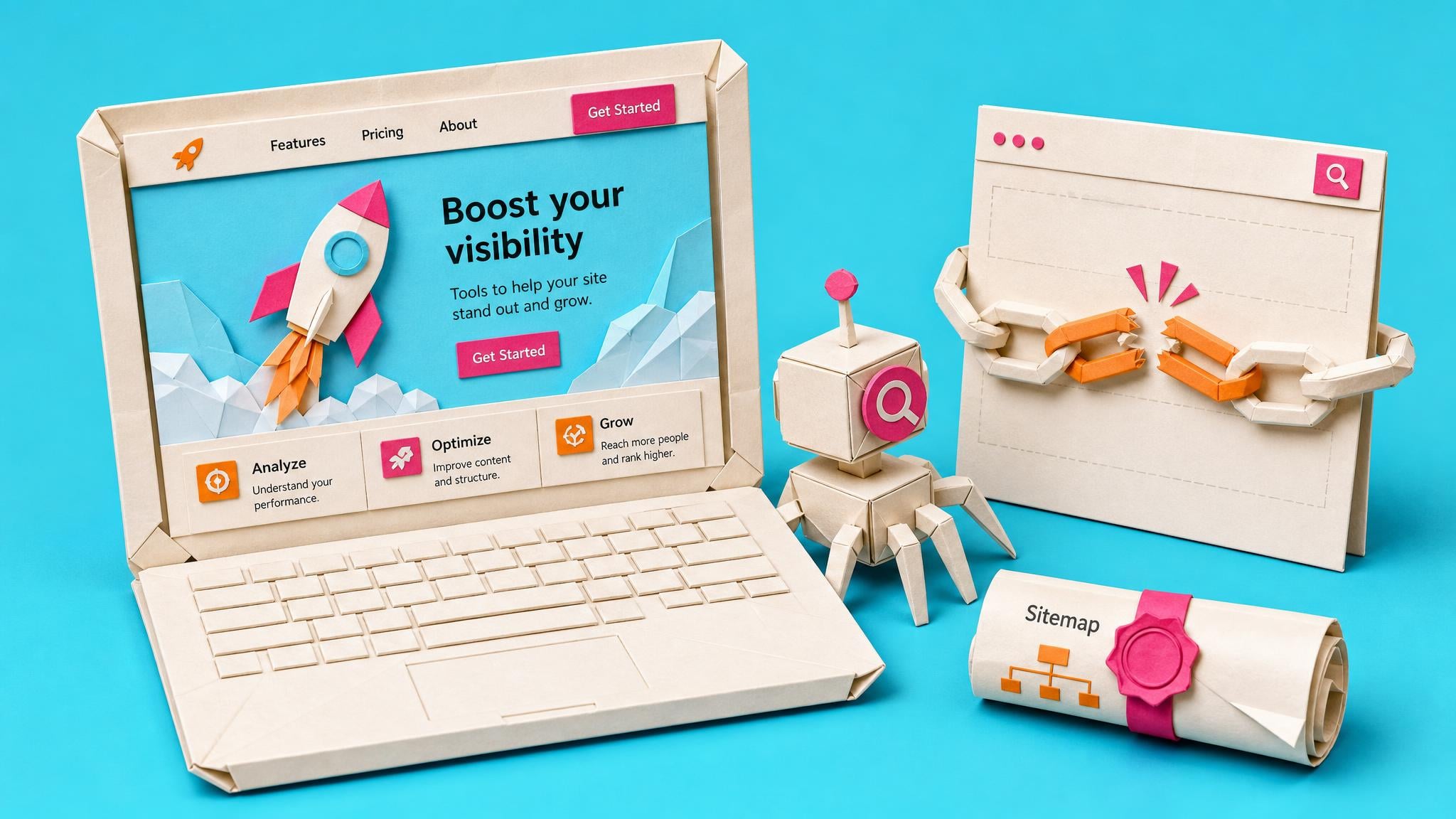
I started the morning pleased that the new site was finally live. The page loaded, the data looked useful, and the link back to my main product made sense for a visitor. That felt like a real win.
By lunchtime I had searched for the site in Google and found nothing. Search Console asked me to prove ownership using DNS, but the site was running on a hosted subdomain I did not control. I could not tell whether the site was blocked, ignored, too new, or simply waiting.
In the afternoon I read about backlinks, domain authority, dofollow links, sitemaps, and AI citations. Every article made a different task sound urgent. I nearly treated the host domain's authority score as proof that my new page must be valuable, even though I had no evidence that the page itself had been crawled or that anyone had clicked its links.
What I want is a simple record that tells me what I have actually done, what the search engines can currently see, and what remains an experiment. Then I can improve one thing at a time instead of changing the whole site from guesswork.
The People
Who experiences this blocker
Solo or two-person bootstrapped founder building SaaS, AI tools, courses, templates, or information products
30-55 • Intermediate product builder with little practical search-engine experience
Skills
Can publish or edit a simple website
Can follow a guided tool setup
Can inspect a public URL and copy small text snippets
Frustrations
- The site is live but absent from search
- Search tools use unfamiliar language
- Hosted subdomains limit DNS access
Goals
- Make one useful website discoverable
- Know whether Google and Bing have found it
- Measure a contextual link without overclaiming
Potential visitor or buyer
Needs a useful answer or resource and may follow the contextual link to the founder's main product when it is the natural next step.
Also affected by this blocker. Often shares the same frustrations or creates additional pressure.
Top Objections
- I do not know what crawling or indexing means
- I cannot edit DNS for this hosted site
- I do not want to become an SEO expert
- I cannot tell whether this is worth the effort
How They Talk
Use These Words
my site is liveGoogle cannot find itdo I need a sitemapwhat is a backlinkhow do I verify this
Avoid
link equity sculptingauthority transferSERP dominationparasite SEOAEO hack
Learning Pathway
Website Discovery Without SEO Guesswork
Publish one genuinely useful small site, make it crawlable, verify it with Google and Bing, and measure what happened without claiming what the evidence cannot prove.
Showing 2 of 2 recommendations
Briefing
Briefing Built
◆◆◆◆◆Excellent Fit
Understand Website Discovery Before Chasing Backlinks
From treating launch as the end of discovery to knowing the next observable check and its limits.
You'll build: Complete a one-page discovery map and choose the next evidence check for one live website.
Includes: Discovery ladder · Backlink value and risk table · First-check checklist
published versus crawled versus indexedbacklinks and followable linksdomain and page authority scores+3 more
Included with Space membership
Course
Course Built
◆◆◆◆◆Excellent Fit
Build a Discoverable Mini-Site with an Evidence Log
From a useful idea with no public route to a live ChatGPT mini-site, a natural backlink, and an honest record of what Google and Bing can see.
8 lessons175 minabsolute beginner
You'll build: Publish one useful no-login mini-site with a contextual backlink, working or specifically blocked crawl routes, verified or specifically blocked Google and Bing properties, a submitted sitemap where possible, and a labelled 30-day discovery record.
Includes: Mini-Site Project Record · Five-line build brief · ChatGPT Sites build and verification prompts · 30-day observation table
useful mini-site selectioncontextual outbound linksrobots.txt and sitemap.xml+3 more
Included with Space membership
Root Cause
Finding where this blocker actually starts
We traced backward through five layers of "why" until we hit the source. Here's what's really driving this.
1
Why can the founder open the site but not find it in search?
A direct URL only proves the site is online. It does not prove that a search engine has discovered, crawled, indexed, or chosen to show the page.
2
Why might a search engine not know about the page yet?
The page may be new, poorly linked, blocked, inaccessible without a login, absent from a sitemap, or simply not yet crawled and processed.
3
Why does the founder not know which condition applies?
They have not verified the site in Google Search Console or Bing Webmaster Tools and do not yet have a simple discovery record.
4
Why was this setup left until after launch?
The founder treated hosting as discovery and assumed useful content would be found automatically.
5
Why does the confusion persist?
Search advice mixes technical setup, content quality, link acquisition, third-party authority scores, and AI visibility into one vague promise instead of separating what each action can prove.
Root Cause
The founder is missing a discovery model and an evidence log. Without those, they cannot separate a live page from a discoverable page or distinguish a completed setup step from an external result such as ranking or citation.
The Numbers
How this stacks up
Editorial assessments based on the available evidence. Scores do not establish demand, purchases or measured financial impact.
78
7
9
7
8
"Our startup was completely invisible to Google."
A founder describing the discovery that a live product site was not meaningfully visible to Google. — Indie Hackers founder post, 2026
More Evidence
What others are saying
"The problem is that it's very confusing because there are a lot of things to check."
A new website owner asking how to prioritise crawling, indexing, sitemaps, internal links, metadata, and backlinks. — Reddit r/SEO beginner question, 2026
The Landscape
What solutions exist today?
Current market solutions and where there are opportunities.
Leader
G
Google Search Console
Approach: Verify ownership, inspect URLs, submit sitemaps, and monitor Google Search data.
Pricing: Free
Weakness: The interface assumes the user already understands properties, verification, crawling, indexing, and the limits of submission.
Leader
B
Bing Webmaster Tools
Approach: Verify a site, submit sitemaps, inspect URLs, and monitor Bing visibility.
Pricing: Free
Weakness: It provides diagnostics but does not decide whether the page is useful, worthy of links, or likely to rank or be cited.
Leader
S
SEO authority checkers
Approach: Estimate the relative backlink strength of a domain or page.
Pricing: Free checks and paid plans
Weakness: A domain-level score can be mistaken for a Google score or for proof that a new hosted page transfers the host domain's strength.
G
Generic SEO launch checklists
Approach: List technical, content, link, and measurement tasks before or after launch.
Pricing: Usually free
Weakness: They often present every task as equally urgent and do not give a beginner a clear evidence sequence or proof boundary.
The Gap
Why existing solutions keep failing
The pattern they all miss — and how to beat it.
Common Failure Mode
Beginner material commonly starts with tools or checklists. The missing product is a people-first discovery workflow that explains each term before asking the founder to act and records what each step can actually prove.
How to Beat Them
Use a build-first discovery sequence: choose one useful small site, build it with ChatGPT Sites or a fallback builder, publish it without sign-in, place the main-site link where it helps the visitor, test the crawl routes, verify Google and Bing, then observe what happens. This creates one honest discovery experiment. It does not prove ranking, traffic, authority growth, or AI citation.
The Fix
What a solution needs to succeed
The non-negotiables and nice-to-haves for any product or service tackling this blocker.
The 3 Wishes
Give the founder one calm sequence that turns a useful live page into a crawlable, verified experiment without pretending it guarantees rankings or citations.
Must Have
Plain-English discovery model
People-first site selection gate
No-login crawlability
Google and Bing verification fallbacks
Evidence log with proof boundaries
Nice to Have
Referral analytics
Reusable templates
Out of Scope
Guaranteed rankings, traffic, revenue, authority growth, or AI citations
Paid, exchanged, or bulk backlinks
A full SEO programme
Success Metrics
One useful site is public and crawlable
Verification and sitemap status are recorded
The learner can explain what the setup proves and does not prove
Solution Strategy
Which approach fits you?
A Briefing alone solves the language and decision problem, but not the sequenced build. A Blueprint is unnecessary because the learner is configuring a small site and existing webmaster tools rather than building a new software product.
What we recommend
Keep the Briefing as the plain-English discovery model. Then use the eight-lesson Course and its embedded Mini-Site Project Record to help the founder build one genuinely useful mini-site with ChatGPT Sites, link it naturally to a deeper main-site answer, make the mini-site search-ready, and record what Google and Bing can see. Treat this as one measured discovery experiment, not a guarantee of rankings, traffic, authority growth, or AI citations.
The Future
What might make this blocker obsolete
Technologies and trends that could disrupt this space. Factor these into your timing.
high probability
2026-2028
Search and AI assistants merge discovery surfaces
Founders will encounter more citation surfaces, but the baseline remains a crawlable, indexed, useful page. Platform reporting and citation visibility may change.
SaaS: Opportunity
Course: Medium risk
Content: Opportunity
medium probability
2026-2027
Hosted platforms change link and indexing controls
Platforms may change verification support, crawl policies, or link attributes. The course should preserve fallbacks and require live checks.
SaaS: Low risk
Course: Medium risk
Content: Low risk
For Creators
Content Ideas
Marketing hooks, SEO keywords, and buying triggers to help you create content around this blocker.
Buying Triggers
Events that make people search for solutions
- A newly launched site does not appear in branded search
- Google Search Console asks for DNS access the founder does not have
- Bing reports that no sitemap is known
- The founder hears that a hosted-domain backlink is valuable but cannot judge the claim
- The founder wants their work to be eligible for search and AI citations
Content Angles
Attention-grabbing hooks for your content
- Why live does not mean findable
- The six website states beginners accidentally mix together
- What a backlink can prove before it improves anything
- How to verify a hosted subdomain without DNS
- Why a high domain score does not make every new page powerful
Search Keywords
What people type when looking for solutions
new website not showing in Googlehow Google finds a new websiteSearch Console without DNS accesswhat is a backlink for beginnerssubmit sitemap Google and BingAI citation website basics
The Evidence
Where this came from
Every claim in this report is backed by public sources. Verify anything.
13 sources referenced
Source note
Blocker published by Collab365 Spaces, reviewed by Collab365 editorial team on . Cite as "My new website is live, but Google does not seem to know it exists", Collab365 Spaces. 13 sources referenced.
Have a question or correction?
No comments yet