I spend hours fixing AI drafts that miss what leadership actually wants
A non-technical mid-career manager can get a polished AI draft quickly, but still cannot send it to leadership without careful repair. The draft may miss recent decisions, use the wrong tone, repeat old framing, or hide assumptions that the manager would normally catch while writing. The workslop research supports the broader pattern: low-substance AI work can shift review and correction effort downstream. For this avatar, the $2,000-4,000 annual impact is best presented as an illustrative estimate: if the manager spends 4-8 hours a month repairing AI drafts at a $39/hour salary proxy, the hidden rework can plausibly cost thousands per year. The real pain is that the AI appears to save time while moving the most judgment-heavy work into review.
Blocker Reviewed by Helen Jones
Reviewed by Helen JonesContext
The blocker, in a nutshell
If this blocker is unfamiliar, start here.
Mid-career managers sit between executives who set direction and teams who execute. They translate strategy into weekly priorities, write status updates, prepare briefings, and keep cross-functional work moving. Their value comes from knowing which facts matter, which risks can be named, which words create friction, and how to frame trade-offs for each stakeholder.
Most of that judgment is not stored in one clean file. It lives in prior decks, meeting notes, chat threads, feedback from leaders, and decisions the manager remembers because they were in the room. AI drafting tools can produce a polished first version quickly, but they do not automatically know the unstated leadership context that makes a draft safe to send.
Key Terms
Industry jargon explained
Click any term to see its definition.
The Reality
A day in their life
Non-technical mid-career manager
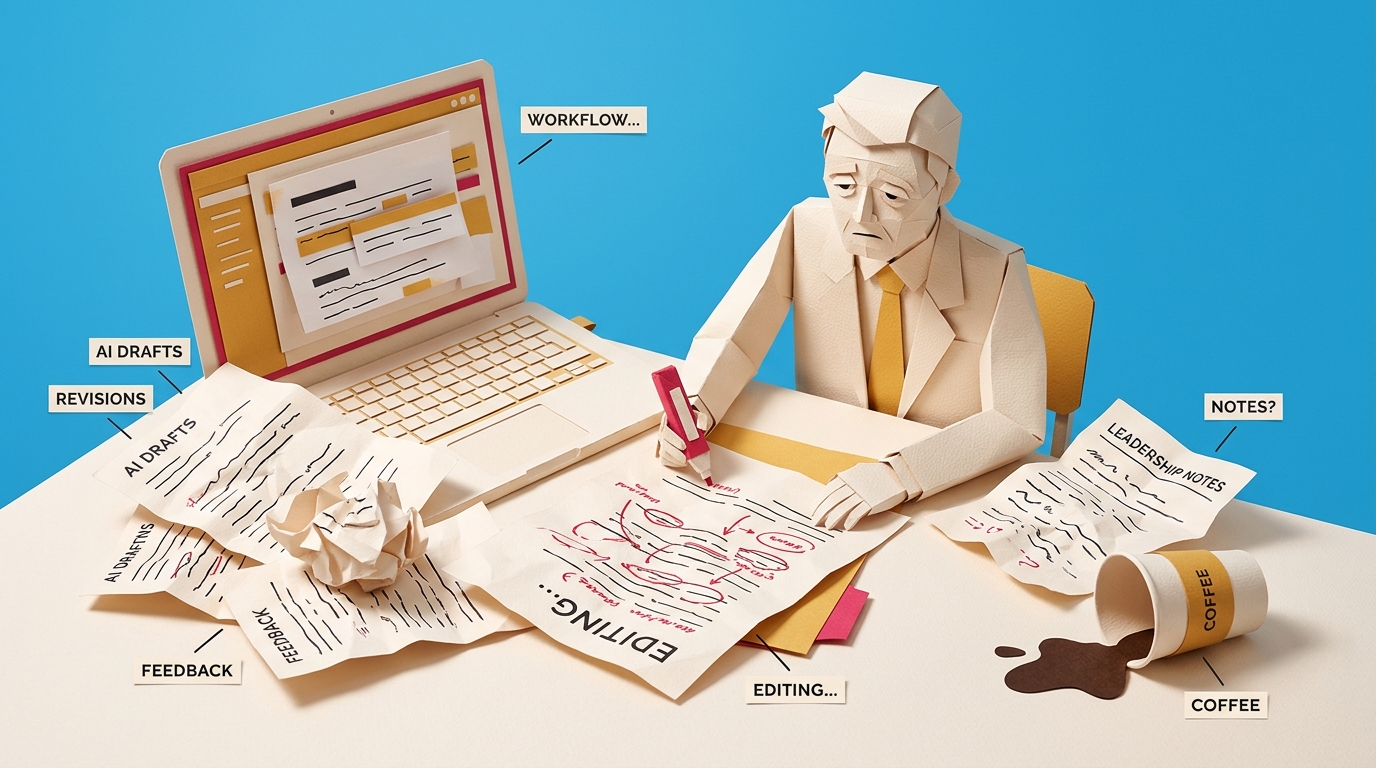
Tuesday starts with a 9:15 Slack from the VP asking for a quarterly update deck by Thursday noon. I open the last version, paste the rough notes into an AI tool, and ask it to make the update sound more strategic. Twenty minutes later the draft comes back clean, confident, and wrong about two priorities that shifted after last week's offsite.
I spend the next 40 minutes in our shared drive hunting for the slide that shows the real constraint. Then I rewrite the tone paragraph because the AI used language our CFO always pushes back on. The small win is that the structure is usable: the sections are in the right order, and I am not starting from a blank page.
By lunch the draft is technically done, but not leadership-ready. I still need to run it past two team leads who were in the meeting where the real decisions were made. One replies with factual corrections. The other points out that the risk section misses the vendor issue we discussed. I feed the corrections back into the AI, and the new version drops the budget timing from the previous draft.
By 5:15 the update is finally something I can send without embarrassment. The painful part is not that AI failed completely. It is that I had to inspect every sentence because the mistakes looked polished. The review took the same kind of judgment I was trying to save time on.
What I wish existed is a simple way to give the AI the right facts, tone rules, and leadership context before it writes, then check the result quickly after. I do not need a giant new system. I need the draft to remember what leadership actually wants before I spend another evening fixing it.
The People
Who experiences this blocker
Non-technical mid-career manager
42 • 18 years in operations and team leadership across two mid-sized companies
Skills
Stakeholder communication
Budget oversight
Process documentation
Cross-team coordination
Frustrations
- AI drafts that sound right but get key facts wrong
- Losing an hour fixing tone after every generation
- Having to re-explain context that should already be known
Goals
- Send stakeholder updates without a second round of edits
- Protect team time instead of creating hidden review work
- Keep AI from eroding the trust built over years
Department VP or executive
Sets deadlines and expects polished drafts; often assumes AI has removed the need for extensive human review time.
Also affected by this blocker. Often shares the same frustrations or creates additional pressure.
Top Objections
- This will break like the last custom GPT that lost all my files after an update
- I don't have time to learn another system on top of my actual job
- My team will never adopt something new even if I do
- It sounds like it will require feeding the AI all our internal docs, which I can't do
How They Talk
Use These Words
draftstakeholder noteswhat leadership actually wantstone checkbusiness fitsend it back for another round
Avoid
context windowvector storeRAGembeddingschemaAPI key
Learning Pathway
Leadership-Ready AI Drafts
Turn polished but risky AI drafts into source-backed, tone-aware updates you can send with fewer surprises.
Showing 1 of 1 recommendation
Briefing
Briefing Built
◆◆◆◆◆Excellent Fit
Check an AI Leadership Draft Before You Send It
From a polished AI draft that feels risky to a clear decision: send it, revise it, or get a human/source check before leadership sees it.
You'll build: Use the Leadership Draft Repair Kit to decide whether one AI-assisted leadership draft is ready to send, needs revision, or needs a named human/source check; record the decision, unresolved assumptions, and open questions before leadership review.
Includes: Leadership Draft Repair Kit · Five-check pre-send checklist · Fact/source trace table · Assumption label examples · Tone and framing risk prompts · Send/revise/escalate decision rule · Optional reviewer handoff note
AI draft reviewLeadership-ready updatesSource-backed facts+4 more
Briefing/template candidate
Root Cause
Finding where this blocker actually starts
We traced backward through five layers of "why" until we hit the source. Here's what's really driving this.
1
Why is this painful?
The manager spends time correcting AI-generated drafts for facts, tone, assumptions, missing context, and leadership fit before they can send them on.
2
Why does the output require so much correction?
The AI draft often looks polished, so the mismatch is discovered during close review rather than at the point of generation.
3
Why can't the manager prevent the mismatch before it happens?
The draft is missing the manager's current decision context: what changed recently, which trade-offs matter, what leadership already rejected, and what phrasing will land badly.
4
Why is the context not available to the AI in usable form?
That context is scattered across meeting notes, chat threads, prior approved drafts, stakeholder feedback, and memory instead of being captured as a reusable source pack.
5
Why does this structural gap persist?
Managers have historically carried this judgment tacitly because they were writing and reviewing the work themselves. AI makes the hidden judgment layer visible because a generic first draft cannot safely replace it.
Root Cause
The true root cause is the missing handoff between tacit managerial judgment and AI drafting: the manager knows the facts, sensitivities, trade-offs, and leadership expectations, but that knowledge is scattered and not packaged into a reusable source pack before the AI generates the draft.

The Numbers
How this stacks up
Key metrics that determine the opportunity value.
Overall Impact Score
72/100
Urgency
7/10
Moderate pressure to solve
Build Difficulty
8/10
Complex, needs deep expertise
Market Size
8/10
Massive addressable market
Competition Gap
8/10
Major gap in the market
"It feels like AI is speeding up drafting, but pushing more of the judgment work onto the reviewer."
Manager asking whether AI-assisted writing has shifted thinking and review burden onto managers. — Reddit r/managers, April 2026 (Reddit timestamp showed 2mo ago when checked on 2026-06-08)
More Evidence
What others are saying
"AI does not produce writing that is 'just about there'"
Writing practitioner describing executive expectations that AI drafts are nearly complete and workers only need to finish them. — LinkedIn - Mike Rosenberg, March 2026 (LinkedIn timestamp showed 3mo when checked on 2026-06-08)
"I had to waste more time following up on the information and checking it with my own research."
Survey respondent in HBR workslop research describing rework caused by AI-generated work that lacked enough substance. — Harvard Business Review / BetterUp Labs / Stanford Social Media Lab, 2025-09-22, updated 2025-09-25
The Landscape
What solutions exist today?
Current market solutions and where there are opportunities.
Leader
C
ChatGPT Custom GPTs
Approach: Users create persistent GPT personas by uploading files or pasting instructions for customized AI responses.
Pricing: Plus tier is publicly listed at $20/month; OpenAI Help verified on 2026-06-08 that Plus includes file uploads and custom GPT creation/use. Team, Business, Enterprise, and Edu availability depends on plan and workspace controls.
Weakness: A custom GPT can store instructions and uploaded knowledge, but it does not automatically know which recent decisions, tone sensitivities, stakeholder preferences, or unverified assumptions matter for a specific leadership draft.
Challenger
N
Notion AI
Approach: AI writing and summarization embedded directly in Notion pages/databases for in-workspace content generation.
Pricing: Business plan and AI pricing should be rechecked before publish because SaaS plan packaging changes frequently.
Weakness: Useful when the manager's source context already lives in Notion, but it cannot reliably capture off-platform conversations, leadership sensitivities, or unstated decision history without extra structure.
Niche
M
Mem
Approach: Captures notes, meetings, and other digital traces into searchable AI-powered memory for retrieval and drafting.
Pricing: Personal/Pro and team pricing should be rechecked before publish because plan packaging changes frequently.
Weakness: Helpful for recall, but recall is not the same as knowing which facts, caveats, and tone choices make this draft safe for leadership.
Challenger
G
Google Workspace Gemini
Approach: Native AI in Docs, Gmail, Meet, and related Google Workspace surfaces for drafting and summarizing within the Google ecosystem.
Pricing: Workspace Gemini plan and inclusion details should be rechecked before publish because Google plan packaging changes frequently.
Weakness: Useful inside the Google ecosystem, but the manager still needs a process for gathering the right source facts, leadership context, and review gates before sending a high-stakes draft.
The Gap
Why existing solutions keep failing
The pattern they all miss — and how to beat it.
Common Failure Mode
The gap is not basic drafting. It is the missing leadership context layer: the manager's current facts, decision history, tone rules, stakeholder sensitivities, and known corrections are scattered across places AI cannot reliably interpret from one prompt. Most tools help generate text or store files, but they do not give a non-technical manager a simple way to turn judgment into a reusable, private review pack before the draft is generated.
How to Beat Them
Teach managers a repeatable, low-technical process for preparing a leadership draft source pack before generation and using a review checklist after generation. The method should make facts traceable, assumptions visible, and tone risks explicit without requiring prompt-engineering jargon or broad uploads of sensitive internal material.
The Fix
What a solution needs to succeed
The non-negotiables and nice-to-haves for any product or service tackling this blocker.
The 3 Wishes
Give the manager a lightweight way to turn the facts, tone rules, stakeholder sensitivities, and known corrections for one leadership draft into a reusable source pack and review checklist.
Must Have
A simple source pack format for one real leadership draft
A fact-check step that ties claims back to sources or marks them as assumptions
A tone and framing checklist based on prior leadership feedback
A correction log so repeated fixes become reusable context next time
A privacy-safe boundary for sensitive or confidential information
Nice to Have
Examples for status updates, decks, policy notes, and executive summaries
A short prompt pattern that works across common AI tools
A reusable review template for team members before manager review
Out of Scope
Guaranteeing executive approval
Automating all stakeholder communication
Building an enterprise memory system
Replacing legal, compliance, finance, HR, or executive judgment
Success Metrics
The learner can trace each important factual claim in the draft to a source or mark it as unverified
The learner can identify at least three tone or framing risks before sending
The final draft includes labelled assumptions and open questions
The learner creates a reusable correction log for the next similar draft
Solution Strategy
Which approach fits you?
Generic AI drafting tools help produce text faster, while note tools and workspace AI help retrieve some context. None of those routes automatically proves the draft is leadership-ready. The practical alternative is a lightweight source-pack and review workflow that works before and after generation.
What we recommend
Build an applied mini-course that teaches managers to prepare one leadership draft source pack, generate against it, and review the output for facts, tone, assumptions, and stakeholder fit before sending.
The Future
What might make this blocker obsolete
Technologies and trends that could disrupt this space. Factor these into your timing.
medium probability
2026-2027
Always-on context capture for teams
Managers may gain access to structured context libraries without manual extraction. Tools that require ongoing human structuring could lose relevance, but adoption will depend on IT approval and data governance rules.
SaaS: Medium risk
Course: Low risk
Consulting: Opportunity
Content: Low risk
high probability
2025-2026
Interactive AI that asks follow-up questions
Interactive AI can reduce some missing-context failures by asking follow-up questions before generating. Managers still need to answer those questions accurately and safely.
SaaS: Opportunity
Course: Medium risk
Consulting: Low risk
Content: Low risk
low probability
2027-2028
Mandatory human review gates
More formal review gates could make the existing informal review burden visible. This may create demand for simple checklists and sign-off records, especially in regulated or high-stakes workflows.
SaaS: Medium risk
Course: Opportunity
Consulting: High risk
Content: Medium risk
medium probability
2026-2028
Company-specific AI trained on approved work
Organizations that invest in approved internal knowledge sources may reduce generic output. Managers will still need routines to keep priorities, tone rules, and decision context current.
SaaS: High risk
Course: Opportunity
Consulting: Medium risk
Content: Low risk
For Creators
Content Ideas
Marketing hooks, SEO keywords, and buying triggers to help you create content around this blocker.
Buying Triggers
Events that make people search for solutions
- Executive asks for an AI-assisted draft that then requires major factual or tone corrections
- Team lead pushes back on using AI because previous outputs needed too many fixes
- A deadline reveals that the draft missed context from a recent leadership meeting
- The manager realizes AI usage has created a recurring review bottleneck instead of reducing total work
- A stakeholder asks why an AI-assisted update does not match the tone or decision history of prior updates
Content Angles
Attention-grabbing hooks for your content
- Why AI drafts move judgment work onto managers
- The review checklist every leadership AI draft needs before it is sent
- How to stop polished AI drafts from hiding missing context
- When an AI draft saves the first hour but costs the next three
- The manager's source pack for AI drafts leadership can trust
Search Keywords
What people type when looking for solutions
manager AI drafts fixing timeAI generated content review burdenmid level manager ChatGPT editsAI output QA manager redditexecutives expect workers fix AI draftsworkslop review burden managers
The Evidence
Where this came from
Every claim in this report is backed by public sources. Verify anything.
73 sources referenced
Source note
Blocker published by Collab365 Spaces, reviewed by Helen Jones on . Cite as "I spend hours fixing AI drafts that miss what leadership actually wants", Collab365 Spaces. 73 sources referenced.
Have a question or correction?
No comments yet