Everyone's Copilot outputs look different and managers keep rewriting them
Managers need a shared output standard for Copilot-assisted work, not just a shared prompt library. Without an agreed structure, evidence rule, tone, caveat style, and review rubric, every team member can produce a plausible draft that still needs manager rewriting.
Blocker Reviewed by Helen Jones
Reviewed by Helen JonesContext
The blocker, in a nutshell
If this blocker is unfamiliar, start here.
Prompt sharing standardises what people ask. Output standards define what the team is willing to accept. For Copilot-assisted work, the standard usually needs a template, source expectations, tone rules, caveat language, example outputs, and a review rubric. Without that layer, managers still normalise every draft by hand.
Key Terms
Industry jargon explained
Click any term to see its definition.
The Reality
A day in their life
Team manager
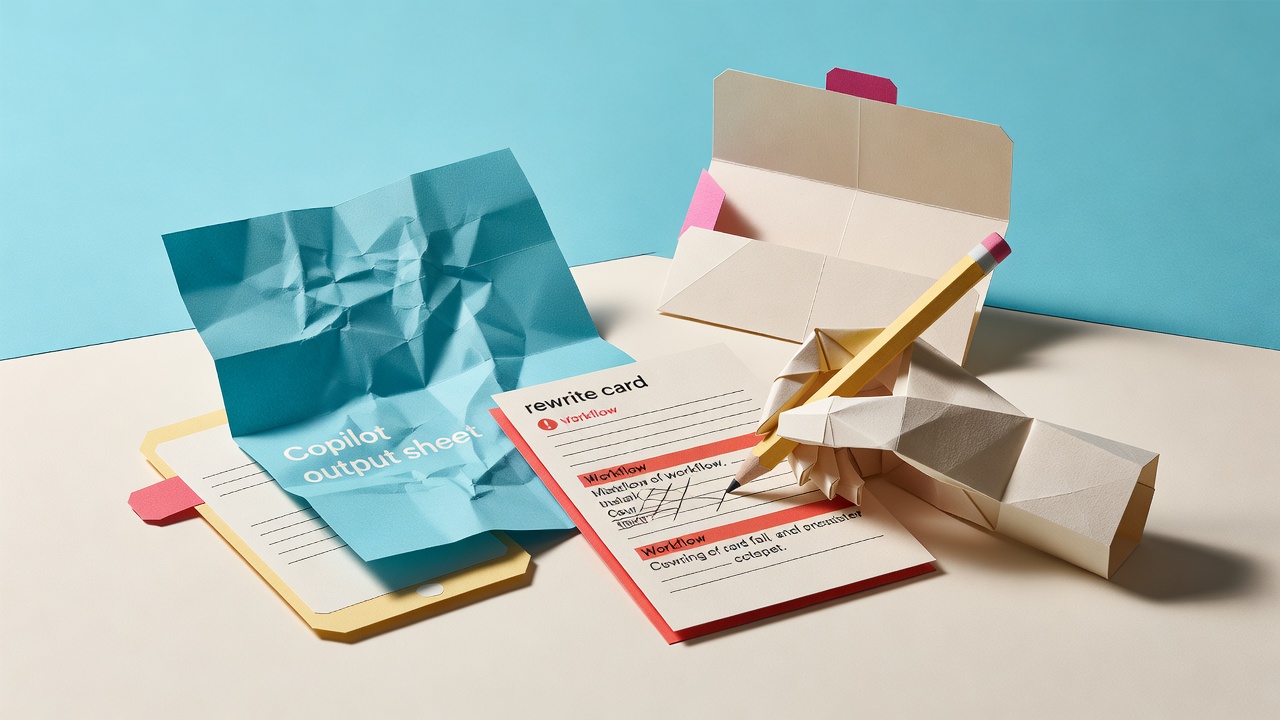
A team manager opens a batch of AI-assisted updates before a stakeholder meeting. One person has pasted a long Copilot summary with no clear decision. Another has produced a polished paragraph that sounds confident but does not show which source it came from.
A third has the right facts but uses the wrong tone for the audience. None of the drafts are useless, so the manager cannot simply reject them. Instead, they spend the review block reshaping headings, adding caveats, checking source claims, cutting filler, and rewriting the final message so everything sounds like one team.
By the time the update is ready, Copilot has increased draft volume but not reduced the manager’s final editing burden.
The People
Who experiences this blocker
Team manager
35-52 • Experienced Microsoft 365 user or team lead, not a specialist AI trainer.
Skills
Microsoft 365
Teams
SharePoint
Outlook
business writing
Frustrations
- Readable drafts that still need heavy manager rewriting
- Team members using different structures for the same recurring update
- No shared rubric for what passes before manager review
Goals
- Define one accepted output standard for a recurring team artifact
- Reduce manager rewrite time without pretending drafts need no review
- Give team members a rubric they can use before submitting AI-assisted work
Microsoft 365 adoption lead or operations manager
They need teams to show practical Copilot adoption, but they do not want adoption to create a new manager-review bottleneck.
Also affected by this blocker. Often shares the same frustrations or creates additional pressure.
Top Objections
- I do not have time for another generic AI course.
- I need something safe enough to use with work files.
- I need a method my team can repeat without me sitting beside them.
How They Talk
Use These Words
draftchecksource filemeeting notesclient updateSharePointTeams
Avoid
transformationAI-firstunlock productivityagentic10x
Learning Pathway
Team Copilot Output Standards
Define what good AI-assisted team work looks like before managers rewrite every draft.
Showing 2 of 2 recommendations
Course
Start Here
Course Built
◆◆◆◆◆Excellent Fit
Standardise Copilot Outputs Across a Team
From every AI-assisted draft needing manager rewrite to one shared output shape the team can practise against.
7 lessons120 minbeginner
You'll build: A team output standard pack for one recurring artifact, including template, example, review rubric, and prompt instructions.
Includes: output standard canvas · manager rewrite audit worksheet · review rubric · before/after example library · prompt instruction template
artifact selectionrewrite pattern analysisoutput template design+4 more
Course candidate
Briefing
Briefing Built
◆◆◆◆◇Good Fit
Copilot Output Standards vs Prompts: Decision Guide for Teams
From assuming inconsistent Copilot outputs are always a prompt problem to choosing the right first fix for the actual failure pattern.
You'll build: A simple decision record choosing one next move: improve the prompt, share prompts through Prompt Gallery, check source/context, or create a team output standard before using the linked course.
Includes: decision checklist · prompt versus output-standard comparison · manager next-move table
Copilot grounding and permissionsprompt ingredientsPrompt Gallery team sharing+3 more
Root Cause
Finding where this blocker actually starts
We traced backward through five layers of "why" until we hit the source. Here's what's really driving this.
1
Why does the manager still rewrite Copilot-assisted work?
Each team member produces a plausible draft, but the drafts do not follow the same structure, level of detail, tone, caveat style, or evidence rule.
2
Why do the drafts vary so much?
Copilot responds to each user’s prompt, source context, files, permissions, and writing habits. A shared prompt can reduce variation, but it does not define what the final artifact must look like.
3
Why does prompt training not fix it?
Prompt training teaches people what to ask. The manager’s pain is about what the team is allowed to submit: headings, source references, caveats, length, audience fit, and review checks.
4
Why does the team repeat the problem?
The manager’s rewrite criteria stay implicit. Team members see edits after the fact, but they do not have an output template or rubric they can use before submitting the next draft.
5
Why does it persist after adoption starts?
No one owns the output standard as a living artifact. Prompts get shared, but examples, review rules, owners, and retirement dates are not maintained with the same discipline.
Root Cause
The bottleneck is output acceptance criteria, not prompt availability.

The Numbers
How this stacks up
Key metrics that determine the opportunity value.
Overall Impact Score
72/100
Urgency
7/10
Moderate pressure to solve
Build Difficulty
8/10
Complex, needs deep expertise
Market Size
8/10
Massive addressable market
Competition Gap
7/10
Moderate competition
"the result can differ significantly based on the user (particularly for the full M365 Copilot) as it looks at their personal files and interactions"
Older but relevant practitioner comment about M365 Copilot results varying by user context. — Reddit r/microsoft_365_copilot prompt gallery discussion, 2025
The Landscape
What solutions exist today?
Current market solutions and where there are opportunities.
P
Prompt libraries
Approach: Standardise the asking side of the workflow.
Weakness: Do not define the accepted shape of the output.
B
Brand or writing guidelines
Approach: Define general tone and formatting.
Weakness: Usually do not include AI-specific source, caveat, and review rules.
The Gap
Why existing solutions keep failing
The pattern they all miss — and how to beat it.
Common Failure Mode
Teams collect prompt examples, but they do not define the accepted artifact those prompts should produce.
How to Beat Them
Start with one recurring artifact the manager already rewrites. Compare two or three inconsistent AI-assisted drafts, extract the manager’s rewrite pattern, convert that pattern into an output template and review rubric, then align shared prompts to that accepted shape.
The Fix
What a solution needs to succeed
The non-negotiables and nice-to-haves for any product or service tackling this blocker.
The 3 Wishes
Give the learner a repeatable way to handle "Everyone's Copilot outputs look different and managers keep rewriting them" using their own Microsoft 365 work without pretending the course can prove organisation-wide ROI or compliance.
Must Have
output template
source/citation expectation
tone rules
length rules
review rubric
example good/bad outputs
Nice to Have
sample Microsoft 365 files
before/after examples
manager review rubric
Out of Scope
full brand guideline rewrite
automated quality scoring
enterprise content governance
Success Metrics
Learner completes the final artifact using their own realistic work example.
Learner can explain what the artifact proves and what still needs human or organisational validation.
Learner can repeat the workflow without relying on a generic prompt list.
Solution Strategy
Which approach fits you?
Prompt libraries standardise the asking side, but managers need output acceptance criteria: structure, source use, tone, caveats, and review standards.
What we recommend
Lead with the main course that creates a team output standard pack. Add a second short course/workshop that packages approved prompts for Microsoft native Prompt Gallery sharing without losing owner, example, and review rules.
The Future
What might make this blocker obsolete
Technologies and trends that could disrupt this space. Factor these into your timing.
medium probability
2026-2027
Copilot adds team templates and style memory
Native templates may reduce variation, but teams still need to agree what good looks like for their real artifacts.
SaaS: Medium risk
Course: Opportunity
Consulting: Opportunity
Content: Opportunity
high probability
2026-2028
AI habits become team operating standards
As teams mature, generic AI awareness courses lose value. Courses that create role-specific artifacts, review gates, and team operating standards stay useful.
SaaS: Low risk
Course: Opportunity
Consulting: Opportunity
Content: Medium risk
For Creators
Content Ideas
Marketing hooks, SEO keywords, and buying triggers to help you create content around this blocker.
Buying Triggers
Events that make people search for solutions
- Manager rewrites every Copilot-assisted update
- Team has prompts but outputs still vary
- Stakeholders complain about inconsistent AI drafts
Content Angles
Attention-grabbing hooks for your content
- Your team does not have a prompt problem. It has an output standard problem
- Why managers still rewrite Copilot drafts
- The missing standard for AI-assisted updates
Search Keywords
What people type when looking for solutions
standardise Copilot outputsCopilot team templatesAI-assisted writing standards Microsoft 365
Source note
Blocker published by Collab365 Spaces, reviewed by Helen Jones on . Cite as "Everyone's Copilot outputs look different and managers keep rewriting them", Collab365 Spaces.
Have a question or correction?
No comments yet