
The Structural Disruption of the Entry-Level Labor Market
The integration of artificial intelligence into the global enterprise has fundamentally restructured the labor market, accelerating a paradigm shift that has disproportionately impacted early-career professionals. As of 2026, the traditional entry-level role—once characterized by routine cognitive tasks, administrative data processing, and foundational content generation—has been severely hollowed out by the widespread deployment of Large Language Models and agentic automated systems. Data indicates that job postings for routine administrative, clerical, and basic customer-facing roles have fallen by nearly a third since the mainstream popularization of generative models in late 2022.
Longitudinal academic studies analyzing the United Kingdom job market between 2021 and 2025 reveal that firms highly exposed to advanced generative capabilities reduced total employment by an average of 4.5 percent. However, this contraction was not distributed evenly; it was almost entirely concentrated in junior positions, which saw a decline of 5.8 percent. Consequently, highly exposed firms became 16.3 percentage points less likely to post new vacancies. Occupations highly exposed to automated generation saw a substantial 23.4 percent drop in job postings, while high-salary occupations experienced a staggering 34.2 percent decline in listings. Furthermore, the advertised salaries for highly exposed roles decreased by an average of £2,951, representing a 6.3 percent reduction in compensation. Technical roles, such as software engineers and data analysts, experienced the steepest declines in job listings, while roles requiring direct interpersonal interaction, such as sales representatives, remained relatively resilient.
This hollowing out presents a profound structural challenge for corporate talent pipelines. Historically, entry-level positions served as the foundational training grounds where graduates developed business acumen through hands-on, albeit repetitive, execution. With the automation of these tasks, organizations face a paradoxical situation: they demand junior talent capable of operating at the strategic level of a mid-career professional, yet they are systematically dismantling the roles that traditionally built those capabilities. Researchers warn that removing these junior roles breaks the traditional pipeline where workers develop skills through real-world practice, suggesting that companies will soon struggle to grow future senior talent internally. Entry-level workers themselves are acutely aware of this volatility; surveys show that while many are optimistic, just over one in four believe that half or fewer of their current skills will still be relevant in three years.
The result is the emergence of an "experience premium" gap. However, leading indicators and labor productivity metrics suggest that this gap can be aggressively narrowed by a new classification of worker: the AI-Augmented Professional.
Defining the AI-Augmented Professional and the Agentic Layer
An AI-Augmented Professional is not merely a casual user of consumer-grade chatbots or someone who occasionally generates text prompts. Rather, they are strategic operators who leverage advanced models to bend the demand curve of work, achieving exponential gains in productivity and performance. Macroeconomic data demonstrates that sectors utilizing artificial intelligence the most, such as financial services, information technology, and professional services, are experiencing labor productivity growth almost fivefold greater than sectors with lower exposure, such as transport, manufacturing, and construction. To secure employment in 2026, graduates must transcend the traditional static resume. They must provide empirical proof of their augmented capabilities by building, deploying, and contextualizing "Business Artifacts"—tangible, interactive, no-code projects that solve specific departmental challenges.
The transition from a traditional worker to an augmented professional mirrors a broader technological shift from traditional Software-as-a-Service platforms to the "Agentic Layer". Historically, workers used digital tools to complete manual processes. Today, businesses are effectively "hiring" digital workers, with autonomous agents scaling at a pace far beyond physical hires. These agents do not merely respond to prompts; they make decisions, adjust to new information, and carry out work independently. A traditional automation workflow connects applications through rigid rules and triggers, but an agentic workflow utilizes logic and context-aware decision-making to handle ambiguity.
The primary source of productivity gains in this new era is the reduction of the experience premium, as the gap between experts and novices narrows dramatically. Studies assessing the productivity of customer service agents utilizing generative models estimated a 14 percent overall improvement, but the most pronounced gains were observed among novice workers. These entry-level employees attained the capabilities of highly experienced agents in just three months, rather than the traditional ten months. For graduates, proving they can operate as an augmented professional means demonstrating the ability to function at this accelerated ten-month proficiency level from day one. 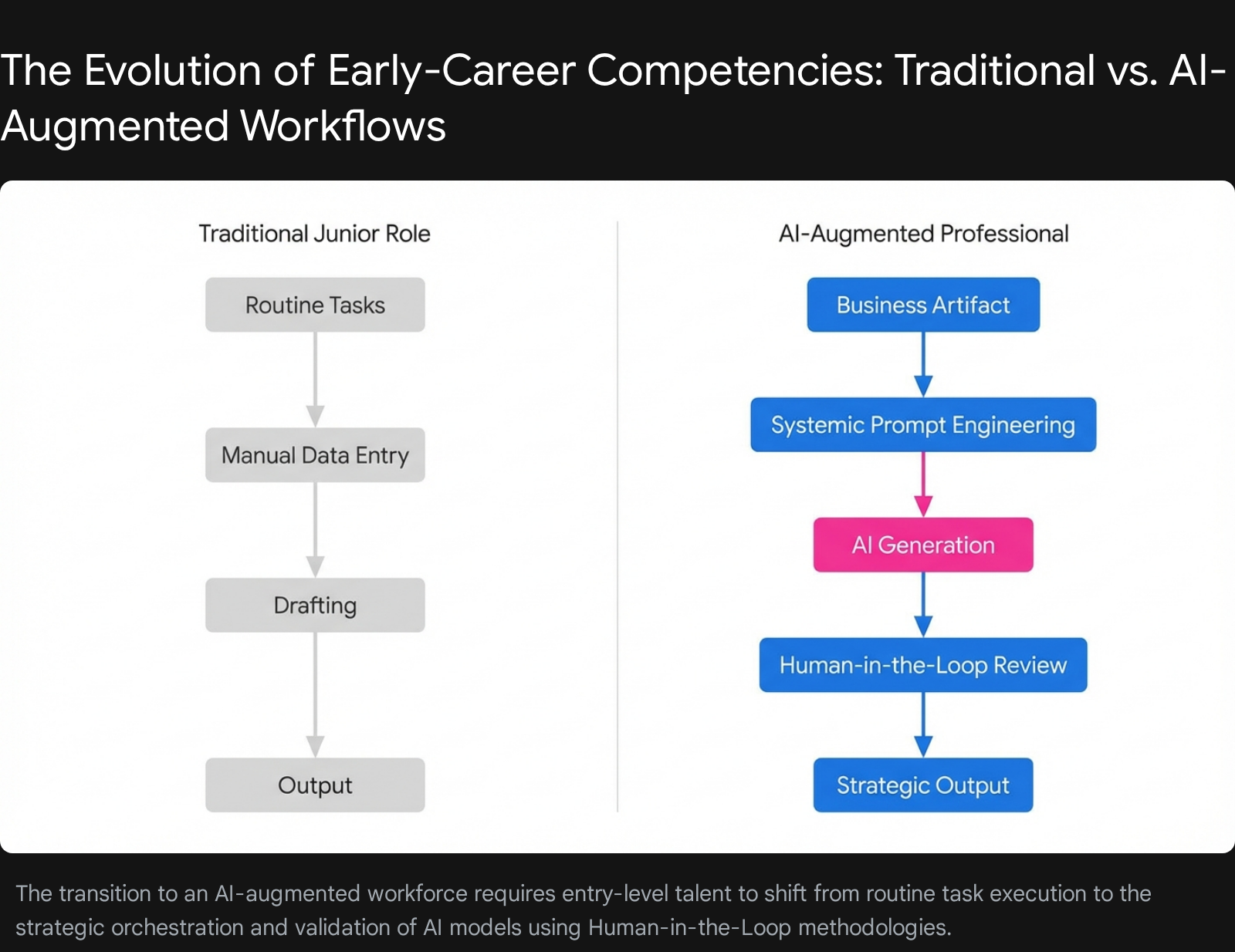 The Architecture of a High-Value Business Artifact
In a recruitment landscape where technical parsing of resumes is becoming obsolete and high-salary job listings are increasingly scarce, candidates must rely on verifiable proof of work. A High-Value AI Artifact is a specific, deployable project that demonstrates a candidate's ability to fuse domain knowledge with autonomous system capabilities.
Unlike traditional portfolio pieces, such as a static PDF essay or a mock marketing campaign drafted in a word processor, an augmented artifact must possess three defining characteristics. First, it must provide functional utility by performing a recognizable business operation, such as scoring applications, analyzing client sentiment, or generating brand-aligned copywriting at scale. Second, it must be deployable via no-code or low-code environments. Platforms such as Softr, Zapier Central, Gamma, and Lindy.ai allow a recruiter to interact with the system via a public link without requiring back-end engineering access. Third, and most importantly, it must be underpinned by an auditable Human-in-the-Loop architecture.
The no-code ecosystem has matured significantly by 2026, offering diverse platforms suited for different artifact types. Candidates must select the appropriate infrastructure to host their portfolio projects.
| Platform Category | Leading No-Code Tools | Optimal Use Cases for Graduate Portfolios | Architecture Characteristics |
|---|---|---|---|
| Relational Dashboards | Softr, Glide, Google AppSheet | Client portals, sentiment dashboards, internal reporting hubs. | Transforms unstructured databases (Airtable, Sheets) into secure, role-based front-end applications with integrated generative analysis. |
| Agentic Automation | Zapier Central, Lindy.ai, Relevance AI | Automated resume filters, constrained sales outreach, conversational triage. | Deploys autonomous digital workers capable of making logic-based decisions and interacting via chat interfaces or background triggers. |
| Visual Workflow Logic | Make, n8n, Kissflow | Complex multi-step data routing, API integrations, multi-model chaining. | Best for demonstrating complex conditional logic and data transformation, though steeper learning curves apply. |
| Generative Presentation | Gamma.app, Tome | Supply chain risk audits, executive strategy briefings, project coordination. | Bypasses traditional slide decks by using natural language to format, design, and structure complex operational data instantly. |
| Knowledge Management | Notion AI, Coda | Brand voice engines, standardized operating procedures, policy generation. | Utilizes master prompts and custom properties to enforce consistency across vast repositories of textual information. |
Building on these platforms proves to an employer that the candidate understands modern enterprise architecture. However, deploying the tool is only the foundational step. The true value of the candidate lies in their ability to govern the system securely.
The Strategic Imperative of Human-in-the-Loop Governance
The defining differentiator for graduates entering the non-coding workforce in 2026 is their demonstrable mastery of Human-in-the-Loop (HITL) protocols. HITL is an architectural pattern in which human feedback is mandated to guide the decision-making of an autonomous application, providing essential supervision for precision, safety, and regulatory accountability. Within the realm of automated systems, this method signifies the presence of manual intervention at critical junctures, acting as a failsafe against algorithmic anomalies.
Recruiters evaluating portfolios are highly attuned to the risks inherent in machine learning outputs. Chief among these are "hallucinations"—instances where predictive language models fabricate information confidently, replacing memory gaps with false narratives. These errors occur in up to 20 percent of unguarded outputs, leading to inaccurate analytics, negative biases, and trust-eroding communications sent directly to clients. Furthermore, organizations face severe regulatory pressure regarding algorithmic bias, which can trigger massive compliance violations. Therefore, a business artifact is effectively worthless if it simply demonstrates that a candidate knows how to write a prompt. The portfolio must rigorously document the manual review and validation process.
Organizations deploy multiple variants of HITL governance, and graduates must reflect an understanding of these variants in their portfolios. Decision Review protocols require human operators to evaluate and, if necessary, override machine-generated outputs before they are finalized. Knowledge Attribution Review keeps humans in the loop to ensure the traceability of the decision pipeline to original knowledge producers, which is critical in regulated industries. Advanced frameworks, such as the pharmaceutical industry's Ongoing Process Verification guidelines, explicitly mandate deterministic behavior, traceability, and explainability for models used in critical applications, entirely excluding adaptive and probabilistic systems from operating without oversight.
When hiring managers evaluate a candidate's portfolio, they specifically scrutinize the documentation for evidence of rigorous governance. They look for context stacking and constraint management, requiring proof that the candidate understands how to bound the model's knowledge base to prevent it from inventing policies. They look for bias auditing, demanding documented methodologies showing how the candidate ran tests on outputs to ensure non-discrimination against specific demographics. Finally, they require evidence of confidence thresholding, demonstrating the candidate's ability to architect systems that flag outputs falling below a certain probability score, automatically routing them for manual human adjudication.
Human-in-the-Loop Governance: Domain-Specific Review Protocols
| Department | Primary AI Risk | HITL Intervention Action | Business Outcome |
|---|---|---|---|
| HR | Algorithmic Bias | Demographic A/B testing & Qualitative override | Prevent AI from replicating and amplifying historical bias |
| Marketing | Brand Dilution & Fact Hallucination | SEO verification & Voice calibration | Maintain audit readiness and accuracy of business-critical data |
| Customer Success | Policy Hallucination | Knowledge base constraint mapping | Ensure responses reflect accurate information consistent with regulations |
| Operations | Data Provenance Failure | Traceability audits & Constraint validation | Establish traceable chain of custody to survive regulatory audits |
Effective AI deployment requires domain-specific human oversight. Graduates must demonstrate mastery of these specific intervention protocols to prove their capability as AI-augmented professionals.
Comprehensive Analysis of Top 5 Non-Coding Roles and Artifacts
The following sections provide a granular analysis of the five entry-level non-coding roles experiencing the highest degree of structural disruption. For each discipline, the operational context is defined, followed by the specific architectural requirements for a high-value artifact, the deployment methodology using no-code infrastructure, and the mandatory manual review documentation required to prove professional competency.
Role 1: Marketing and Content Coordination
The marketing sector remains heavily reliant on content generation, localization, and multi-channel distribution. Current data reveals that 38 percent of businesses utilize automated tools to generate content ideas, while 42 percent employ them to develop long-form written material. However, the aggressive scaling of automated production has exposed critical operational vulnerabilities. Organizations face a severe degradation of what search algorithms classify as Experience, Expertise, Authoritativeness, and Trustworthiness. Without human perspective, automated text fails to build authority or retain readers. Furthermore, reliance on models trained on existing public data frequently generates material overly similar to existing pages, subjecting the brand to duplicate content penalties and SEO degradation. The most common errors undermining marketing departments include an over-reliance on generative outputs without human oversight, a lack of fact-checking leading to fabricated statistics, and the abandonment of unique brand tone in favor of robotic, repetitive phrasing.
To secure a marketing coordination role, a graduate must prove they can scale content creation without sacrificing brand integrity or triggering algorithmic penalties. The required artifact is a "Brand-Aware Content Engine." This is a centralized system that ingests a single piece of dense source material—such as a webinar transcript, a technical product specification, or an internal whitepaper—and autonomously transforms it into ten distinct assets, including platform-specific social media posts, localized blog drafts, and targeted email newsletters. Crucially, the engine must demonstrate the ability to perfectly mimic a hyper-specific brand voice across all formats.
Beginner-friendly platforms such as Notion AI or Canva Magic Studio serve as the ideal hosting infrastructure for this artifact. Utilizing Notion AI, the candidate constructs a public "Brand Hub" workspace. This workspace features custom autofill properties and embedded system instructions that force the model to reference a specific tone document. A recruiting manager can access the public link, paste a raw text input into a database row, and observe the system instantly generating localized copy constrained by the pre-loaded brand guidelines.
The defining element of the portfolio is the HITL manual review evidence, typically presented as an audit log alongside the generative database. The candidate must explicitly detail instances where the system fabricated information—such as citing a 2022 algorithm update instead of the current 2026 data—and document the manual correction of the source reference. The portfolio must also document the voice calibration process, showing how the prompt was iteratively refined to eliminate generic transitional phrasing in favor of a colloquial, distinct brand tone. Finally, the candidate must provide evidence of SEO verification, detailing the manual structural adjustments made to avoid keyword stuffing and duplicate content risks inherent to raw model outputs.
Role 2: Human Resources and Talent Acquisition
Human resources and talent acquisition departments are under immense pressure to process historically high volumes of applications efficiently. By 2026, traditional resume parsing is effectively obsolete as a primary filter for competitive roles, acting merely as a legacy data entry step rather than a strategic evaluation tool. It has been replaced by behavioral signal processing, which analyzes the structure and content of a candidate's communication rather than superficial demographic details. However, this transition is fraught with compliance risks. Generative systems learn from historical data, and if that data reflects unintentional discrimination, the automated filter will replicate and amplify it at scale. High-profile failures, such as automated recruiting tools penalizing resumes containing the word "women's" or search algorithms demoting female candidates, highlight the catastrophic reputational and legal risks of unmonitored systems. Consequently, under frameworks like the EU AI Act and local municipal regulations, automated recruitment systems are classified as high-risk, demanding absolute transparency, mandatory bias audits, and strict human oversight.
The artifact required to demonstrate competency in this highly regulated environment is an "Automated Recruitment Filter and Structured Onboarding Engine." The graduate builds an end-to-end workflow that ingests unstructured candidate data, such as mock resumes or simulated interview transcripts. The system scores these inputs against a rigidly defined, bias-free competency rubric, outputting a standardized candidate scorecard. Upon a passing score, the system autonomously triggers the generation of a customized 30-60-90 day onboarding checklist, dynamically adjusting the training milestones based on the specific skill gaps identified during the screening phase.
Zapier Central or Lindy.ai serve as the optimal deployment platforms. Using Zapier Central, the graduate builds an agent trained on specific job descriptions and compliance guidelines. They then generate a public template link for the agent. A recruiting director reviewing the portfolio can click the link, interact with the agent's conversational interface, upload a mock candidate profile, and instantly evaluate how the agent applies the scoring rubric.
The HITL documentation for this role is arguably the most critical of any discipline. The portfolio must explicitly frame the automated system as an efficiency tool designed to augment, not replace, human decision-making. The required evidence includes comprehensive bias mitigation audits, structured as a methodology document demonstrating how the graduate stress-tested the filter by processing identical resumes containing different demographic signifiers, proving the prompt does not discriminate. Furthermore, the candidate must document qualitative judgment overrides, providing examples where the system incorrectly rejected a candidate for lacking a rigid keyword, but the human reviewer intervened because the candidate possessed highly transferable, non-traditional experience. Finally, the artifact must enforce explainability, ensuring the system outputs natural-language reasoning for every score it generates, effectively neutralizing the compliance risk associated with black-box algorithms.
Role 3: Customer Success and Account Management
Customer Success Managers operate at the intersection of product utilization and client retention. The traditional Quarterly Business Review, long the cornerstone of account management, is increasingly viewed as an overly manual, backwards-looking, and self-serving exercise. The integration of advanced analytics transforms this process by synthesizing real-time product usage data, historical support tickets, and communication sentiment into predictive health scores. AI dynamically generates personalized reports tailored to usage patterns and engagement history, allowing teams to take proactive action before friction escalates into churn. The operational danger in customer success lies in automated communications hallucinating policy rules to clients or fundamentally misinterpreting the nuanced frustration embedded in a client's support history.
To validate their strategic capability, a graduate must engineer a "Customer Sentiment Dashboard and Dynamic QBR Builder." This artifact ingests a dataset of over one hundred simulated customer interactions, including emails, chat transcripts, and usage metrics. It utilizes natural language processing to automatically categorize these interactions into distinct sentiment buckets, such as At-Risk, Neutral, or Expansion Opportunity. The system then synthesizes the core friction points and success metrics into a tailored Quarterly Business Review presentation draft, completely bypassing manual data collation.
Softr, integrated directly with an Airtable or Google Sheets database, provides the most robust no-code environment for this artifact. The graduate constructs a front-end portal using Softr's drag-and-drop interface. By leveraging Softr's native generative integrations and establishing distinct user-group permissions, the candidate creates a secure, role-based dashboard. A recruiter can log in via a public URL, view the unified analytics, and interact with an embedded digital analyst to query specific churn risks or account trends.
Because customer success fundamentally requires empathy and relationship management that machines cannot replicate, the HITL documentation must focus on contextual nuance. The portfolio must highlight contextual policy grounding, showing how the candidate configured the system's guardrails so it exclusively references approved internal knowledge bases, preventing it from hallucinating non-existent refund policies, feature roadmaps, or warranty compliance rules. The candidate must also provide evidence of sentiment override, detailing an instance where the system miscategorized a highly sarcastic customer email as a positive interaction, requiring manual re-tagging of the data and refinement of the tone-detection prompt. Finally, the documentation must demonstrate empathy injection, showing how the generated QBR narrative was manually edited to address specific, unquantifiable client relationship dynamics that the quantitative data alone failed to capture.
Role 4: Project Coordination and Industrial Operations
Operations, logistics, and supply chain management are incredibly data-dense disciplines. While predictive models can optimize delivery routes, anticipate demand fluctuations, and manage inventory, the industrial and manufacturing sectors face a massive trust deficit regarding automated implementation. Industry reports indicate that pilot project failure rates for advanced analytics in complex physical industries can reach as high as 95 percent. Unlike digitally native sectors like finance, logistics operations operate in the physical world, dealing with fragmented data environments and unpredictable variables. The primary bottleneck to scaling these systems is data provenance—the ability to prove exactly where a piece of data originated and how it has been handled. If a coordinator cannot verify a dataset's history, the output cannot be utilized in a regulated manufacturing or transit environment.
The required artifact for operations roles is a "Supply Chain Risk Auditor and Capacity Simulator." The candidate builds an analytical reporting generator that processes simulated vendor compliance data, global weather patterns, and regional transit delays to flag potential supply chain disruptions. The artifact synthesizes these disparate variables into a dynamic risk matrix, identifying bottlenecks and proposing alternative resource allocations before the disruption impacts production timelines.
Given that operations reporting requires exceptionally clear visualization to secure executive alignment, the graduate utilizes Gamma.app to construct the artifact. Gamma bypasses traditional slide deck creation by using natural language prompts to format and design complex operational data into an interactive, visually coherent presentation or web page. The graduate shares this via a public Gamma link or embeds it directly into their broader digital portfolio, allowing a recruiter to click through the predictive models and strategic summaries.
The HITL manual review evidence for operations must focus entirely on risk management, standard operating procedures, and compliance auditing. The graduate must document data provenance and traceability protocols, proving that every generated risk assessment can be traced back to a specific source artifact, such as a localized site permit or a specific vendor bill of lading, thereby addressing the critical audit gap. The portfolio must also detail constraint validation, showcasing instances where the system confidently suggested an optimized logistics route that was physically impossible due to unmapped road closures or violated regional environmental regulations, and explaining how the human coordinator intervened to input the correct operational constraints. Furthermore, the candidate must implement and document a low-confidence flagging protocol, demonstrating a systemic rule where any prediction with a confidence score below a specified threshold, such as 90 percent, is automatically diverted to a human review queue for manual adjudication.
Role 5: Sales Development Representative (SDR)
In the realm of Business-to-Business sales, the era of un-targeted, high-volume outbound email sequencing is entirely obsolete. Advanced algorithms are now deeply embedded in Customer Relationship Management workflows, automating preliminary research, drafting follow-up communications, and identifying granular buyer intent signals to accelerate pipeline velocity. However, deploying an unmonitored digital sales agent is a massive organizational liability. These agents are probabilistic engines designed to predict language patterns, not to verify objective truth. Consequently, when unguarded, they will confidently hallucinate software features, invent unauthorized pricing tiers, or make unfulfillable promises in an attempt to close a conversation.
The artifact required to prove competency as an augmented SDR is a "Constrained Personalization Agent." The graduate engineers a customized digital assistant that ingests a target company's recent press releases, annual financial reports, and executive professional profiles to draft highly personalized, multi-touch outreach sequences. Crucially, the system utilizes Retrieval-Augmented Generation principles, establishing a closed knowledge loop that ensures the agent only pitches verified product features and strictly adheres to approved messaging architectures.
Zapier Central or CustomGPT provide the ideal infrastructure for this build. Using Zapier Central, the graduate builds an agent linked to a mock CRM, such as a structured Google Sheet acting as a lightweight database. They generate a shareable template link, which a recruiter can access. The recruiter inputs a mock prospect's URL or identifier, and the agent automatically retrieves the relevant data, applies the designated sales framework, and outputs a compliant, personalized drafted communication.
Sales leadership demands to see systemic constraints. The graduate must evidence their ability to govern the agent through detailed documentation. This includes hallucination guardrails, consisting of clear documentation of how the system prompts strictly forbid the agent from discussing pricing structures or offering arbitrary discounts, routing any such commercial inquiries to a human representative. The candidate must also demonstrate strategic nuance, providing examples of how an auto-drafted email was structurally sound but lacked a compelling "human hook," requiring the SDR to manually inject an industry-specific perspective that an automated model would inherently miss. Finally, the portfolio must include a fact verification checklist, demonstrating the manual cross-referencing of the system's claims regarding a prospect's recent funding rounds or organizational changes against primary source financial data.
Summary Matrix: The Prompt-Review-Deploy Framework
To comprehensively synthesize the requirements for securing an entry-level position in 2026, the following framework maps the five key non-coding roles to their respective business artifacts, verification platforms, and the critical operational steps that must be documented within a candidate's portfolio.
| Target Role | High-Value AI Artifact | No-Code Verification Platform | 1. Prompt Strategy (The Build) | 2. Manual Review Steps (HITL Evidence) | 3. Deploy Mechanism (The Showcase) |
|---|---|---|---|---|---|
| Marketing Coordinator | Brand-Aware Content Engine | Notion AI / Canva | Utilizes context stacking and master prompts to enforce brand voice guidelines and formatting constraints across multiple distinct asset types. | Manually corrects SEO hallucinations, edits out repetitive phrasing, and verifies statistics against external authoritative sources. | Publishes a public Notion Web Page featuring the generative database and a linked, interactive Brand Hub document. |
| HR / Talent Assistant | Automated Recruitment Filter | Zapier Central / Lindy.ai | Employs chain-of-thought logic to evaluate candidate resumes against a rigid, behavior-based competency rubric, bypassing obsolete keyword parsing. | Audits outputs for demographic bias and overrides strict algorithmic rejections by applying human qualitative judgment to transferable skills. | Shares a public Zapier Agent Template link or Lindy chat UI, allowing recruiters to test mock resumes against the active agent. |
| Customer Success Associate | Sentiment Dashboard & QBR Builder | Softr (via Airtable) | Directs the system to synthesize raw usage data and categorize unstructured support transcripts into predictive churn risk profiles. | Calibrates tone-detection for sarcasm and prevents policy hallucinations by restricting the model to specific, approved knowledge bases. | Hosts a secure, mobile-ready SaaS dashboard portal via Softr with mock client data sets visible through guest login access. |
| Project Coordinator (Ops) | Supply Chain Risk Auditor | Gamma.app | Analyzes disparate logistical variables to generate predictive disruption alerts and propose alternative resource allocation models. | Validates systemic assumptions against physical constraints, enforces data provenance tracking, and reviews low-confidence prediction flags. | Embeds a dynamic, auto-generated Gamma presentation directly into their digital portfolio, clearly outlining operational risk matrices. |
| Sales Development Rep (SDR) | Constrained Personalization Agent | Zapier Central / CustomGPT | Applies Retrieval-Augmented Generation principles to draft outreach sequences based purely on verified CRM data and prospect news events. | Enforces strict guardrails to prevent pricing or feature hallucinations, and manually injects authentic human empathy into drafted outreach. | Provides a Zapier Central template link connected to a mock CRM dataset to demonstrate real-time, compliant drafting capabilities. |
Deployment Strategy: Building the Verifiable Professional Portfolio
The fundamental shift in recruitment dynamics dictates that merely listing technological proficiencies on a resume is entirely insufficient; the skills must be demonstrated interactively and immediately. Graduates must architect a cohesive digital environment where these artifacts reside, utilizing the sharing architectures of modern no-code platforms to provide irrefutable proof of competency.
A candidate should utilize a platform like Softr or Notion to act as the overarching portfolio container, functioning as the central hub. Softr enables the creation of secure portals and dynamic project lists without requiring coding knowledge. A candidate can connect an Airtable base containing their project metadata, generating a professional, mobile-responsive directory of their artifacts, complete with customized filtering and tagging. Alternatively, Notion provides highly flexible workspace publishing, allowing the candidate to structure their portfolio as a comprehensive digital wiki.
For hosting interactive agents, such as those built in Zapier Central or Lindy.ai, candidates must effectively utilize template links and public conversational interfaces. When a recruiter clicks a Zapier template link, they are transported to a safe, sandboxed environment. Here, they can inspect the agent's exact systemic instructions, review the connected actions, and examine the foundational knowledge sources without possessing the ability to alter the candidate's original build architecture. Similarly, Lindy.ai permits users to share a conversational interface via a direct public link, enabling the recruiter to experience the automated agent exactly as an end-customer or internal departmental stakeholder would.
Crucially, the publishing documentation—the HITL evidence of manual review, bias mitigation, and constraint mapping—must live directly alongside the interactive artifacts. The candidate must share comprehensive, well-formatted pages containing their audit logs, prompt iteration histories, and methodological frameworks. By embedding Gamma presentations or Softr portals directly into these explanatory pages, the candidate creates a seamless, immersive demonstration of both their technical build capability and their strategic governance acumen.
Ultimately, the candidate's professional networking profile must act as the optimized top of the recruitment funnel. Specialized optimization platforms note that recruiters utilize highly specific keywords when searching for candidates, and profiles lacking these precise terms remain invisible to automated sourcing tools. Instead of listing generic, consumer-grade tools as standalone skills, the profile must use precise operational terminology aligned with the augmented workflow. A summary statement must explicitly articulate the structural integration of these tools. Optimization experts recommend a clear, declarative sentence: "I integrate AI tools into my workflow to speed up research, improve output quality, and work more efficiently across teams," accompanied by direct hyperlinks to the centralized portfolio hub. This exact phrasing signals to applicant tracking systems and human recruiters alike that the candidate operates at the required agentic level.
Conclusion
The aggressive proliferation of advanced automated systems and generative models in the global enterprise has not eliminated the need for junior talent; rather, it has permanently altered the baseline competencies required to enter the professional sphere. The 2026 labor market no longer rewards the rapid, manual execution of routine cognitive tasks, as these have been thoroughly commoditized by automation. Instead, it places a massive premium on strategic governance, process engineering, and systemic risk mitigation.
By constructing High-Value Business Artifacts, graduates transcend the vulnerability of the traditional entry-level worker. They demonstrate the tangible ability to construct scalable operational solutions while simultaneously wielding the critical analytical skills necessary to constrain, audit, and refine machine intelligence through rigorous Human-in-the-Loop methodologies. In doing so, they provide irrefutable evidence that they are not merely surviving the technological disruption, but are actively equipped to orchestrate it. Organizations seeking to future-proof their operations and maintain regulatory compliance will definitively bypass candidates offering mere theoretical knowledge in favor of those who can provide a hyperlink to a deployed, audited, and business-ready solution.