My AI sales pages still need heavy editing before launch
Solo and duo product founders use AI to draft sales pages, but the first version often needs substantial human editing before it is safe to publish. The pain is not that AI cannot produce words. The pain is that the founder still has to repair structure, customer language, proof, objections, and claims while launch work is already crowded.
Blocker Reviewed by Helen Jones
Reviewed by Helen JonesContext
The blocker, in a nutshell
If this blocker is unfamiliar, start here.
Solo and duo product founders often use AI to draft sales pages for SaaS, AI products, courses, templates, and info-products. The tool can reduce blank-page friction, but the founder still has to check whether the page names the right buyer pain, proves the promise, explains the offer, handles objections, and avoids claims the product has not earned. This problem is narrower than expert-style copy imitation. It is about the practical edit and QA pass needed before a tiny product business can publish a sales page with confidence.
Key Terms
Industry jargon explained
Click any term to see its definition.
The Reality
A day in their life
Solo or two-person bootstrapped founder building a SaaS, AI product, course, template, or info-product
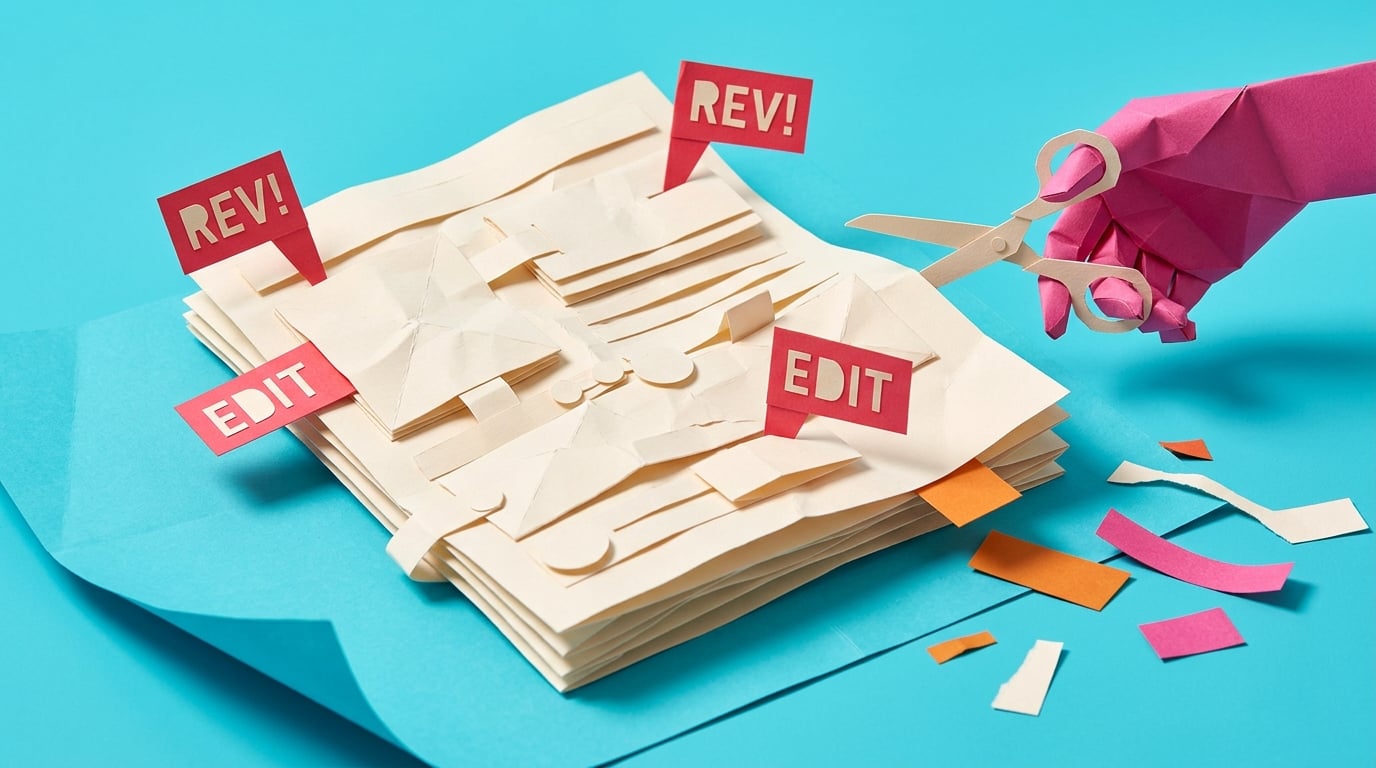
I start the morning planning to finish the sales page before I touch product work. The AI draft is already there, which feels like a small win. At least I am not staring at a blank page. But the first read is flat: the hook could fit any SaaS tool, the proof is vague, and the offer sounds bigger than what I can honestly promise.
By lunchtime I have three tabs open: the product notes, a handful of customer messages, and the AI draft. I am moving real phrases into the page, cutting glossy claims, and trying to make the problem sound like something my buyer would actually say. The draft gave me structure, but I am still doing the hard judgement work: what belongs above the fold, which objection needs answering, and which claim needs evidence before it stays.
The painful part is the context switching. A support question arrives, analytics need checking, and a small product fix would be easier than another copy pass. I can feel the launch slipping, not because the page is impossible, but because every section asks for a decision I hoped AI would make cleanly. I do not want clever copy. I want a page I can trust.
By the end of the day the page is better. The customer language is stronger, the proof is cleaner, and the CTA is less vague. What I wish existed is a simple review workflow that turns the AI draft into a launch-ready page without pretending it can guarantee conversions. I still want the final judgement, but I do not want to rebuild the whole page by hand every time.
The People
Who experiences this blocker
Solo or two-person bootstrapped founder building a SaaS, AI product, course, template, or info-product
35-50 • Intermediate founder who can build the product and draft copy with AI, but still owns positioning, proof, and launch decisions without a marketing team.
Skills
Product building
Customer conversations
Basic funnel and offer awareness
Using ChatGPT, Claude, Jasper, Copy.ai, or similar AI writing tools
Frustrations
- AI drafts help with the blank page but still sound generic when the page needs product-specific proof.
- Sales page structure breaks down across hook, problem, proof, offer, objections, and CTA.
- The founder has to decide what is true, what is hype, and what still needs proof.
Goals
- Publish a clear sales page without losing launch week to copy edits
- Turn customer language and product proof into sharper page sections
- Use AI for drafting without letting generic claims or weak structure reach buyers
Top Objections
- I do not want another generic prompt pack.
- I cannot spend days learning a copywriting framework before launch.
- I need a reviewable page, not a promise that AI will double conversions.
- I need this to work for a tiny product business, not an agency or client service workflow.
How They Talk
Use These Words
sales pagelaunch pageofferhookproofobjectionsCTAAI draftgeneric copyAI slopcustomer wordsMRRbootstrap launch
Avoid
client deliveryretaineragency funnelscope of workVA teamenterprise transformation
Learning Pathway
AI Sales Page Launch-Readiness Pathway
Turn a generic AI sales page draft into a founder-reviewed, proof-aware launch page without pretending AI can guarantee conversions.
Showing 3 of 3 recommendations
Course
Start Here
Course Built
◆◆◆◆◆Excellent Fit
Edit AI Sales Pages Into Launch-Ready Copy
Before the course, the founder keeps regenerating and editing by instinct. After the course, they have a reviewed page and a reusable checklist for the next launch.
5 lessons90 minbeginner
You'll build: Produce one launch-ready sales page revision pack: edited page, section QA checklist, proof notes, claim fixes, objection gaps, and a publish/revise/hold decision.
Includes: Sales page QA checklist · Claim proof log · Customer language insertion worksheet · Publish/revise/hold decision sheet
Sales page QACustomer language insertionClaim safety+2 more
Blueprint
Build Brief Ready
◆◆◆◆◇Good Fit
Build an AI Sales Page QA Checker for Tiny Founders
You'll build: Build and pass the fictional seed test for a private founder-only app with Offer Brief and Evidence Library, Draft Intake, queued QA, Report Overview, Issue Detail, Human Decision Log, Markdown Export, History, and redacted diagnostics.
Includes: QA report schema · Claim/proof matching rubric · Revision export format · Acceptance test draft with known issues
Build brief: Build with code · AI coding handoff
Briefing
Briefing Built
◆◆◆◆◇Good Fit
When Your AI Sales Page Looks Finished But Still Isn't Launch-Ready
You'll build: Create a one-page repair decision record: draft status, failure type, next repair move, unsupported claims, missing proof, objection gaps, and publish/revise/hold status.
Includes: AI sales page repair decision table · Proof/claim boundary checklist · Publish/revise/hold decision record
Root Cause
Finding where this blocker actually starts
We traced backward through five layers of "why" until we hit the source. Here's what's really driving this.
1
Why is this painful?
The founder gets a page-shaped draft, but it is not launch-ready because the copy still needs edits for specificity, proof, sequence, and claim safety.
2
Why does the AI draft need those edits?
Generic prompts and templates tend to produce plausible sales-page sections without enough customer language, offer context, proof, objections, or page-specific structure.
3
Why does the founder still carry the hard work?
The hard part is judgement: deciding what is true, what the buyer already believes, what proof belongs on the page, and which claim would be hype without evidence.
4
Why does this persist in a tiny founder business?
The founder has no dedicated copy team, researcher, strategist, or editor, so sales-page QA competes with product work, customer support, analytics, and launch logistics.
5
Why is a generic tool not enough?
A one-shot AI tool can generate text, but it does not automatically enforce a founder's proof boundary, customer wording, offer logic, and publish/no-publish decision.
Root Cause
The root cause is not weak prompting alone. It is the missing review workflow between an AI draft and a trusted sales page: customer language, section sequence, proof, objections, and claim safety still have to be checked by the founder.

The Numbers
How this stacks up
Editorial assessments based on the available evidence. Scores do not establish demand, purchases or measured financial impact.
Overall Impact Score
62/100
Urgency
7/10
Moderate pressure to solve
Build Difficulty
8/10
Complex, needs deep expertise
Market Size
5/10
Moderate estimated reach
Competition Gap
7/10
Moderate assessed gap
"everything sounds generic without heavy editing"
SaaS founder tested several AI content tools and separated useful drafting/distribution help from poor authentic voice and strategy. — Reddit r/SaaS, 2026-03 approx
More Evidence
What others are saying
"I spent an entire week trying to create new website copy using just AI + heavy editing."
B2B SaaS practitioner describes moving from one-shot prompts to a workflow built on positioning, voice, customer transcripts, and structure. — LinkedIn post by Stan Rymkiewicz, 2025-12 approx
"Nearly 40% of AI time savings are lost to rework"
Global AI workplace research reports rework from fixing, rewriting, and verifying low-quality AI output. This is adjacent evidence, not sales-page-specific proof. — Workday research press release, 2026-01-14
"landing page looks plain and looks like ai generated"
SaaS builder asks how to fix an AI-generated landing page that feels generic and undifferentiated. — Reddit r/ClaudeCode, 2026-05 approx
"you need to work in tandem with the tool"
Specialist review of AI copywriting tools says AI writing still needs human process and editing to become accurate and useful. — Alex Birkett, 2026-02-20 updated
The Landscape
What solutions exist today?
Current market solutions and where there are opportunities.
Leader
J
Jasper
Approach: Marketing-focused AI content platform with brand voice, campaign, and collaboration features.
Pricing: Pro listed at $59/month billed yearly or $69/month billed monthly as checked June 3, 2026; Business is custom pricing.
Weakness: Can help draft and manage marketing content, but the founder still needs a sales-page QA workflow that checks customer language, proof, objections, and claim safety for a specific offer.
Challenger
C
Copy.ai
Approach: AI platform for chat and GTM workflows, including content generation and process automation.
Pricing: Self-serve Chat plan listed at $29/month as checked June 3, 2026; enterprise workflow pricing is custom/usage-based.
Weakness: Workflow features do not remove the need for founder judgement on proof, buyer language, and publish safety for a specific sales page.
Challenger
W
Writesonic
Approach: SEO and AI-search visibility platform with AI articles, site audits, and agentic workflows.
Pricing: Pricing page checked June 3, 2026 positions Writesonic as an AI search visibility platform, with annual self-serve plans shown from $79/month.
Weakness: Useful for search/content workflows, but not a focused sales-page editing gate for offer proof, objections, and launch-readiness.
C
ChatGPT or Claude with one-shot prompts
Approach: Founder prompts a general AI assistant to produce or rewrite the sales page draft.
Pricing: Varies by account and model access; not price-checked for this repair.
Weakness: Fast and flexible, but output quality depends heavily on supplied context and the founder's review process.
The Gap
Why existing solutions keep failing
The pattern they all miss — and how to beat it.
Common Failure Mode
Existing tools solve draft generation but leave the launch-readiness gap: the founder still has to turn generic AI copy into a proof-backed sales page they can safely publish.
How to Beat Them
Teach a proof-first sales page review workflow: start from the AI draft, insert customer language, check each section's job, remove unsupported claims, and finish with a clear publish/revise/hold decision.
The Fix
What a solution needs to succeed
The non-negotiables and nice-to-haves for any product or service tackling this blocker.
The 3 Wishes
A small review workflow that turns an AI sales page draft into a proof-aware launch page with customer language, section fixes, claim notes, and a publish/revise/hold decision.
Must Have
A section-by-section sales page QA checklist
A way to insert real customer language into the draft
A proof and claim-safety review
A clear publish, revise, or hold decision
A workflow small enough to run during launch week
Nice to Have
Reusable page brief template
Before/after examples
Optional AI prompt for each QA section
A simple scorecard for future drafts
Out of Scope
Writing the whole page manually from scratch
Designing page visuals or page-builder layout
Running paid ads or CRO tests
Agency/client delivery workflow
Guaranteeing conversion rates, revenue, or product-market fit
Success Metrics
Every sales page section has a clear role and pass/fail status
Unsupported claims are removed, softened, or assigned evidence
At least three real customer phrases are placed where they improve clarity
Founder has a documented publish, revise, or hold decision
Post-launch validation questions are listed separately from launch-readiness checks
Solution Strategy
Which approach fits you?
A prompt pack would create more first drafts but would not force proof review. A course teaches the judgement gate. A small QA checker can later make the repeat workflow faster without pretending it knows whether the market will buy.
What we recommend
Course first, build spec second. Do not start with a SaaS product claim because the evidence proves editing burden, not buying demand for a standalone tool.
The Future
What might make this blocker obsolete
Technologies and trends that could disrupt this space. Factor these into your timing.
medium probability
6-12 months
AI page builders add stronger built-in proof checks
Could reduce the need for a standalone checker, but founders still need to supply customer language and approve claims.
SaaS: High risk
Course: Medium risk
medium probability
12-18 months
Models improve long-context brand and customer memory
May reduce generic first drafts when founders provide strong source material, but does not remove the need for proof boundaries.
SaaS: Medium risk
Course: Medium risk
low probability
18-24 months
Conversion platforms automate test generation from page copy
Could make post-launch validation faster, but it still will not prove conversion before traffic and buyer behaviour exist.
SaaS: Opportunity
Course: Low risk
For Creators
Content Ideas
Marketing hooks, SEO keywords, and buying triggers to help you create content around this blocker.
Buying Triggers
Events that make people search for solutions
- A launch page is due this week and the AI draft still feels generic
- The founder is about to publish a course, template, SaaS feature, or AI product offer
- The page makes claims the founder is not sure they can prove
- A previous launch underperformed and the founder suspects weak messaging or proof contributed
- The founder has customer language available but no repeatable way to use it in the page
Content Angles
Attention-grabbing hooks for your content
- Why AI sales page drafts still need founder judgement
- The sales page QA pass between AI draft and launch
- How to keep AI copy persuasive without unsupported hype
- Stop editing AI sales pages from scratch every launch
Search Keywords
What people type when looking for solutions
AI sales page heavy editingAI landing page looks genericAI sales copy needs editingfix generic AI sales pageSaaS founder AI copy editingAI sales page proof checklistAI copy sounds generic founderlaunch page AI draft review
The Evidence
Where this came from
Every claim in this report is backed by public sources. Verify anything.
1.2.3.4.5.
Reddit r/SaaS: Testing AI content creation tools for SaaS marketing
reddit.com
LinkedIn: Stan Rymkiewicz on AI website copy workflow
linkedin.com
Workday: Companies Are Leaving AI Gains on the Table
newsroom.workday.com
Reddit r/ClaudeCode: Landing page looks like AI slop
reddit.com
Alex Birkett: The 12 Best AI Copywriting Tools in 2026
alexbirkett.com
8 sources referenced
Source note
Blocker published by Collab365 Spaces, reviewed by Helen Jones on . Cite as "My AI sales pages still need heavy editing before launch", Collab365 Spaces. 8 sources referenced.
Have a question or correction?
No comments yet