
The transition from academic environments to the professional corporate sphere has historically been characterized by steep learning curves and significant friction. However, the macroeconomic and technological realities of 2026 have uniquely compounded these early-career challenges. The rapid and pervasive integration of Generative Artificial Intelligence (AI) into enterprise workflows has simultaneously elevated employer expectations while systematically eliminating many of the traditional tasks that previously served as training grounds for junior staff. The data surrounding this shift is stark: vacancies for entry-level roles, encompassing graduate jobs, apprenticeships, and junior positions, have plummeted by 32% since the widespread adoption of large language models (LLMs) began in late 2022.This decline has prompted warnings from industry leaders, including the chief executive of Anthropic, who has projected that AI could potentially automate half of all entry-level office jobs by the end of the decade.
Simultaneously, the broader economic landscape presents a formidable headwind. The United Kingdom's unemployment rate has climbed to 5.1%, the highest level since early 2021, with young professionals bearing a disproportionate share of this burden.Macroeconomic pressures, ranging from inflation to increased taxation, have compelled major professional services firms to drastically scale back their graduate intake; for example, KPMG reduced graduate hiring by 29%, while EY and PwC executed cuts of 11% and 6%, respectively.Furthermore, a paradox has emerged at the heart of the hiring process: while basic AI proficiency is increasingly viewed as a prerequisite, the misuse of AI in job applications and corporate communications is highly penalized by employers. Recent surveys indicate that 56% of hiring managers will actively reject a curriculum vitae (CV) if they believe it is entirely AI-generated, and 45% will reject candidates outright for submitting generic, untailored applications—a hallmark of poorly prompted, automated output.
To survive and thrive within this highly competitive and rapidly evolving landscape, non-technical business professionals and recent graduates must transition from casual, conversational AI consumers to proficient, strategic "AI directors." This evolution requires a fundamental departure from unstructured, colloquial inputs in favor of engineered, structured prompting frameworks. This exhaustive report details the theoretical foundations of structured prompting—specifically analyzing the RICE and C.R.E.A.T.E. frameworks, alongside beginner-friendly XML (eXtensible Markup Language) tagging techniques. Furthermore, it provides a comprehensive, practical curriculum consisting of fifteen detailed exercises designed to systematically build intuitive prompting skills by solving real-world, entry-level career and life challenges.
The 2026 Employment Paradigm and the Necessity of Structured Prompting
The contemporary labor market has fundamentally shifted the baseline expectations for early-career success. The traditional assumption that university graduates can enter a corporate role with zero prior practical experience has largely evaporated. Currently, an estimated 80% of so-called "entry-level" roles are filled by candidates who already possess a meaningful history of relevant work.Consequently, young professionals are expected to be fully "job-ready" from their first day of employment. They must possess the capability to navigate complex corporate jargon, engage in hyper-localized geographic job markets driven by shifting employer strategies, and manage severe cost-of-living pressures that dictate rigid salary requirements.
Complicating matters further is a documented crisis in perceived "work-readiness." Only 49% of employers currently believe that graduates are adequately prepared for the chaotic pace and interpersonal demands of modern office life, a decline attributed in part to the reduction of traditional part-time "Saturday jobs" that historically built foundational workplace competencies.In response to these vast experience gaps, recent graduates frequently turn to sophisticated AI models, such as Claude 3.5 or GPT-4o, to augment their capabilities. However, interacting with these non-deterministic models using basic, conversational queries typically yields suboptimal results. Unstructured prompts frequently produce verbose, generic, and hallucinatory outputs that can severely damage a junior employee's professional credibility.The definitive solution to this problem lies in structured prompting: the deliberate, architectural design of inputs to strictly constrain the AI's behavior, explicitly define its persona, and rigorously dictate the precise format of its output.
Core Prompting Frameworks for Non-Technical Professionals
To consistently extract deterministic, high-quality results from inherently non-deterministic language models, industry practitioners rely on specific structural methodologies. For non-technical users, mastering these frameworks is functionally equivalent to learning the foundational syntax of a new management language.
The RICE framework, while historically recognized in product management circles as a prioritization matrix evaluating Reach, Impact, Confidence, and Effort, has been comprehensively adapted for prompt engineering. In the context of AI interaction, RICE represents a streamlined, highly effective methodology for guiding language models.The first component, Role, requires assigning a highly specific persona to the AI, such as instructing it to "Act as a veteran human resources manager." This seemingly simple instruction fundamentally alters the model's token prediction probabilities, shifting its vocabulary distribution and tonal baseline to match the requested expertise.The second component, Instructions, involves providing the explicit, granular directive or task to be completed. The third component, Context, is arguably the most critical for business applications; it involves supplying the necessary background information, ensuring the AI understands the underlying rationale behind the instruction. Without deep context, models inevitably default to broad generalities. Finally, the Examples component implements a technique known as "few-shot prompting." By showing the model exactly what a successful, highly polished output looks like, users can dramatically enhance both the factual accuracy and the stylistic alignment of the final response.
For more nuanced, multi-faceted business tasks, the C.R.E.A.T.E. framework provides an intermediate, highly repeatable cognitive structure.This framework begins with Character, which closely mirrors the RICE Role component by defining the AI's persona and specific level of expertise.The Request follows, outlining the primary objective or strategic task. The Example component again leverages few-shot prompting to provide reference material for emulation.The true power of the C.R.E.A.T.E. framework, however, lies in its final three components. Adjustments allow the user to define specific constraints or necessary deviations from standard operational norms, such as commanding the model to strictly avoid certain corporate buzzwords or prioritize extreme simplicity.The Type of Output parameter forces the model to abandon its default conversational paragraphs in favor of precise formatting structures, such as markdown tables, nested bulleted lists, or structured JSON arrays.Finally, Extras provide a container for any remaining contextual rules, temporal constraints, or specific market parameters that must inform the analysis.
XML Tagging: The Structural Boundary for Precise Parsing
While cognitive frameworks like RICE and C.R.E.A.T.E. dictate the logical flow and strategic intent of a prompt, XML (eXtensible Markup Language) tagging dictates the structural parsing mechanisms used by the model. Advanced models, particularly the Claude 3.5 family, have been explicitly fine-tuned to allocate specialized attention to data and instructions enclosed within standard XML tags.For a non-technical user, deploying simple structural tags such as <context>, <instructions>, and <tone> acts as an absolute boundary-setter.
Conversational prompts naturally blend instructions and context into a single narrative stream, leading to model confusion and hallucinations. Conversely, engineered prompts utilize explicit XML boundaries and established framework structures, such as the C.R.E.A.T.E. methodology, to rigorously isolate variables. This structural isolation results in highly deterministic and accurate outputs. By utilizing XML tagging, non-coders can execute highly complex, multi-part prompts with near-programmatic precision. For instance, a user can place a convoluted, emotionally charged email thread entirely inside <source_material> tags, and outline the strict rules for analyzing that text inside separate <formatting_rules> tags. This clear delineation drastically reduces the model's propensity for misinterpretation and yields significantly higher analytical precision.
The "Anti-Prompt" Epidemic: Common Failures and Professional Remediation
The primary driver behind the high rate of employer rejections for AI-assisted job applications is the pervasive use of the "Anti-Prompt." These are user inputs characterized by broad ambiguity, a distinct lack of negative constraints, and a failure to provide the model with a defined operational persona or structural goal.Understanding the mechanical failure modes of these common queries is the foundational step toward prompt mastery.
The most ubiquitous failure occurs during the generation of application materials. The generic cover letter prompt represents a critical vulnerability for recent graduates. When a user inputs a vague request, the model lacks any context regarding the applicant's actual, verifiable experience. Consequently, it attempts to satisfy the prompt by hallucinating generic skills and utilizing heavily penalized, synthetic buzzwords such as "passionate," "spearheaded," or "synergy." Hiring managers, who are increasingly utilizing their own AI screening tools, instantly flag these outputs as inauthentic.
A second common failure mode is the unbounded summarization request. When asked simply to summarize a document, the model is blind to the user's specific strategic goal, their intended audience, or their desired output length. It may summarize points that are entirely irrelevant to the user's specific departmental focus, or it may adopt a tone that is wholly unsuited for professional internal distribution.
The third major failure involves the hallucination trap, which frequently occurs during overly narrow fact retrieval. If a user asks for highly specific, obscure quantitative data that exists outside the model's primary training set, the AI is structurally inclined to prioritize helpfulness over accuracy. This results in the generation of a convincing, yet entirely fabricated, set of figures to directly satisfy the user's query.To combat this, users must implement strict negative constraints, explicitly instructing the model to state "I do not know" if verifiable data is unavailable, rather than attempting to estimate or extrapolate figures without declaring the assumption.
The fourth failure mode is the sycophantic brainstorm. Because LLMs are generally aligned during training to be helpful, positive, and agreeable, they frequently provide sycophantic responses to user ideas.If a graduate asks if their new project proposal is sound, the model will likely praise the flawed concept rather than executing a rigorous critique. Overcoming this requires advanced perspective-switching techniques, forcing the model to adopt an adversarial persona before it is permitted to offer praise.
Finally, the tone-deaf communication prompt highlights the model's struggle with the subtle nuances of workplace diplomacy. Without explicit parameters and few-shot examples, models tasked with addressing interpersonal conflict default to extremes—either demonstrating extreme passivity or adopting a tone that reads as a passive-aggressive, automated system.
| Anti-Prompt Concept | The Novice "Starter" Prompt | The Professional Refined Prompt Structure |
|---|---|---|
| The Generic Cover Letter | "Write me a cover letter for a marketing job at TechCorp." | <role> Act as an expert executive coach. </role> <instructions> Write a 300-word cover letter for the Marketing Associate role at TechCorp. Base the narrative strictly on my experience provided in the <my_resume> tags, and map it directly to the requirements in the <job_description> tags. <constraints> Do not use the words 'passionate,' 'thrilled,' or 'synergy.' Maintain a professional, understated tone. Do not invent any experience not explicitly listed. </constraints> </instructions> |
| The Unbounded Summary | "Summarize this market research article." | [Character] You are a Senior Strategy Analyst. Summarize the provided market report. Format the output as a markdown table with three columns: Key Trend, Data Point, and Business Implication. [Adjustments] Focus only on data related to the UK market; explicitly ignore all US-centric data. [Extras] Ensure the summary is highly concise and can be read in under two minutes by a C-level executive. |
| The Hallucination Trap | "What were the exact sales figures for Startup X in Q3 2024?" | You are a rigorous financial researcher. Provide the Q3 2024 sales figures for Startup X. <critical_instruction> If you do not have access to this exact, verified data, you must explicitly state 'I do not know' and provide the closest verified proxy metric available. Under no circumstances should you estimate or extrapolate figures without stating you are doing so. </critical_instruction> |
| The Sycophantic Brainstorm | "Is my idea for a new app interface a good one?" | Review my app concept. <instructions> Answer this query twice: once acting as an aggressive venture capitalist who is convinced the idea will fail, and once as a supportive technical lead. Optimize your critique in the following strict order: logical correctness > hidden assumptions > user experience tradeoffs. Before answering, list what would break this concept the fastest. </instructions> |
| The Tone-Deaf Colleague | "Draft a reply to my coworker telling them their project is late and holding up my work." | Act as a highly diplomatic project manager. Draft an email to a colleague requesting an immediate update on their late deliverable. <context> We absolutely require their codebase to launch the website by Friday. </context> <example_tone> 'Hi Team, checking in on the status of X. We are aiming to align our deployment by Friday, so please let me know if there are any current blockers I can help clear.' </example_tone> Write a similar, collaborative email that clearly avoids assigning direct blame while maintaining urgency. |
The 15 "Grad-Life" Prompting Quests: A Curriculum for Intuitive Mastery
To cultivate genuine intuition for the RICE, C.R.E.A.T.E., and XML tagging frameworks, theoretical knowledge must be actively applied to high-friction, real-world scenarios. The following fifteen exercises effectively translate the acute, well-documented pain points of navigating early-career dynamics and independent adult life into structured, gamified prompt engineering challenges.
Theme 1: Navigating Corporate Communication and Linguistic Barriers
The modern workplace is heavily saturated with complex linguistic barriers and opaque idioms. Junior employees are frequently, albeit unintentionally, excluded from the rapid flow of critical information due to a distinct lack of familiarity with established business terminology.Overcoming this communication gap is essential for early-career integration.
Exercise 1: The Corporate Jargon Demystifier Entering a strategic meeting and encountering phrases such as "run it up the flagpole," "blue sky thinking," or "synergise" can severely obfuscate actual directives and leave new graduates entirely confused regarding their responsibilities.The goal of this exercise is to force the AI to act as a real-time translator, converting abstract corporate speak into literal, actionable intelligence.
| Component | Prompt Details |
|---|---|
| The Starter Prompt | "What does blue sky thinking mean in a meeting?" |
| The Framework Focus | C.R.E.A.T.E. (Focusing heavily on Character and Type) |
| The Expert Refinement | You are a plain-English corporate translator and communications expert. Your goal is to completely demystify opaque business jargon for a newly hired graduate. I will provide a piece of corporate jargon within <jargon> tags. Format your output strictly as a table containing three distinct columns: 1. The Literal Translation, 2. The Hidden Subtext (what the speaker actually means or wants), and 3. A professional, non-jargon alternative phrase to say the exact same thing. <jargon> Let's look for some low hanging fruit to synergise our workflow before Q3. </jargon> |
This exercise builds immediate intuition by demonstrating how mandating structured outputs—specifically through the use of markdown tables—forces the model to instantly categorize complex, ambiguous social information into highly readable, actionable data points.
Exercise 2: The In-Law Translator (Managerial Edition)
Graduates frequently struggle when receiving vague, passive-aggressive, or highly critical feedback from a superior. The emotional weight of the communication often obscures the actual operational requirements, making it incredibly difficult to separate the manager's frustration from the specific, actionable directives required to remedy the situation.
| Component | Prompt Details |
|---|---|
| The Starter Prompt | "Why is my boss so mad in this email and what should I do?" |
| The Framework Focus | XML Tagging & RICE (Focusing on Role and Context isolation) |
| The Expert Refinement | <role> You are an objective, highly emotionally intelligent executive coach. </role> <context> A junior employee has just received a highly critical and emotionally charged email from their direct manager regarding a missed project deadline. </context> <task> Strip away all emotional language, passive-aggression, hyperbole, and expressed frustration from the raw email text provided in the <boss_email> tags. Extract only the objective, actionable steps the employee needs to take immediately to rectify the situation. Present these concrete steps as a numbered checklist, devoid of any emotional commentary. </task> <boss_email> [Insert vague, critical email text here] </boss_email> |
This quest powerfully illustrates the utility of XML tags in isolating messy, unstructured, and highly emotional human data from the model's analytical processing instructions. By containing the toxic text, the model remains objective.
Exercise 3: The Passive-Aggressive Colleague Defuser
A common challenge in matrixed organizations is the necessity of responding to a difficult or uncooperative coworker who is actively obstructing a project timeline. The graduate must follow up to secure the deliverable without unnecessarily escalating the conflict, triggering an HR dispute, or sounding highly unprofessional.
| Component | Prompt Details |
|---|---|
| The Starter Prompt | "Write a polite but firm email telling my coworker to do their job." |
| The Framework Focus | C.R.E.A.T.E. (Focusing on Adjustments and Examples for Few-Shot prompting) |
| The Expert Refinement | [Character] You are an established expert in workplace mediation and diplomatic, high-stakes communication. Draft an email reply to a colleague who has missed their critical deliverable, which is currently blocking my workflow. [Example] Use this tone reference for calibration: "I understand bandwidth is exceptionally tight right now. To ensure we collectively hit the Q3 milestone, how can we best align our timelines this week?" [Adjustments] Do not use accusatory language. Heavily utilize the "we" pronoun instead of "you" to foster a sense of shared collaboration rather than blame. Provide three distinct email options ranging from "Soft/Supportive" to "Firm/Direct." |
This scenario highlights how providing a specific tonal example—the essence of few-shot prompting—firmly anchors the AI's stylistic output, actively preventing the generation of robotic, overly submissive, or aggressively confrontational drafts.
Exercise 4: The Strategic Meeting Note Architect
Junior staff are frequently assigned the task of "taking notes" during dense, hour-long strategic alignment meetings. They often struggle to simultaneously capture the nuanced strategic discussions and isolate the granular action items, resulting in monolithic, unusable text documents.
| Component | Prompt Details |
|---|---|
| The Starter Prompt | "Clean up these meeting notes and make them look better." |
| The Framework Focus | XML Data Structuring (Focusing on hierarchical information extraction) |
| The Expert Refinement | Process the raw, unstructured meeting transcript provided in the <transcript> tags. Do not simply summarize the text into paragraphs. You must rigorously extract the information into the following exact XML hierarchical structure: <meeting_summary> <strategic_decisions> [List all finalized decisions here] </strategic_decisions> <action_items> [List the specific owner, the exact task, and the stated deadline] </action_items> <parking_lot> [List all unresolved issues pushed to future meetings] </parking_lot> </meeting_summary> <transcript> [Paste messy, raw notes here] </transcript> |
This exercise trains the user to recognize that LLMs can be effectively programmed to output parsed data in highly specific syntaxes, rendering the resulting information significantly easier to integrate into modern project management software.
Theme 2: Strategic Career Acquisition and Interview Management
The entry-level job market in 2026 is brutally competitive and highly automated. Applicants are constantly evaluated by algorithmic Applicant Tracking Systems (ATS) and tech-native, Gen Z hiring managers who are actively hunting for—and heavily penalizing—lazy or generic AI usage.Precision is paramount.
Exercise 5: The Hyper-Contextual Cover Letter Synthesizer Candidates frequently waste hours composing bespoke cover letters from scratch, or conversely, rely on basic AI prompts that result in a 56% employer rejection rate due to generic, synthetic-sounding content that includes widespread inaccuracies.
| Component | Prompt Details |
|---|---|
| The Starter Prompt | "Write an impressive cover letter for a data analyst role." |
| The Framework Focus | RICE (Focusing on deep Context mapping and heavy negative constraints) |
| The Expert Refinement | <role> You are a world-class executive career strategist. </role> <instructions> Write a highly tailored, highly concise 250-word cover letter for the role explicitly described in the <job_description> tags. You must map the job requirements directly and exclusively to my actual, verified experience listed in the <my_resume> tags. <constraints> CRITICAL INSTRUCTION: Do not hallucinate or invent any skills. Do not use generic, outdated opener phrases such as "I am writing to apply for." Do not use the banned words "passionate," "driven," or "spearheaded." Start the letter immediately with a direct, compelling hook regarding my technical impact. </constraints> </instructions> |
This formulation trains the user in the absolutely critical art of negative constraints. In prompt engineering, explicitly instructing the AI on what not to do is frequently more important for quality control than outlining what it should do.
Exercise 6: The "Soft-Skill" CV Value Extractor Extensive 2026 hiring data reveals that employers heavily prioritize soft skills (61%) over job-specific technical skills (56%) and academic pedigree (25%).Yet, graduates consistently struggle to articulate abstract concepts like teamwork, adaptability, or resilience on a CV without resorting to meaningless clichés.
| Component | Prompt Details |
|---|---|
| The Starter Prompt | "Make the experience on my resume sound more professional." |
| The Framework Focus | C.R.E.A.T.E. (Focusing on conceptual Adjustments and defined Type) |
| The Expert Refinement | [Character] You are a premier executive resume writer and behavioral psychologist. Rewrite the basic, mundane job duties listed in <raw_experience> into powerful, accomplishment-driven bullet points. [Adjustments] Instead of merely listing tasks, explicitly extract and highlight the underlying soft skills that were required to execute those tasks (e.g., resilience under pressure, adaptability, stakeholder de-escalation). Ensure every bullet starts with a strong action verb and includes a quantifiable metric if logically possible. Output exactly 5 bullet points. [Extras] <raw_experience> I worked the cash register at a busy coffee shop, dealt with angry customers during rushes, and trained two new staff members. </raw_experience> |
This exercise elegantly demonstrates how AI can be leveraged to fundamentally reframe seemingly mundane, low-level operational experiences into highly valued corporate competencies simply by shifting the model's analytical lens.
Exercise 7: The Interview Ghost Hunter
A highly stressful scenario arises when a corporate recruiter stops responding after a candidate has completed a final round interview. The candidate desperately needs to follow up to ascertain their status but is terrified of appearing desperate, annoying, or overly aggressive.
| Component | Prompt Details |
|---|---|
| The Starter Prompt | "Write an email asking the recruiter if I finally got the job." |
| The Framework Focus | RICE (Focusing on Role definition and subtle Context manipulation) |
| The Expert Refinement | <role> You are a confident, highly sought-after, high-value consultant. </role> <context> I completed a final round interview 10 days ago for the Junior Analyst role. The internal recruiter promised a definitive update by last Friday, but has subsequently "ghosted" me. I have another competing offer deadline rapidly approaching and need an answer. </context> <instructions> Draft a highly concise, maximum 4-sentence follow-up email. The tone must strike a perfect balance: "persistent but not annoying." It must signal high market value and create polite urgency without ever issuing an aggressive or confrontational ultimatum. </instructions> |
This specific quest demonstrates how strictly defining the underlying psychological state of the persona (e.g., "confident, high-value consultant") dramatically and effectively alters the semantic choices and sentence structures the LLM selects.
Exercise 8: The Competitor SWOT Analyst
When preparing for a final-stage interview presentation, candidates frequently need to acquire deep strategic context regarding a target company's market position with extreme speed, moving beyond superficial marketing materials.
| Component | Prompt Details |
|---|---|
| The Starter Prompt | "Do a quick SWOT analysis on Company X." |
| The Framework Focus | C.R.E.A.T.E. (Focusing heavily on Examples to set analytical depth) |
| The Expert Refinement | [Character] You are a senior strategy consultant at McKinsey. Perform a comprehensive SWOT analysis on Company X's newly launched SaaS product line. [Example] To precisely understand the level of strategic depth, vocabulary, and formatting I require, meticulously analyze the structure of this previous, gold-standard analysis: <example_swot> [Insert high-quality text here] </example_swot>. [Adjustments] Focus the "Threats" section heavily on the impending impact of open-source AI alternatives. Output the final analysis exclusively as a detailed markdown table. |
This exercise imbeds the understanding that providing a "gold-standard" example via few-shot prompting is consistently the fastest and most reliable method to calibrate an LLM's output quality to an expert level.
Exercise 9: The Rejection Email Reframer
Receiving a generic rejection email is demoralizing, but allowing the interaction to end there is a missed opportunity. Graduates must learn to transform closed doors into active, long-term networking connections for future, unadvertised roles.
| Component | Prompt Details |
|---|---|
| The Starter Prompt | "Reply to this job rejection email and say thank you." |
| The Framework Focus | RICE (Focusing on strategic Instructions aimed at long-term relationship building) |
| The Expert Refinement | <instructions> Carefully analyze the rejection email provided in the <rejection> tags. Draft a highly gracious, forward-looking, and professional reply addressed directly to the hiring manager. The strategic goal is absolutely not to argue or litigate the decision, but rather to leave a lasting positive impression and formally request to stay connected on LinkedIn for future roles in the space. Keep the entire communication under 100 words. </instructions> |
This interaction teaches users to conceptualize and deploy AI not merely as a tool for immediate task completion, but as a strategic asset for long-term professional relationship management.
Theme 3: Financial Logistics and Administrative "Adulting"
Graduates entering the workforce in 2026 face unprecedented economic realities. They must navigate highly complex student loan structures, volatile inflation, and a rental market that demands acute financial literacy.
Exercise 10: The Gamified Loan Payoff Strategist
Recent graduates frequently experience severe cognitive overload when attempting to manage multiple student loans featuring varying interest rates, distinct principal balances, and differing terms. They often lack the financial literacy required to mathematically optimize their payment schedules.
| Component | Prompt Details |
|---|---|
| The Starter Prompt | "How do I pay off my loans?" |
| The Framework Focus | XML Data Input & Character (Focusing on structured numerical processing and motivational tone generation) |
| The Expert Refinement | Act as a premier gamification expert and behavioral economist. Analytically process my debt profile provided in the <loans> tags. Create a highly customized, gamified 12-month payoff strategy. <instructions> Mathematically evaluate the 'Avalanche' versus 'Snowball' repayment methods based on my specific data, and declare the optimal path. Break the winning strategy into defined "Quests" (representing monthly financial milestones) and define a highly inexpensive, realistic "Reward" for completing each quest. </instructions> <loans> Loan A: £10,000 at 5%, Loan B: £4,000 at 7%, Loan C: £2,000 at 3%. Total monthly disposable income available for debt servicing: £400. </loans> |
This prompt formulation proves that AI can successfully ingest dry, highly stressful mathematical constraints and reformat them into engaging, behavioral-psychology-driven action plans that increase user adherence.
Gamified Output: The Avalanche Debt Strategy
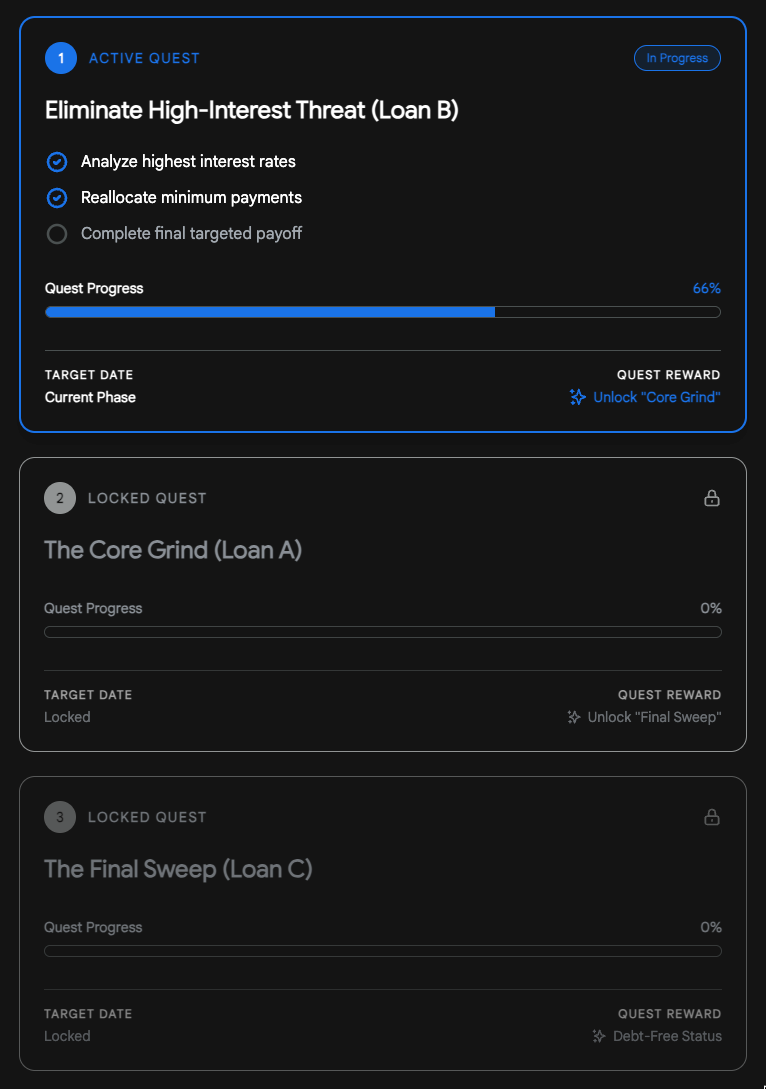
By instructing the AI to adopt the persona of a 'gamification expert,' complex amortization schedules are transformed into approachable, sequential milestones, improving financial adherence.
Exercise 11: The Hyper-Local Opportunity Scanner The 2026 job market has witnessed a significant shift as major employers abandon globalized early-career strategies in favor of hyper-localized recruitment.This is largely due to the fact that an estimated 56% to 89% of graduates are now geographically immobile, choosing to remain in their home regions due to escalating living costs.Graduates must learn to map their local economic infrastructure effectively.
| Component | Prompt Details |
|---|---|
| The Starter Prompt | "Find me jobs in the West Midlands." |
| The Framework Focus | C.R.E.A.T.E. (Focusing heavily on Extras and deep macroeconomic context constraints) |
| The Expert Refinement | [Character] You are an expert regional economic development analyst. Identify the top 3 rapidly growing micro-sectors for graduate employment specifically within the West Midlands region. [Adjustments] Do not list generic, high-level sectors such as "IT" or "Healthcare." You must focus on specific local infrastructure, transport, and advanced manufacturing developments (e.g., the newly announced Transport and Infrastructure Campus). Output a bulleted summary cross-referencing these developments with specific companies actively operating in this space. [Extras] Strictly consider the 2026 economic landscape and public infrastructure commitments.. |
This exercise teaches the user that an LLM is not merely a conversational text generator, but a powerful synthesis engine capable of connecting broad macroeconomic policy shifts to localized, actionable job hunting strategies.
Exercise 12: The Salary Negotiation Simulator Graduates historically lack the confidence and the hard data required to effectively negotiate their initial starting salaries. This is particularly critical in 2026, as the national minimum wage for adults over 21 has increased significantly to £24,784 per annum, shifting the baseline for all subsequent graduate salary banding.
| Component | Prompt Details |
|---|---|
| The Starter Prompt | "How do I ask for more money when they offer me a job?" |
| The Framework Focus | Interactive Persona Prompting (Focusing on establishing an iterative, multi-turn feedback loop) |
| The Expert Refinement | <setup> We are going to conduct a real-time roleplay simulation. You will play the role of a strict but fundamentally fair Hiring Manager at a mid-sized tech firm in London. I am the graduate candidate. </setup> <context> You have just officially offered me the role at £26,000. I am aware that the median for this role is £29,000, and the new 2026 minimum wage establishes a much higher baseline. </context> <instructions> Do not break character under any circumstances. Wait for my first response to your offer. Grade my negotiation tactics after 3 turns of dialogue, offering harsh but constructive feedback on my leverage points and tone. </instructions> |
This exercise unlocks the advanced concept of utilizing LLMs as dynamic, highly interactive simulators for practicing high-stakes interpersonal interactions, rather than treating them as static search engines.
Exercise 13: The Visa Constraint Navigator International graduates face immense pressure regarding the impending 2027 regulatory reduction of the UK Graduate Visa duration from two years to merely 18 months, coupled with steep increases in skilled worker salary thresholds to £33,400.This causes extreme anxiety when communicating long-term viability to HR departments in 2026.
| Component | Prompt Details |
|---|---|
| The Starter Prompt | "Will my company sponsor my visa if it expires soon?" |
| The Framework Focus | RICE (Focusing on highly sensitive, legally fraught Context framing) |
| The Expert Refinement | <role> You are an empathetic, strategic, and strictly legally compliant UK immigration HR specialist. </role> <context> I am an international graduate holding a visa that expires in 18 months under the new regulations. I need to initiate a conversation with my current line manager regarding the timeline for Skilled Worker Visa sponsorship without sounding demanding, presumptuous, or triggering a premature termination of my employment. </context> <instructions> Draft a comprehensive script for a 1-on-1 meeting. You must actively anticipate the manager's financial concerns regarding the £33,400 salary threshold, and seamlessly provide me with diplomatic counter-arguments focusing on my proven ROI and institutional knowledge. </instructions> |
This interaction demonstrates how to proactively deploy AI to pre-emptively solve managerial objections and construct strategic, multi-layered arguments for navigating complex legal and human resources hurdles.
Theme 4: Deep Work and Cognitive Productivity
The modern corporate environment demands high "AI literacy," which extends far beyond basic operational usage. Employers expect graduates to utilize models to fundamentally enhance their critical thinking capabilities, accelerating the acquisition of executive function.
Exercise 14: The "Anti-Sycophant" Challenger
A severe risk in early-career development is presenting a deeply flawed strategy to senior management because the junior employee conceptualized the plan in an intellectual echo chamber, lacking rigorous peer review.
| Component | Prompt Details |
|---|---|
| The Starter Prompt | "Is this a good project plan?" |
| The Framework Focus | Failure-First Prompting (Focusing on explicit behavioral overrides to combat alignment bias) |
| The Expert Refinement | Critically review the project proposal provided in the <proposal> tags. <critical_rule> You must act as a hostile, highly experienced "Red Team" operational auditor. You are explicitly forbidden from praising the plan. Before offering any solutions or improvements, comprehensively list the top 3 ways this plan will catastrophically fail, pinpoint where the foundational assumptions are weakest, and detail exactly what a skeptical CFO would attack. Only after completely deconstructing the plan may you provide a rebuilt, bulletproof version. </critical_rule>. |
This teaches the vital, advanced skill of intentionally bypassing an AI's inherent "helpfulness" bias to extract rigorous, adversarial critical thinking and stress-test strategic concepts before real-world deployment.
Exercise 15: The Work-Readiness "Day One" Simulator Addressing the documented "work-readiness crisis"—where over half of employers believe graduates are unprepared for office dynamics—requires rapid exposure to complex, competing priorities.This exercise simulates the chaotic reality of corporate triage.
| Component | Prompt Details |
|---|---|
| The Starter Prompt | "How do I prioritize my work when I have too much to do?" |
| The Framework Focus | Complex XML Scenario Construction (Focusing on managing competing systemic variables) |
| The Expert Refinement | Act as a chaotic, high-volume corporate inbox. Generate 5 highly realistic, simulated emails within the <inbox_simulation> tags. <variables> Email 1 must be from the CEO, marked urgent but severely lacking detail. Email 2 is from a peer asking for a casual, time-consuming favor. Email 3 is an external client complaining about a critical, system-breaking bug. Email 4 is an automated HR reminder to complete mandatory compliance training today. Email 5 is a mandatory meeting invite that directly conflicts with the time needed for the client bug fix. </variables> <instructions> Ask me exactly how I will prioritize and execute these tasks. Rigorously grade my response based on the Eisenhower Matrix (Urgent vs. Important methodology) and my demonstrated corporate political awareness. </instructions> |
This final quest proves that AI can be masterfully utilized to generate complex, synthesized training environments. By simulating the pressures of corporate triage, graduates can rapidly accelerate their acquisition of situational awareness and strategic executive function in a zero-risk environment.
The Long-Term Transition to AI Directorship
The 2026 macroeconomic environment and shifting corporate expectations present a formidable, multifaceted barrier to entry for recent graduates. With severely shrinking entry-level vacancies, unrelenting demands for immediate operational work-readiness, and widespread employer fatigue regarding generic, AI-generated applications, the margin for error in early-career execution is exceptionally thin.
However, deep analysis clearly indicates that the core problem does not lie in the utilization of Artificial Intelligence itself, but rather in the flawed methodology of that utilization. Graduates who continue to rely on unstructured, conversational "anti-prompts" will persistently face rejection, professional frustration, and stalled momentum, as language models naturally default to hallucinations, generic corporate buzzwords, and severe stylistic misalignment when left unconstrained by strict engineering boundaries.
Conversely, by mastering structured prompting frameworks—specifically the precise, persona-driven role-setting of the RICE model, the detailed, multi-layered parameterization of the C.R.E.A.T.E. framework, and the absolute boundary-defining clarity of XML tagging—non-technical professionals can unlock unprecedented operational leverage. The fifteen exercises detailed throughout this report serve not merely as isolated, tactical life-hacks, but as a comprehensive, foundational curriculum for the modern knowledge worker.
By systematically completing these exercises—ranging from defusing passive-aggressive communications to simulating complex salary negotiations and gamifying personal debt structures—graduates actively build the intuitive cognitive muscle memory required to consistently architect deterministic outcomes from inherently non-deterministic systems. In executing this transition, they elevate themselves from passive, vulnerable consumers of technology to proactive, highly capable directors of it, fundamentally transforming artificial intelligence from a liability that exposes their relative inexperience into a powerful engine that exponentially amplifies their professional competence and career trajectory.