I spend hours fixing AI drafts that still don't sound like me
A non-technical mid-career manager can't finish a client-ready document because every AI draft still needs them to check facts, adjust tone, and confirm it fits their actual business situation. This matters because the verification work takes roughly as long as writing it themselves, so the promised time savings disappear. The root issue is that their professional judgment—built over years—stays locked in their head and scattered documents rather than traveling with each request. When this keeps happening, managers stop using AI for anything beyond the simplest tasks and the workload stays the same.
Context
The problem in plain English
If you're unfamiliar with this industry, start here.
Mid-career managers in operations, marketing, or program roles coordinate between teams, produce status reports, and prepare materials for leadership or clients. They earn their keep by keeping projects on track and information flowing accurately. Most of their day involves turning raw data and decisions into documents that other people can act on. When AI tools appeared, these managers tried them for drafting updates and memos. The output arrived quickly but still needed the same fact-checking, tone adjustment, and business-context review that manual writing required. The promised time savings largely disappeared into post-generation cleanup.
Key Terms
Industry jargon explained
Click any term to see its definition.
The Reality
A day in their life
Non-technical mid-career manager
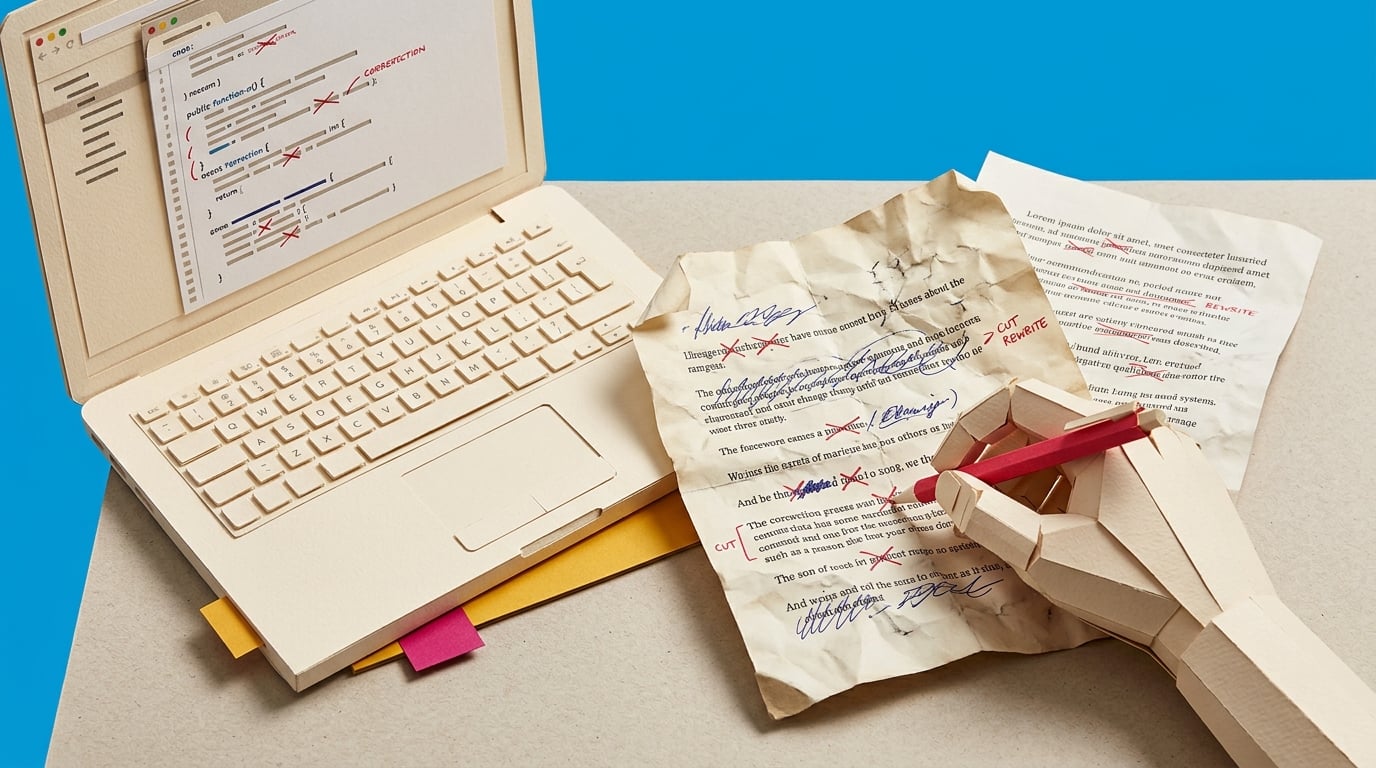
Tuesday morning, 8:47 a.m. I open the quarterly stakeholder update that needs to go out by noon. I paste last quarter's numbers into Claude and ask it to write the narrative section. The first version comes back in 40 seconds. Half the claims are off—revenue from the wrong product line, a client name misspelled, and the tone sounds like a press release instead of an internal note.
I spend the next 90 minutes cross-checking the CRM exports, Slack threads, and my own notebook. At 10:15 I rewrite two paragraphs because the draft uses language we stopped using after the rebrand. My direct report pings me at 10:40 asking if the numbers are final so she can build the slides. I tell her not yet.
By 11:20 the document is finally something I can send to legal for a quick look. They flag one sentence that could be read as a commitment we didn't intend. I fix it, re-export the PDF, and send the final version at 11:52. The actual writing took under an hour. The checking and fixing took three.
Later that afternoon my boss asks why the update is shorter than last quarter. I don't have the energy to explain that I spent the morning doing the same work twice—once by the model, once by me. I just say it was a busy day and move on to the next task that will need the same cycle tomorrow.
The People
Who experiences this problem
Non-technical mid-career manager
38-48 • 12-18 years in operations, marketing, or program management
Skills
Stakeholder communication
Budget oversight
Cross-team coordination
Internal reporting
Frustrations
- AI drafts require as much fixing as starting from scratch
- Tone never matches internal voice without heavy editing
- Facts from company data get invented or mixed up
Goals
- Reduce time spent on routine writing
- Produce client-ready work faster
- Stop re-explaining the same constraints every week
Direct report or project coordinator
Waits for the manager to finish verification before they can build slides or send materials, creating schedule pressure that makes the manager feel the time cost acutely.
Also affected by this problem. Often shares the same frustrations or creates additional pressure.
Top Objections
- I already tried prompt packs and still end up rewriting half the output
- No time to document every rule I use in my head
- My team won't adopt another system they have to learn
- This sounds like it will break the moment the project scope changes
How They Talk
Use These Words
quick checkmake it sound like usrun it by legalclient-readystakeholder sign-off
Avoid
schemaAPIorchestrationJSONworkflow engine
What to Build
Product ideas that fit this problem
Based on the problem analysis, here are solution approaches ranked by fit.
Showing 3 of 3 recommendations
Course
◆◆◆◆◆Excellent Fit
Turn AI Drafts into Checked Stakeholder Updates
From spending hours rescuing AI drafts to running a reusable fact, tone, and source review before sending.
4 lessons90 minbeginner
You'll build: Create a stakeholder-ready update from an AI draft with a completed fact, tone, source, and business-constraint review checklist attached.
Includes: source pack template · tone guide worksheet · send/no-send checklist
AI draft reviewtone matchingsource checking+1 more
Briefing
◆◆◆◆◇Good Fit
Choose the Right AI Context Method Before You Rewrite Again
From endlessly rewriting AI drafts to knowing which context method is missing.
You'll build: A diagnosis note identifying the missing context method for one recurring draft type.
Includes: context-method decision tree · draft diagnosis worksheet · example patterns
AI context methodstone guidessource packs+1 more
Blueprint
◆◆◆◆◇Good Fit
Build a Draft Review Workspace for Manager Updates
From ad hoc manual rewrites to a repeatable review workspace with visible source and tone checks.
You'll build: A build-ready specification for a draft review workspace that outputs a checked update and review record.
Includes: review checklist schema · source-pack fields · send/no-send flow
Handoff: platform_app · platform_build_blueprint
draft reviewsource packstone guides+1 more
Root Cause
Finding where this problem actually starts
We traced backward through five layers of "why" until we hit the source. Here's what's really driving this.
1
Why is this painful?
A fast first draft still requires the manager to spend equivalent time verifying facts, adjusting tone, and confirming business fit.
2
Why does verification consume as much time as the original work?
The draft contains no embedded signals about source accuracy, intended audience tone, or alignment with the specific business context.
3
Why is the output missing those signals?
The manager's facts, tone standards, and business constraints exist only in their head or scattered across internal documents that the generation step never references.
4
Why can't the manager close that gap before generation?
Each new task draws on different combinations of tacit knowledge, so the manager must re-articulate the relevant constraints every time rather than having them travel with the request.
5
Why does this re-articulation burden persist at the market level?
Professional judgment in mid-career roles is accumulated through years of pattern recognition that remains tacit and context-specific, so no standardized external source exists that can supply the missing verification layer without the manager's ongoing involvement.
Root Cause
Tacit professional judgment built through years of role-specific pattern recognition cannot be externalized once and reused, forcing the manager to re-supply verification context for every task.

The Numbers
How this stacks up
Key metrics that determine the opportunity value.
Overall Impact Score
78/100
Urgency
7/10
Moderate pressure to solve
Build Difficulty
8/10
Complex, needs deep expertise
Market Size
9/10
Massive addressable market
Competition Gap
8/10
Major gap in the market
"To prepare a presentation, I spent a couple of hours tweaking an AI draft that just didn't sound like me, making me wonder if I should have just written it myself."
User reflecting on using AI for work presentation drafting and editing — Glassdoor community, Feb 26, 2026
More Evidence
What others are saying
"yet not one of claude's initial outputs from the 5 concurrent sub-projects i was running i'd even categorize as 65% correct"
Ben Lazaroff describing AI output quality on professional deliverables like decks and memos — LinkedIn, June 1, 2026
"I notice a trend that for general knowledge, AI does ok. In any field where I have deep experience, AI responses are ..."
User discussing need to fact-check and review AI outputs in specialized domains — Reddit, unknown (post context 2025)
The Landscape
What solutions exist today?
Current market solutions and where there are opportunities.
Leader
C
ChatGPT Custom Instructions / Custom GPTs
Approach: Users set persistent custom instructions or build reusable Custom GPTs with knowledge files and behavior rules to guide tone, facts, and style across chats.
Pricing: Free tier limited; Plus $20/month for full access and creation
Weakness: Instructions are static and must be manually updated per task or project; no automatic embedding of evolving business context or real-time verification against internal docs, leading to ongoing manual QA.
Challenger
C
Claude Projects and Artifacts
Approach: Organize chats and knowledge into Projects for reusable context; Artifacts provide editable side-by-side outputs for iteration on documents or content.
Pricing: Free limited; Pro ~$20/month; Team/Enterprise higher
Weakness: Requires manual curation of knowledge bases per project; lacks seamless integration with company data sources or automatic tone/business-fit scoring without user re-prompting.
Leader
M
Microsoft 365 Copilot
Approach: AI assistant embedded in Word, PowerPoint, etc., grounded in user's Microsoft 365 data (emails, docs, SharePoint) for context-aware drafting with enterprise controls.
Pricing: $30/user/month add-on (annual); Business edition ~$21/user/month for smaller orgs
Weakness: Strong on company data grounding but still requires user review for tone alignment and external fact accuracy; adoption barriers for non-technical users due to licensing and setup.
Niche
G
Grammarly Business
Approach: AI writing assistant with tone detection, clarity suggestions, and custom style guides that can be set for brand/organizational voice.
Pricing: Pricing not publicly listed (enterprise quotes)
Weakness: Focuses on surface-level edits (grammar, tone) rather than deep fact-checking or business strategy fit; limited for complex managerial content requiring tacit knowledge.
The Gap
Why existing solutions keep failing
The pattern they all miss — and how to beat it.
Common Failure Mode
All solutions fail because they address isolated prompting steps instead of embedding the manager's tacit verification standards into an end-to-end reusable workflow that travels with every task.
How to Beat Them
To beat them: create reusable workflow blueprints that capture facts, tone rules, and business constraints once, then automatically apply them to every new request so the verification layer runs without re-articulation.
The Future
What might make this problem obsolete
Technologies and trends that could disrupt this space. Factor these into your timing.
medium probability
2027-2028
AI remembers your rules across projects
If agents retain tone, fact, and constraint rules between tasks, the re-articulation burden drops. Managers would still need to audit whether the stored rules remain current. High adoption could shrink the market for manual verification tools.
SaaS: Medium risk
Course: Low risk
Consulting: Low risk
Content: Low risk
high probability
2026-2027
Real-time fact and policy checks built in
If enterprise platforms add automatic flagging of factual errors and policy violations, the verification workload shrinks. Accuracy would still depend on the quality of the underlying data sources. This would reduce demand for separate review steps.
SaaS: High risk
Course: Medium risk
Consulting: Low risk
Content: Low risk
medium probability
2027
Speak decisions, get formatted output
Managers could record constraints and decisions verbally and receive structured drafts. The bottleneck would shift from typing rules to ensuring the spoken input captures nuance correctly. This could lower the barrier for non-technical users.
SaaS: Medium risk
Course: Low risk
Consulting: Low risk
Content: Low risk
low probability
2028-2029
One living source of truth for tone and rules
If organizations maintain a shared, versioned set of tone, fact, and constraint data, individual managers would no longer carry that knowledge alone. Maintenance cost would move to a central team. This would reduce the personal re-articulation burden but introduce governance overhead.
SaaS: Medium risk
Course: Low risk
Consulting: Medium risk
Content: Low risk
For Creators
Content Ideas
Marketing hooks, SEO keywords, and buying triggers to help you create content around this problem.
Buying Triggers
Events that make people search for solutions
- A major deliverable comes back from AI with factual errors that reach stakeholders
- Legal or compliance flags content that was supposed to be final
- Direct report asks why a task took twice as long as expected after using AI
- Manager compares hours spent this month versus last and sees no reduction
Content Angles
Attention-grabbing hooks for your content
- The hidden 3-hour tax on every AI-generated report
- Why your team's AI output still needs the same review cycle it did six months ago
- Managers who tried custom GPTs and still rewrite half the draft
- The verification workload nobody counted when they bought the AI license
Search Keywords
What people type when looking for solutions
AI draft fact check timemanager AI output verificationAI writing still needs editingChatGPT output wrong factsClaude draft doesn't sound rightAI productivity lost to rework
The Evidence
Where this came from
Every claim in this report is backed by public sources. Verify anything.
10 sources referenced in this report
Collab365 Research • Collab365 Spaces
Have a question or correction?
No comments yet