
An executive summary of the data indicates three immediate realities for marketing graduates entering the UK job market. First, traditional CVs hold declining value. Applicant tracking systems automatically filter out candidates lacking specific technical keywords. A publicly verifiable portfolio demonstrating artificial intelligence proficiency is now the primary mechanism to bypass these automated rejections. Specific prompt frameworks reduce content creation time from hours to minutes. This allows entry-level candidates to produce strategic, multi-platform campaigns at the speed of senior agency staff.
Second, the data points to a clear, repeatable process for securing interviews. Graduates must adopt specific, high-level structural prompts rather than relying on generic chat requests. The most successful applicants use frameworks like the "Chief Social Media Strategist" system. This approach forces the software to analyse algorithms, attention economics, and hook retention curves before generating a single word of copy. Implementing this strategy over a strict 90-day timeline yields a 10-post portfolio that proves both strategic thinking and technical competence.
Third, a surprising finding emerges from hiring managers and marketing directors. They actively reject candidates who submit unedited, machine-generated copy. Content directors report physical frustration when reading generic artificial intelligence text. The key to securing a graduate scheme is using the technology for structural frameworks and first drafts. Graduates must then apply heavy human editing to remove the robotic tone and elevate the reading level. Precision in editing separates successful applicants from the rejected majority.
The Reality of the UK Marketing Job Market
The UK job market presents a hostile environment for recent marketing graduates. A degree certificate no longer guarantees an interview. Hiring managers face a surplus of applicants and rely heavily on automated software to manage the volume. You must understand the mechanics of these filtering systems to survive the initial screening process.
Applicant tracking systems dictate who gets seen. These algorithms scan incoming applications for exact keyword matches. In 2025, the required keywords reflect a fundamental shift in marketing operations. Recruiters actively search for phrases like "AI Content Generation", "Machine Learning", "Natural Language Processing", and "Predictive Analytics". A CV lacking these terms rarely reaches a human reader.
Furthermore, basic formatting errors eliminate over half of all applicants. Data shows 55 percent of UK CVs face immediate rejection simply for poor formatting. Complex layouts, tables, and graphics confuse the tracking software. You must use clean, text-based documents that highlight measurable achievements.
The competition is adapting rapidly. Your peers use artificial intelligence to automate their job applications and build freelance businesses. Graduates report watching coursemates who used generative tools throughout their degree easily secure employment. Meanwhile, traditional applicants send hundreds of CVs over several months without receiving a single interview invitation.
Senior marketing directors face slashed budgets. They must produce higher volumes of content with fewer resources. They actively seek candidates who can bridge this gap. Employers replace human writers with artificial intelligence to cut costs. However, they need operators to guide the software. Your portfolio must prove you are that operator.
You cannot simply state you know how to use ChatGPT. You must prove it. A portfolio of 10 highly strategic, platform-specific social media posts serves as this proof. It demonstrates you understand audience psychology, platform algorithms, and efficient production workflows.
Traditional CVs Fail Against AI-Optimised Portfolios
| Feature | Traditional CV | AI-Optimised Portfolio |
|---|---|---|
| Formatting & Content Focus | Relies on standard clean layouts free of tables or graphics to avoid automated screening rejection. Often highlights general duties. | Demonstrates high-paying skills in AI integration combined with digital analytics to solve practical business problems. |
| Keyword Strategy | Focuses on traditional role-specific ATS keywords such as "Python", "project management", or "stakeholder engagement". | Incorporates next-generation 2025 trends: ML/NLP, intelligent automation, RPA, predictive analytics, and Industry 5.0 concepts. |
| Proof of Value | Risks relying on generic phrases or unpaid/voluntary experience, which employers may actively disregard resulting in rejection. | Proves capability to leverage AI tools for task assistance while emphasizing crucial human oversight and QA testing before production. |
| Application Approach | Experiences a major pitfall through over-reliance on traditional job boards and online adverts. | Focuses on networking and direct referrals, a strategy representing 11% of successful hires from only 2% of total applications. |
Applicant tracking systems heavily favour candidates demonstrating practical artificial intelligence application over those relying solely on academic credentials.
To successfully navigate this environment, you must transform your application strategy. You must build a portfolio that serves as undeniable social proof of your technical competence. This portfolio will consist of dummy campaigns for fictional brands. It will show exactly how you generate ideas, format content, and apply strategic thinking.
When recruiters look at a LinkedIn profile, they expect to see quantified results and specific sector terminology. A completed portfolio gives you the exact metrics and terminology to populate your profile. You will use the data generated during your portfolio creation to prove your value.
High-Performance ChatGPT Prompt Templates
Basic prompts generate useless output. Asking a language model to "write an Instagram post about marketing" yields generic text that hiring managers instantly recognise and reject. To build a professional portfolio, you must use complex framework prompts. These templates assign a specific persona to the artificial intelligence. They dictate constraints, tone, and psychological triggers.
The following exact prompt templates are proven to work for marketing graduates building portfolios. They cover the three most critical platforms for modern digital marketing. These are Instagram, LinkedIn, and TikTok.
You must treat these prompts as software code. Copy and paste them exactly as written. Replace the bracketed information with your own specific brand details.
Instagram Carousels and Strategic Frameworks
Instagram demands visual and educational value. Carousels perform exceptionally well because they encourage users to swipe. Every swipe signals high engagement to the algorithm. Before creating a single slide, you must define the brand strategy.
Use the Content Pillars prompt to establish the foundation. This prompt forces the software to act as a senior strategist. A content pillar is a core theme that your brand consistently discusses. Having defined pillars proves to an employer that you think long-term.
Prompt 1: Define Instagram Content Pillars Copy and paste this exact text into the chat interface:
"Act as a senior content strategist who manages Instagram for a brand called [insert fictional brand name], which operates in the [insert industry] space. The brand's target audience includes [describe audience segments, roles, or demographics], and you want to position the brand as [describe positioning: approachable expert, innovative leader, etc.]. The brand values include [list values such as transparency, creativity, empowerment, performance]. The goal of the brand's Instagram presence is to [main business goals: increase brand awareness, drive engagement, support product education, generate leads, etc.]. Based on this, define 3 to 5 strategic Instagram content pillars. For each content pillar: Give it a clear and compelling name. Explain its purpose in relation to the brand's goals. Describe how it connects to the target audience's interests, motivations, or challenges. Recommend the best types of Instagram formats to use for this pillar. Suggest 2 to 3 post ideas for each pillar with a short caption hook and ideal format."
Once you have your strategic pillars, you generate the actual content. You must instruct the software to break the content down slide by slide. This next prompt uses the concept of a hook generator.
A hook generator is a specific instruction that forces the software to write a compelling first sentence. This sentence must stop the user from scrolling. On Instagram, the text on your first slide is your hook.
Prompt 2: Write a High-performing Instagram Carousel Copy and paste this exact text into the chat interface:
"Act as a content creator managing Instagram for a [describe brand] in the [industry/niche] space. The audience is [describe audience], and the brand voice is [playful, expert, straightforward]. Create a carousel post on the topic: [insert topic]. Write a slide-by-slide breakdown for an Instagram carousel: Slide 1: Attention-grabbing hook. Slides 2 to 6: Clear, concise points or tips that build on each other. Final slide: Strong CTA encouraging saves, shares, or comments. Use a tone consistent with the brand and include short caption text for each slide."
This structured approach guarantees the output matches professional agency standards. It prevents the model from writing an unusable block of text and forces it to think visually. You take this text output and paste it directly into free design software like Canva. You select a free carousel template and paste the text onto each corresponding slide. This simple step creates a highly professional portfolio piece.
LinkedIn Threads and B2B Psychology
LinkedIn requires a completely different approach. The platform rewards vulnerability, bold claims, and actionable professional insights. Vanity metrics like basic likes no longer impress employers. You need frameworks that drive deep engagement and position you as a thought leader.
The most effective LinkedIn prompts rely on behavioural psychology. The Value Ladder Architect and Micro-Commitment Sequence prompts reverse-engineer successful growth strategies.
A value ladder is a marketing concept that maps how a customer moves from a free product to your most expensive service. Proving you understand this concept tells an employer you care about revenue, not just social media likes.
Prompt 3: The Value Ladder Architect This prompt maps how customers ascend through business offers. Copy and paste this exact text into the chat interface:
"My business offers [list your fictional products/services with prices]. Design a value ladder that takes someone from 0 to my highest offer. For each step: define the specific transformation it delivers, the objection it overcomes to prepare them for the next level, the price point, and the bridge content needed between steps. Then identify where my ladder is broken or missing rungs."
Prompt 4: The Micro-Commitment Sequence This prompt engineers small yeses that lead to big conversions. Copy and paste this exact text into the chat interface:
"My goal is to convert [cold audience] into [desired action/purchase]. Design a sequence of 5 to 7 micro-commitments that progressively increase investment (time, attention, small actions) before asking for the sale. Each step should feel easy in isolation but build psychological commitment. Include the psychological principle each step leverages."
To create the actual post structure, use a detailed framework designed to maximize impressions. A thought leadership framework is a predetermined structure for a post that builds authority. It usually starts with a contrarian statement, provides proof, gives actionable steps, and ends with a philosophical takeaway.
Prompt 5: The Thread That Prints Followers Copy and paste this exact text into the chat interface:
"Act as a Twitter/X and LinkedIn growth strategist, a storytelling expert, and a conversion copywriter. Create a 10-part thread. Tweet 1: Bold, contrarian claim with a proof element. Tweets 2 to 7: Tactical tips with specific actionable insights and real examples. Tweet 8: Relatable address of the number 1 mistake people make. Tweet 9: Mindset shift and philosophical reframe. Tweet 10: Powerful recap with a soft CTA to drive profile visits or newsletter signups."
These prompts ensure your LinkedIn portfolio demonstrates commercial awareness. You are not just writing posts. You are engineering conversion pathways. You show the employer that your content exists to drive sales and capture leads. This directly satisfies the ATS requirements for terms like "Conversion Optimisation" and "Strategic Planning".
TikTok Reels and Video Algorithms
Short-form video dominates current marketing strategies. However, most posts fail because they ignore attention mechanics, pacing, and hook retention curves.
A hook retention curve is a metric used by video platforms. It measures exactly when viewers scroll past a video. Most viewers leave within the first three seconds. Therefore, your video script must contain an aggressive visual or auditory hook immediately. You cannot ask for a generic script. You must force the artificial intelligence to reason from algorithm patterns.
The Chief Social Media Strategist framework is the most powerful prompt for video scripting. It turns the software into a cross-platform master. It forces the software to explain the logic behind the script before writing it.
Prompt 6: Chief Social Media Strategist Copy and paste this exact text into the chat interface:
"You are a Chief Social Media Strategist with cross-platform mastery. Your expertise spans: Instagram Reels, TikTok, X, LinkedIn, YouTube Shorts. You understand: Algorithm behavior patterns, Attention economics, Content psychology, Hook retention curves, What actually performs in the current market. You do NOT guess. You reason from patterns, trends, and audience behavior.
OBJECTIVE: Generate a high-performing content framework for a social media post or reel that maximizes: Hook strength (first 1 to 3 seconds), Watch time / dwell time, Saves & shares, Comment engagement.
INPUTS (ask me for these first): Platform, Niche / Topic, Target audience (who + pain/desire), Goal (views, followers, authority, sales), Content format (talking head, text reel, carousel, POV, screen recording).
Once inputs are received, follow this 4-Step Framework Structure: Step 1: Market Snapshot. Explain what type of content is currently winning in this niche, what most creators are doing wrong, and the psychological trigger to be exploited. Step 2: Viral Framework. Provide a scroll-stopping hook, a pattern interrupt, core value delivery logic, a re-hook moment, and a platform-optimized CTA. Step 3: Script / Structure. Provide a full Reel script. Step 4: Optimization Layer. Specify ideal video length, caption style, hashtag logic, and posting angle."
This prompt is exceptional. It refuses to write the script until it has established exactly why the script will work. Including this level of strategic planning in your portfolio proves you are ready for a senior graduate scheme. You present the script in a two-column format. You put the audio text on the left. You put the visual actions on the right. This matches professional agency formatting exactly.
The Mathematics of Time Savings
The primary advantage of these frameworks is raw speed. Building a 10-post portfolio manually requires dozens of hours. Using strategic artificial intelligence cuts this time by over 90 percent. You must understand these metrics to quantify your value in job interviews.
Data from multiple official studies and marketing experiments confirms the massive reduction in production time. Hootsuite implementation studies report a 70 percent reduction in first-draft creation time for social media teams. OpenAI reports that the average ChatGPT Enterprise user saves 40 to 60 minutes per active day. Furthermore, 85 percent of marketing and product users report significantly faster campaign execution.
AI Reduces Content Creation Time by Over 90 Percent
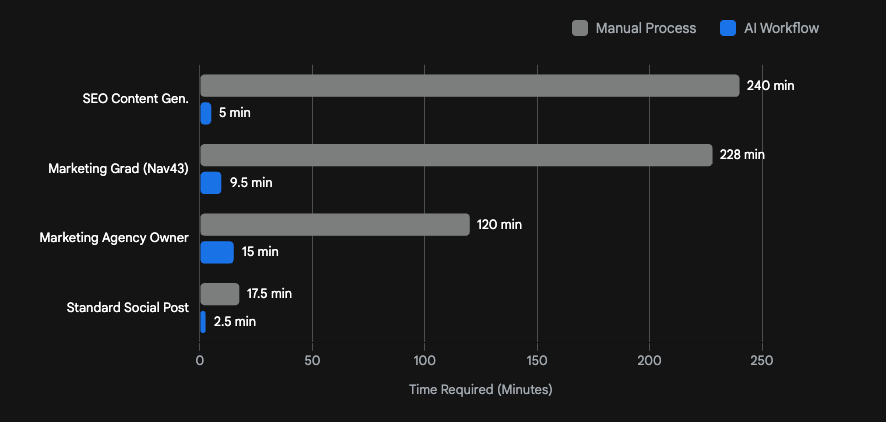
Multiple case studies demonstrate that strategic artificial intelligence implementation reduces the time required to draft a social media post from several hours to under 15 minutes.
The specific minute-per-post savings are staggering. You must internalize these numbers. When a hiring manager asks why they should hire you, you will quote these exact statistics. You will explain that your workflow operates at a fraction of the traditional cost.
| Source Data Origin | Manual Production Time | AI-Assisted Production Time |
|---|---|---|
| Nav43 Workflow Study | 228 minutes (3.8 hours) | 9.5 minutes |
| David Martinez Agency | 120 minutes (2 hours) | 15 minutes |
| Brandon Leuangpaseuth SEO | 240 minutes (4 hours) | 5 minutes |
| Hashmeta Research | 15 to 20 minutes | 2 to 3 minutes |
| Official ChatGPT Marketing Guide | Standard manual time | Saves 3 to 5 minutes strictly on short text |
| Aizolo Student Experiment | Standard manual time | Saves 40 to 60 minutes per post via hybrid workflow |
Calculate the impact on your portfolio. If a graduate creates a 10-post multi-platform campaign manually, they will spend roughly 40 hours researching, drafting, and editing. Using the prompts provided in the previous section, the drafting phase drops to under 2 hours. This leaves 38 hours free for strategy refinement, visual design, and interview preparation.
When you sit in an interview, you must state these numbers. Tell the hiring manager that your workflow reduces drafting time by 85 percent. Explain that this efficiency allows you to focus on strategy and community engagement. That statement alone separates you from other applicants. It proves you understand the financial metrics of agency work.
Five Catastrophic Pitfalls Ruining Graduate Portfolios
Access to fast content generation creates a dangerous illusion of competence. Many graduates fail because they submit raw, unedited text. Hiring managers spot this instantly. You must navigate five common implementation pitfalls to ensure your portfolio looks professional. The difference between a rejected application and a job offer lies entirely in your editing process.
1. The 15-Year-Old Reading Level
Language models default to a simplistic, overly enthusiastic tone. If you ask ChatGPT about the reading level of its standard output, it admits the text is geared toward 12 to 15-year-olds. This tone works for basic consumer content but fails entirely for business-to-business marketing.
Relying on this default voice strips your portfolio of authority. Professional content requires insight, nuance, and a specific brand voice. You must rigorously edit every draft. Use the artificial intelligence for the structure, the bullet points, and the hooks. Do not trust it with the final polish. You must manually rewrite the text to sound like a senior professional speaking to an industry peer.
2. The SEOified Robot Tone
The UK job market is saturated with candidates submitting identical copy. Managers express intense frustration with this trend. On the r/UKJobs forum, an experienced writer noted that reading artificial intelligence content for more than 5 minutes makes managers feel like their head is about to pop.
Another marketer highlighted how obvious the output becomes when a user simply asks the tool to SEOify a page. The text becomes dense, repetitive, and robotic. Furthermore, the models frequently hallucinate facts. In one trial involving legal contracts, the software output was described as utterly useless, full of hallucinations and a complete lack of context.
You defeat this pitfall through heavy intervention. A marketer on Reddit explained their exact method. They ask the tool to write a post on a specific topic to get the bones of the idea. Then, they edit heavily, inserting the brand's true voice and mixing the suggestions with actual expert knowledge from their developers. Your portfolio posts must feature your own distinct edits. You must add specific, fictional data points to your dummy campaigns to ground them in reality.
3. The Unpaid Exploitation Trap
Desperation leads graduates into exploitative roles. To build a portfolio, many accept low-paying or unpaid positions. A common complaint on UK job forums involves graduates serving drinks and making content. Companies exploit candidates who are desperate for experience, knowing they will accept humiliating pay simply to build a starting base.
Furthermore, relying on unpaid or voluntary work often fails to impress corporate recruiters. One applicant with extensive voluntary experience in social media management found that employers refuse to acknowledge the work if it was not paid.
Building your own mock portfolio using artificial intelligence bypasses this trap entirely. You do not need an exploitative internship to prove your skills. You can invent three distinct dummy brands, create high-level campaigns for them, and present this self-directed work as your portfolio. This shows initiative and technical skill without submitting to exploitation.
4. Banned Words and AI Speak
Language models rely on predictable phrasing. They overuse words that instantly flag the text as machine-generated. If your portfolio contains these phrases, recruiters will throw it out. You must use the "find and replace" function in your word processor to eliminate these terms entirely.
| Banned AI Vocabulary | Professional Human Replacement |
|---|---|
| Delve | Examine, analyze, investigate |
| Testament to | Proves, demonstrates, confirms |
| Unlock your potential | Maximize growth, achieve results |
| Comprehensive guide | Detailed report, methodology |
| Navigate the landscape | Understand the market, operate in the sector |
| Game-changer | Major advantage, critical shift |
| Harness the power | Use, apply, implement |
You must act as the final quality control layer. Scan every paragraph. If a sentence feels overly complex or uses dramatic vocabulary to describe a mundane business process, rewrite it in plain English.
5. Compliance and Demographic Risks
General-purpose tools do not understand industry-specific regulations. They will generate text that sounds good but violates the law. In real estate marketing, for example, the software might accidentally generate illegal demographic references like "family-friendly neighborhood" rather than legally compliant terms.
If a hiring manager reads your portfolio and spots a major compliance violation, they will reject you instantly. It shows you rely blindly on the tool. You must act as the final compliance officer for every post in your portfolio. Verify every claim. If you invent a financial technology brand for your portfolio, research the basic advertising rules for financial products in the UK. Ensure your generated text adheres strictly to those rules.
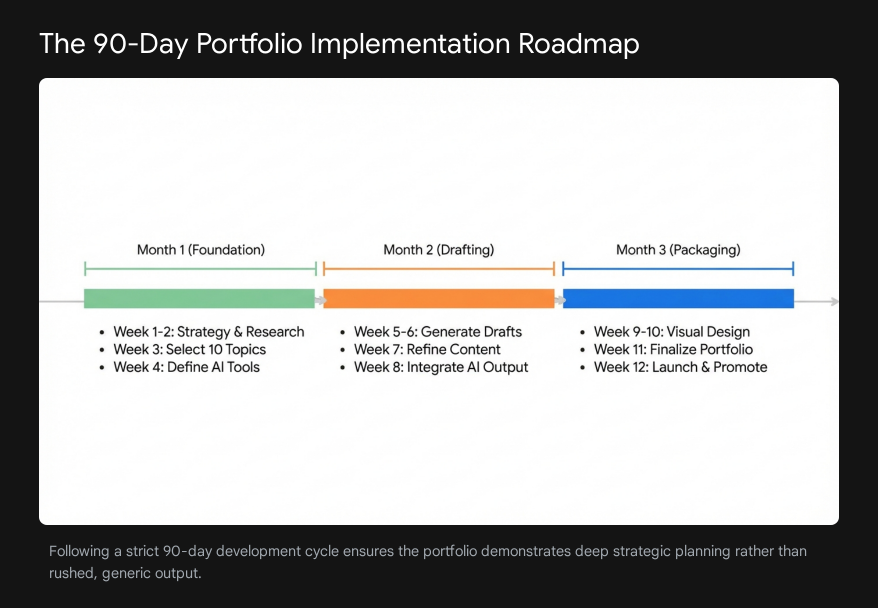
The 90-Day Portfolio Implementation Timeline
Knowledge without a structured execution plan is useless. You need a disciplined timeline to build this asset from scratch. The standard professional onboarding process for a new social media manager follows a strict 30-60-90 day framework. You will use a condensed version of this professional framework to build your 10-post portfolio.
Do not rush. The goal is to produce 10 flawless, highly strategic pieces of content, not 100 generic posts. This timeline breaks down the exact steps you must take every single week.
Month 1: Foundation and Immersion (Days 1 to 30)
The first month focuses entirely on research and strategy. Do not generate any final posts during this period. You are building the foundation of your dummy brands.
Week 1: Select Your Niche and Dummy Brands Choose one specific industry you want to work in. Good examples include B2B software, sustainable fashion, or financial technology. Invent two distinct dummy brands within this niche. Give them names, target audiences, and primary products. Write a one-page summary for each brand detailing their specific tone of voice and market position.
Week 2: Competitor Audits Find three real companies operating in your chosen niche. Perform a manual audit of their Instagram, LinkedIn, and TikTok profiles. Note what works and what fails. You are looking for gaps in their strategy. Look for opportunities where their content is boring or repetitive. Your dummy brand will fill these gaps.
Week 3: Define Content Pillars Open ChatGPT. Use Prompt 1 (Define Instagram Content Pillars). Input the details of your dummy brands. Let the software generate 3 to 5 strategic pillars for each brand. Save these pillars in a master document. Review them carefully. Ensure they sound like authentic business strategies.
Week 4: Platform Strategy Formulation Understand the nuances of each platform. Review algorithms and best practices. Decide which of your 10 posts will go to which platform. A strong mix is 4 Instagram Carousels, 3 LinkedIn Threads, and 3 TikTok Reel scripts. Map out exactly which content pillar applies to which post. Create a basic spreadsheet to track your progress.
Month 2: Drafting and Editing (Days 31 to 60)
The second month is for raw production. You will use the high-performance frameworks to generate the bones of your content.
Week 5: Draft the Instagram Carousels Use Prompt 2 (Write a High-performing Instagram Carousel). Generate the text for your 4 carousels. Ensure every slide has a strong hook generator. Check that the information flows logically from slide to slide. Do not worry about graphics yet. Focus entirely on the text quality.
Week 6: Draft the LinkedIn Threads Use Prompt 5 (The Thread That Prints Followers). Generate your 3 LinkedIn posts. Focus heavily on the mindset shift and the tactical tips. Ensure the contrarian claim in the first sentence is actually interesting. If it sounds generic, delete it and write your own opening line.
Week 7: Draft the TikTok Scripts Use Prompt 6 (Chief Social Media Strategist). Generate the 3 video scripts. Ensure the hook occurs within the first 3 seconds. Read the scripts out loud. If you run out of breath or stumble over the words, the script is too complex. Rewrite it to match natural human speech patterns.
Week 8: The Great Edit This is the most critical week. Disconnect from the artificial intelligence entirely. Open your drafts in a basic word processor. Ruthlessly edit the text. Strip out every instance of robotic phrasing and banned words. Lower the reading age for consumer posts, and elevate the authority for business posts. Inject specific, fictional data points to make the dummy brands feel real. If you skip this week, your portfolio will fail the recruiter test.
Month 3: Visuals, Packaging, and Outreach (Days 61 to 90)
The final month transforms your text documents into a visual, ATS-friendly portfolio.
Week 9: Visual Design You do not need to be a graphic designer. Use free tools like Canva to format your Instagram carousels. Put the text onto clean, minimalist templates. Use consistent brand colours for your fictional companies. For the TikTok scripts, format them into professional two-column documents. Put the audio script on the left and the visual actions on the right.
Week 10: Formatting for the Applicant Tracking System Recruiters expect clean layouts. Do not hide your work in an obscure Google Drive folder. Create a simple, single-page PDF document that links to your visual assets. Include a brief summary of the strategy at the top of the page. State clearly: "Generated structure via AI; edited and finalised by human strategy." This proves transparency and technical competence.
Week 11: Keyword Integration Review your own CV and the portfolio introduction. Ensure you have included the exact keywords recruiters search for in 2025. You must explicitly state that you use "AI Content Generation", "Machine Learning Workflows", and "Data-Driven Strategy". Tie these skills directly to the portfolio pieces you just created.
Week 12: Application and Outreach Your portfolio is complete. You now possess 10 pieces of highly strategic, multi-platform content. You can prove to hiring managers that you understand value ladders, hook retention, and rapid content generation. Stop sending generic applications into the void. Attach your new portfolio directly to marketing directors via LinkedIn messages. Explain that you have built automated workflows that reduce content drafting time by 85 percent.
The job market remains unforgiving for those relying on outdated methods. However, the integration of automation into marketing workflows presents an unprecedented opportunity for entry-level candidates. You no longer need years of agency experience to produce high-level strategic content. By mastering these specific prompts, understanding the mathematics of time savings, and rigorously editing your output to avoid common pitfalls, you immediately elevate your professional standing. Execute the 90-day plan. Build the portfolio. Secure the interview.