
Executive Summary
The entry-level artificial intelligence job market is fundamentally broken for recent graduates. 63% of candidates report experiencing ghosting after interviews, while 40% of corporate job postings in 2024 were classified as "ghost jobs" created entirely to project false corporate growth. Desperate applicants turn to cheap online courses promising high response rates through automated messaging, but these courses teach generic template strategies. These templates trigger immediate rejection from recruiters who are overwhelmed by identical, machine-generated applications. The core problem is not a lack of available talent, but a catastrophic failure in how candidates communicate their value.
A careful analysis of leading job search courses reveals a severe disconnect between what educators sell and what recruiters actually want. Courses from Udemy and major creators focus heavily on mass automation and polished prompt engineering. However, the data indicates that highly polished, error-free outreach messages perform worse than those containing minor human imperfections. The most effective strategy requires a manual technique known as "hook extraction." This involves analyzing a recruiter's recent public activity to identify their immediate business pain points, and then crafting a brief, highly targeted message that addresses that specific issue.
The most surprising insight from the current recruitment data is that artificial intelligence outreach tools are actively destroying candidate brands. Recruiters state clearly that the bottleneck in hiring has never been finding profiles. When candidates use tools to automate their outreach, they merely accelerate bad behavior. Messages that read perfectly are instantly flagged as inauthentic by human readers. To succeed, a job seeker must abandon mass automation, build targeted portfolio projects, and use artificial intelligence strictly for background research rather than direct communication.
Methodology and The Broken Mathematics of Tech Recruitment
The reality of applying for entry-level tech roles defies conventional career advice. Recent graduates frequently apply to hundreds of positions without securing a single interview. This failure rate is a direct result of market mathematics rather than individual incompetence. The data informing this analysis stems from a massive 2024-2025 study analyzing over 20 million outreach attempts, the 2025 Greenhouse Workforce Report analyzing 6,000 workers, and direct feedback from corporate recruiters operating in the United States and the United Kingdom.
To understand the scope of the problem, one must look at the volume of applications. A single entry-level data analyst or artificial intelligence role can attract over 1,000 applications within minutes of being posted. This hyper-saturation is driven by the ease of applying. Automated tools allow a single candidate to apply to hundreds of jobs per day. Consequently, corporate hiring managers are drowning in resumes.
To cope with this influx, companies have deployed their own artificial intelligence systems. Platforms like LinkedIn have introduced tools such as the "Hiring Assistant," which automates candidate sourcing and initial outreach. 37% of organizations are actively integrating generative artificial intelligence into their recruiting teams. Major tech firms like Amazon use machine learning to identify top candidates and assess genuine skills. This creates a bizarre ecosystem where candidate bots submit resumes to recruiter bots. The human element is almost entirely removed from the initial screening process.
The economic environment further complicates the situation. The technology sector experienced massive layoffs throughout 2023 and 2024. Highly experienced professionals are now competing for entry-level positions simply to maintain an income stream. These veteran developers stack remote jobs, making it nearly impossible for a 22-year-old graduate to compete on experience alone. The northern UK data market, for example, has shifted from experimentation to execution. Employers now prioritize hybrid profiles, such as data engineers fluent in cloud migration, over purely academic entry-level candidates.
Furthermore, the existence of "ghost jobs" artificially inflates the perceived number of available roles. In 2024, 40% of companies admitted to posting listings for jobs that did not exist. These listings are kept active to placate overworked employees by simulating incoming help, or to trick investors into believing the company is expanding. Job seekers apply to these roles in vain. 78% of Generation Z candidates report being ghosted after submitting applications or completing initial interviews. A job seeker measuring their success by response rates will inevitably feel like a failure when applying to jobs that literally cannot be filled.
This is the exact environment that breeds desperation. A 22-year-old graduate with zero to two years of experience realizes that standard applications yield zero results. They turn to educational platforms seeking a structural advantage.
Analysis of Leading Job Search Courses
To bridge the gap between graduation and employment, thousands of job seekers purchase online courses. These programs promise high response rates and insider secrets. An objective review of the most popular courses reveals exactly what they teach, what they measure, and where they fundamentally fail the broke recent graduate.
Google: Accelerate Your Job Search with AI (Coursera)
Google offers a highly visible, four-course specialization titled "Accelerate Your Job Search with AI". This program is integrated into all Google Career Certificates and is designed by Google experts in consultation with workforce nonprofits. The course requires approximately six hours to complete and is available in 13 languages.
The curriculum focuses heavily on using Google's proprietary tools, specifically Gemini, NotebookLM, and Career Dreamer. The course teaches candidates how to translate past experiences into transferable skills. A major component involves generating a "career identity statement." This is a formatted pitch explaining how a candidate's background aligns with a specific role. The final modules instruct users on how to use Gemini Live to simulate interview scenarios and practice verbal responses.
Google relies heavily on self-reported success metrics. The company claims that 70% of employers report they prioritize hiring candidates with artificial intelligence skills over candidates with more years of experience. Furthermore, Google states that workers fluent in these tools are 4.5 times more likely to report receiving higher wages. For the specific job search course, 92% of graduates feel better equipped to apply for jobs, and 68% state that the tools saved them time during the application process.
However, the course contains a critical financial and tactical flaw for the recent graduate. After a brief seven-day trial period, the Coursera subscription costs roughly $49 per month. More importantly, the curriculum focuses on broad, corporate-friendly advice. It teaches the creation of polite thank-you emails and follow-ups after receiving a rejection. It explicitly avoids teaching aggressive outbound sales tactics or direct recruiter manipulation. These aggressive tactics are the actual skills required to bypass a saturated applicant tracking system.
Udemy and the Prompt Engineering Hustle
The Udemy marketplace is flooded with highly specific prompt engineering courses designed to capitalize on candidate desperation. One prominent example is the "ChatGPT for Job Search" methodology popularized by instructors like Jafar. These courses typically cost between $20 and $50 and focus almost exclusively on exact text prompts.
The core technique taught in these courses is the "Resume Optimization" prompt. The user is instructed to copy a job description, paste their existing resume, and use a prompt such as: "Analyze my resume and provide tailored improvements to align it with a specific role at a specific company. Highlight skills and achievements". Another prompt focuses on generating a 30-day learning plan to bridge skill gaps rapidly.
The claimed success metrics for these Udemy courses are rarely backed by verifiable placement data. Instructors rely on social proof, such as user likes on platforms like Lemon8 or upvotes on Reddit.
The primary flaw in the Udemy approach is hallucination. When a job seeker instructs a language model to optimize their resume for a specific role, the machine often invents or heavily exaggerates experience to ensure keyword matching. This creates a beautifully formatted document that disintegrates under human scrutiny.
Creator Toolkits and Software Subscriptions
Beyond traditional courses, independent creators sell specialized toolkits and software. Jeff Su, a prominent creator, sells a "Job Search Toolkit" featuring 50 specific prompts. Su heavily promotes the "Download & Learn" technique. This method uses artificial intelligence to generate conversation starters aimed at industry insiders, purportedly to build rapport before asking for a referral. He also advocates the "10X Rule" for keyword stuffing LinkedIn profiles to appear in more recruiter searches. Su claims an 85% response rate for his specific networking templates.
Other creators push dedicated software tools. Platforms like Never Jobless and Careerflow offer Chrome extensions that analyze LinkedIn profiles and automatically generate outreach messages. The Never Jobless platform promises to maximize interview chances by matching the tone of the user's profile to the recruiter's expectations. Careerflow boasts that users see 40 times more opportunities on LinkedIn by using their profile optimizer.
These software tools cost between $15 and $50 per month. They sell the illusion of speed. A candidate can use a tool like Botdog to filter 1,000 profiles down to 50 prospects and generate personalized messages in under 30 seconds. While this sounds highly efficient, the resulting messages are fundamentally hollow.
Comparison of Leading AI Job Search Frameworks
| Course Type | Price Model | Core Technique | Claimed Metric | Primary Flaw |
|---|---|---|---|---|
| Google CourseraAccelerate Your Job Search with AI | $49 USD/month(after 7-day free trial) | Utilizes Gemini and NotebookLM to uncover transferable skills, build a strong pitch, and practice for interviews. | 75% of graduates achieve positive career outcomes within six months; 92% feel better equipped to apply. | Offers foundational skills but lacks aggressive outbound networking strategies. |
| Udemy Prompts (Jafar)ChatGPT for Job Search | Not specified in sources | Provides 10 specific ChatGPT prompts targeting resume optimization and drafting personalized LinkedIn connection messages. | Not specified in sources | Relies heavily on user persistence and adaptability; assumes basic prompt execution. |
| Creator Toolkits (Jeff Su)Job Search Toolkit | Not specified in sources | Employs the X-Y-Z framework, a 20X Referral System, and 50+ AI prompts to generate outreach and CARL stories. | Claims 85% response rates with AI conversation starters and 53% higher callback rates. | Relies on aggressive automation that recruiters frequently penalize. |
While creator toolkits claim the highest response rates, they rely on aggressive automation that recruiters frequently penalize. Google's program offers foundational skills but lacks aggressive outbound strategies.
Evidence regarding The Mechanics of Hook Extraction
The most advanced concept promised by high-end courses is "hook extraction." Most courses execute this concept poorly. To understand why it fails in the hands of novices, one must understand its origins.
Originally, hook extraction is a marketing term. It refers to transcribing and analyzing the first few seconds of successful video advertisements to identify the exact phrasing that captures viewer attention. Marketing agencies use tools to extract these hooks, adapt them, and deploy them in their own campaigns to drive product sales.
When applied to LinkedIn outreach for job seekers, hook extraction takes on a different meaning. It is the process of extracting the core psychological trigger or business pain point from a hiring manager's public profile, and using that specific point as the opening line of a direct message.
Cheap Udemy courses attempt to automate this process. They instruct users to paste a recruiter's "About" section into ChatGPT and ask the machine to generate a personalized greeting. This fails constantly. The artificial intelligence usually extracts generic sentiments. It produces opening lines like, "I saw that you are passionate about driving synergy in the tech space." This is not a hook. It is a cliché.
True hook extraction requires a manual process combined with focused artificial intelligence analysis. The job seeker must find a recent post, technical article, or company press release associated with the target recruiter. The job seeker then feeds this specific, time-sensitive text into an advanced model like Claude or Gemini. The prompt must be highly constrained. A candidate should instruct the model to read a specific press release, identify the single biggest technical challenge the company is facing, and output only a one-sentence question about that challenge.
The resulting question becomes the hook. It proves to the recruiter that the candidate has done actual research. It demonstrates an understanding of the immediate business context. Most importantly, it proves the candidate is not using a mass-mailing tool.
Agencies executing this manual form of hook extraction report phenomenal success. Salesbread, a LinkedIn lead generation agency, boasts a 20% reply rate to their highly targeted LinkedIn messages. Artificial intelligence SDR tools like Landbase claim to lift reply rates by 70% when utilizing deep, context-aware personalization rather than generic templates.
Recent tests in video outreach demonstrate the power of specific personalization. One sales professional tested manual video creation against artificial intelligence video generation. The manual process took 12.5 minutes per video. The automated process took 32 seconds per video, making it 24 times faster. When sending a non-personalized script, the positive reply rate was 4% to 6%. When sending a script personalized with the lead's name, city, and specific company details, the positive reply rate jumped to 15% to 20%. This proves that personalization works, but only when it contains specific, verifiable details about the recipient.
Evidence regarding The Analytics of LinkedIn Outreach
To determine if course methodologies work, one must examine the baseline analytics of cold outreach. The data proves that LinkedIn direct messages are significantly more effective than traditional email, provided they are executed correctly.
According to a massive 2024-2025 study by Belkins and Expandi analyzing over 20 million outreach attempts, the average cold email response rate sits at a dismal 5.1%. In contrast, LinkedIn direct messages average a 10.3% engagement rate. This discrepancy exists primarily because LinkedIn does not utilize the aggressive spam filters found in corporate email servers. Furthermore, decision-makers actively use LinkedIn for networking, making them more receptive to inbound communication.
The level of personalization directly dictates the success of the message. The Expandi data shows that sending a connection request with zero messaging yields a 5.44% acceptance rate. Including a manually personalized message boosts that rate to 9.36%.
The most revealing statistic involves the use of artificial intelligence generation tools. Campaigns utilizing an artificial intelligence-driven first message saw a 4.19% response rate. While this is higher than sending a basic, non-AI text template (2.60%), it is drastically lower than sending a truly personalized, human-written message.
This metric is the smoking gun that invalidates the core premise of $30 Udemy courses. The tools they teach actively reduce a candidate's chances of getting a reply compared to simply writing a manual message.
The industry of the recipient also drastically alters response rates. The legal and professional services sectors show the highest response rate at 10.42%. Conversely, the software and SaaS industries have the lowest response rate at 4.77%. Entry-level tech candidates are targeting the single most difficult industry to elicit a response from. Tech recruiters are hyper-aware of automation software. They ignore automated outreach by default.
The timing of the outreach also matters significantly. Tuesday generates the highest reply rates at 6.90%, closely followed by Monday at 6.85%. Weekend outreach drops to 6.40%. A job seeker mass-applying on a Sunday evening using an automated script is mathematically guaranteed to fail.
Human Personalization Outperforms AI Automation
Average LinkedIn Reply Rate by Outreach Strategy
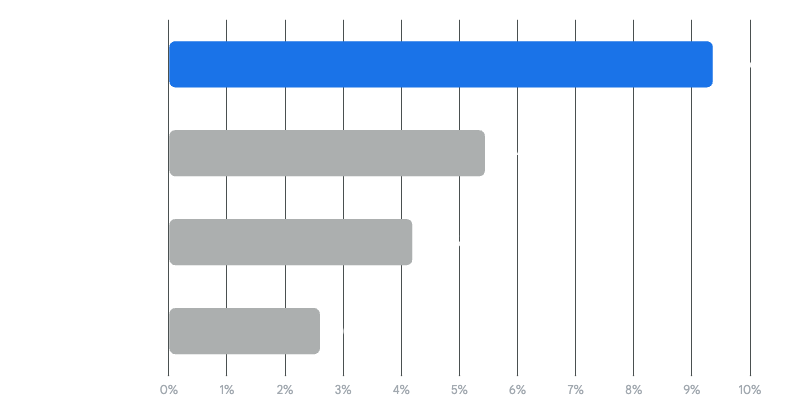
While AI-generated messages perform better than basic templates, they still fall short of true manual personalization. Data reflects average reply rates from over 20 million outreach attempts in 2024-2025.
Evidence regarding Recruiter Backlash and the Five Fatal Flaws
Despite the promises of Udemy instructors and LinkedIn influencers, the courses targeting entry-level job seekers suffer from five fatal flaws. These gaps lead directly to continued ghosting and application failure.
- The "Too Polished" Problem Courses emphasize using language models to rewrite outreach messages until they sound highly professional. This is a massive tactical error. Recruiters review hundreds of messages daily. They have developed an immediate, instinctual radar for machine-generated text. One corporate recruiter with 15 years of experience noted that candidates can instantly be identified when using automated outreach. Messages that are too perfect, lacking the small grammatical quirks or conversational tone of a real human, are dismissed as spam. Artificial intelligence writes in a distinct, overly formal cadence. When a 22-year-old graduate sends a message using words like "delve," "spearheaded," or "synergistic alignment," the recruiter immediately deletes the message.
- Accelerating Bad Behavior The second flaw is the focus on volume over quality. Tools like Careerflow and Never Jobless are designed to help users apply to more jobs faster. However, the bottleneck in hiring is not a lack of applications. Pumping out 500 automated applications does not increase the odds of success; it merely contributes to the noise. Recruiters state that when tools crank up search volume, they only make bad behavior faster and easier. The candidate becomes part of the spam problem. A 15-year corporate recruiter explicitly stated that active talent is fine, but the people companies truly want are passive and quickly taken off the market. Flooding an inbox with AI summaries does not create trust.
- The Illusion of Customization Courses teach candidates to use prompts that merge their resume with a job description. The resulting document is optimized for an Applicant Tracking System (ATS). However, this creates a false sense of security. As one recruiter explained, almost everyone is using these exact same tools to bypass the ATS. This creates a situation where the ATS passes 200 identically optimized resumes to the human hiring manager. The human manager is then forced to manually differentiate between candidates whose resumes read exactly the same. The artificial intelligence has stripped away the candidate's unique voice and specific, granular details. Furthermore, the friction of complex application portals causes 46% of US candidates to abandon applications entirely when forced to re-enter resume data.
- Hallucinated Competence and Technical Failure When a job seeker instructs a chatbot to align their resume with a specific data analyst role, the language model will frequently invent or exaggerate experience to ensure the keywords match. A candidate who used Excel for basic data entry might suddenly find their resume claiming they "architected data pipelines." If the candidate secures an interview based on this document, this hallucinated competence falls apart immediately under technical questioning. Employers are increasingly deploying strict on-site technical interviews and video verifications specifically to catch candidates who used artificial intelligence to fake their initial applications.
- Ignoring the Passive Market and Trust Building The final gap is the complete misunderstanding of how companies actually hire. The best entry-level roles are rarely posted on public job boards. If they are, they are often ghost jobs. True recruitment happens through passive networks and trust-based communities. Recruiters actively hunt on platforms like GitHub or specialized technical forums. Cheap courses teach candidates how to attack the front door of a company alongside 1,000 other applicants. They completely ignore the strategy of building public portfolios that attract inbound recruiter interest.
Recommendations: The 30-Day Anti-Bot Action Plan
To supplement or entirely outperform the $30 courses found online, a job seeker must adopt a radically different approach. The goal is no longer to apply to 100 jobs a day. The goal is to apply to 10 jobs a month, with such overwhelming specificity that rejection becomes difficult. This 30-day plan outlines the exact practical steps required.
Days 1 to 7: The Target Lockdown and Skill Audit
The primary reason entry-level applicants fail is title dilution. Candidates apply for data analyst, product manager, and marketing coordinator roles simultaneously. This forces their resume to become generalized, rendering it useless.
The job seeker must spend the first week picking exactly one job title. Once selected, the candidate must perform a manual "5 JD Scan". This involves opening five recent, legitimate job descriptions for the chosen role. The candidate must read them manually and tally the repeated skills, necessary software tools, and desired business outcomes.
With the list of required skills identified, the candidate must rewrite their resume manually. Artificial intelligence should only be used as a spell-checker. The candidate must use the "Action Verb + Scope + Method + Measurable Result" formula for every bullet point. An example reads: "Led launch of onboarding flow with 3 engineers across 3 markets to optimize drop off rates, cutting total time by 15%". Crucially, the candidate must remove all subjective adjectives. Words like "passionate," "driven," or "detail-oriented" must be deleted. Numbers and specific software environments must replace them.
Days 8 to 14: The Proof of Work Protocol
A resume is merely a claim of competence. In 2026, claims are worthless because anyone can generate them with a prompt. A candidate must provide proof.
During the second week, the job seeker must build a single, highly specific portfolio project. For an entry-level artificial intelligence role, building a generic "Titanic Survival Prediction" model is insufficient, as it is a common tutorial project. The project must solve a real business problem.
Examples of valuable projects include building a customer loyalty prediction model, a driver drowsiness detection script, or a specific real estate price prediction algorithm. The code must be hosted on GitHub with a pristine, human-written README file. The README must explain the business problem, the data source, the methodology, and the outcome. This single link will serve as the core ammunition for all future outreach.
Days 15 to 21: Manual Hook Extraction and The Sniper Approach
With a targeted resume and proof of work complete, the job seeker enters the outreach phase. The candidate must identify 20 specific companies they wish to work for. Using LinkedIn, the candidate must find the specific internal recruiter or the department hiring manager for each company.
The candidate will then execute manual hook extraction. The candidate must read the target's recent posts, company blog entries, or quarterly earnings reports. The goal is to find one specific initiative the company is currently struggling with or heavily promoting.
The initial outreach message must be sent on a Tuesday morning. It must be under 300 characters. It must contain a minor, deliberate imperfection to prove humanity.
A terrible, course-taught message reads: "Hello, I am an entry-level AI engineer passionate about synergizing data pipelines. I noticed your company is scaling. I would love to connect and leverage my skills to drive ROI for your team."
A superior, manual hook-extracted message reads: "Hi Sarah. Saw the press release about your team moving the legacy data to AWS. I built a small script last month that handles unstructured data migration. Thought it might be relevant to the headaches you are probably dealing with this week. Link is on my profile if it helps."
The second message does not ask for a job. It does not demand time. It offers a relevant solution to a specific pain point and relies on the strength of the portfolio project. It uses short sentences and avoids all buzzwords.
Days 22 to 30: The 20X Referral System and AI Interview Prep
The final phase focuses on converting initial conversations into formal interviews. If a recruiter replies to the hook, the candidate must execute a transition strategy. The goal is to move the conversation off LinkedIn and onto a brief, 10-minute video call.
The job seeker should utilize a variation of the "Download & Learn" technique. The candidate asks for a brief conversation to learn about the company's specific data architecture, explicitly stating they are not expecting a job offer. This lowers the recruiter's defensive posture. Once on the call, the candidate's portfolio project does the selling. Industry data indicates that candidates referred internally through these types of informational interviews are hired at vastly higher rates than online applicants.
Finally, the candidate must prepare for the actual interview. This is the only phase where artificial intelligence should be used extensively. The candidate should use Google's NotebookLM or Gemini Live. The candidate must feed the target job description and their own resume into the system. The prompt should dictate exactly how the machine behaves. The candidate must instruct the machine to act as a highly technical, slightly skeptical hiring manager. The machine must ask five technical questions based on the resume and job description, wait for a verbal response, and evaluate the answer based on the Present-Past-Future framework.
By practicing verbal responses against a dynamic artificial intelligence, the candidate builds the muscle memory required to survive technical screening. They learn to articulate their thoughts clearly without relying on a script.
The entry-level job market is unforgiving. However, by understanding the mechanics of the market, ignoring the mass-automation advice sold in cheap courses, and committing to targeted, high-effort outreach, a recent graduate can bypass the bot filters entirely and secure employment.