
Executive Summary
Data reveals a severe disconnect between entry-level artificial intelligence job seekers and recruitment professionals. The United Kingdom unemployment rate reached 5.2 percent in late 2025, with market fears projecting a rise toward 5.6 percent. Graduate unemployment surged 30 percent faster than the broader workforce. Within this tightening market, recent graduates waste up to 30 minutes manually scanning individual recruiter profiles to find a hook. Define a hook as a unique profile detail for personalization. This manual process yields generic outreach messages that recruiters ignore. Automated tools and structured data extraction cut this research time from 30 minutes to under 30 seconds per profile.
The primary recommendation for recent graduates requires abandoning manual profile reading in favor of a free or low-cost automated technology stack. Combining the Apollo.io browser extension for data extraction with a Notion database for tracking allows job seekers to process profiles efficiently without exceeding a budget of $50 per month. Instead of searching for forced commonalities, candidates must identify specific, subtle hooks. These include recent comments left by recruiters on third-party posts, mutual second-degree connections, and recent company funding events. Job seekers must restrict their outreach messages to under 400 characters. Brevity combined with a specific hook increases response rates by 22 percent.
Evidence: The Economic Reality for Entry-Level Roles
A surprising insight from recent recruiter feedback shows that automated, hyper-personalized compliments actively damage a candidate's chances. Artificial intelligence generated flattery triggers immediate rejection from hiring managers who suffer from automation fatigue. Recruiters easily spot messages generated by ChatGPT that praise generic posts about leadership or motivation. The most effective hooks rely on direct, context-rich questions regarding a company's hiring strategy or a shared professional connection. Direct brevity outperforms artificial warmth.
The employment market for recent graduates requires new tactical approaches. Official data from the Office for National Statistics reported a United Kingdom unemployment rate of 5.1 percent in late 2025, which rose to 5.2 percent by the end of the year. Forecasts and market fears suggest a trajectory toward 5.6 percent. This environment places extreme pressure on recent college graduates entering the artificial intelligence sector.
Entry-level white-collar roles face direct threats from the very technology these graduates study. Senior executives report that 63 percent expect artificial intelligence to absorb repetitive tasks traditionally assigned to junior staff. Tasks like basic coding, document review, and data structuring now fall to automated systems. Consequently, unemployment for college graduates has surged by 30 percent since late 2022, outpacing the 18 percent rise seen in the broader workforce. The bottom rung of the career ladder is breaking.
Job seekers react to this pressure by increasing their application volume. The average candidate applies to between 45 and 60 jobs before receiving an offer. This high volume creates a significant time deficit. A manual application requires 15 to 30 minutes. When a candidate attempts to personalize their outreach by scanning a recruiter's LinkedIn profile, they waste an additional 30 minutes searching for a hook. Spending 30 minutes per profile to find a hook for 10 profiles consumes five hours daily.
Automation Reduces Daily Profile Research by Over Four Hours
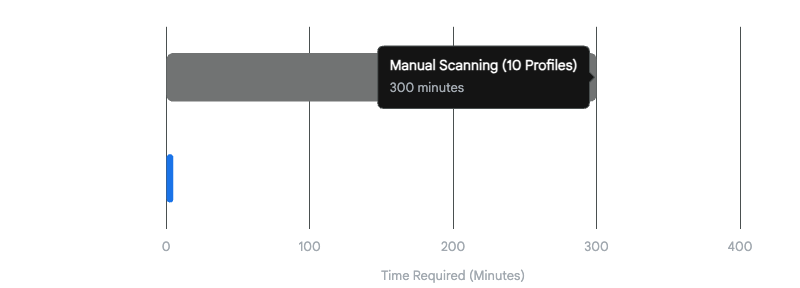
Data indicates that manual scanning consumes up to 300 minutes for ten profiles, whereas automated tools process the same volume in under five minutes.
This time investment rarely produces results. The output often consists of generic notes that recruiters ignore. Candidates face a mathematical necessity to increase their speed and improve the quality of their personalized hooks. Manually reading profiles breaks consistency and prevents job seekers from reaching the volume necessary to secure interviews.
Analysis: The Mathematics of LinkedIn Outreach
Understanding baseline response metrics prevents job seekers from setting unrealistic expectations. Traditional outreach methods offer dismal returns. Cold emails sent without prior connection yield an average response rate of just 3 percent. Some optimized email campaigns reach 5.1 percent, but they remain inefficient for job seekers lacking massive lead databases.
LinkedIn outreach performs significantly better. The platform acts as a verified professional environment, removing the suspicion associated with cold emails. LinkedIn InMail messages generate average response rates between 18 and 25 percent. Top-performing, highly optimized campaigns can reach response rates of 30 to 40 percent. This professional context provides a distinct advantage. A message received on LinkedIn carries the weight of a verifiable professional identity, complete with a work history and mutual connections.
Connection requests also require strategy. Sending a connection request without a personalized message results in a 5.44 percent reply rate. Including a personalized message boosts this reply rate to 9.36 percent.
| Outreach Channel | Average Response Rate | Highly Optimized Response Rate |
|---|---|---|
| Cold Email | 1.0% to 5.1% | 5.1% |
| Unpersonalized Connection Request | 5.44% | N/A |
| Personalized Connection Request | 9.36% | N/A |
| LinkedIn InMail | 18.0% to 25.0% | 30.0% to 40.0% |
Message length strictly dictates success. Outreach messages containing between 25 and 50 words receive 65 percent more replies. Keeping messages under 400 characters increases overall responses by 22 percent. Recruiters do not read long paragraphs. They scan for immediate relevance and professional context.
Timing influences visibility. Tuesday mornings between 7:30 AM and 9:00 AM generate the highest reply rates at 6.90 percent. Monday mornings follow closely at 6.85 percent. Weekends produce the worst results. Saturday reply rates drop to 6.40 percent, and Friday afternoons see a 20 percent decline in responses.
Targeting specific candidate signals further improves these metrics. Candidates who filter recruiters or hiring managers displaying active hiring signals see higher engagement. Furthermore, targeting profiles with the "Open to Work" status yields 37 percent more responsiveness. Targeting the technology and software-as-a-service sectors yields average InMail reply rates of 22 to 28 percent, outperforming the financial and manufacturing sectors.
Methodology: Tool Stacks for Entry-Level Budgets
Recent graduates lack the budget for enterprise software like LinkedIn Recruiter or premium sourcing platforms that cost thousands of dollars annually. The solution requires combining free or low-cost tools to extract hooks rapidly. Job seekers must target tools priced under $50 per month. These tools integrate into a daily 10-profile scan routine.
Apollo.io
Apollo.io provides a robust free tier suitable for daily 10-profile limits. The Apollo Chrome extension overlays directly onto the browser. When a job seeker views a recruiter's profile, the extension extracts verified email addresses and professional data. Users can save leads directly to a target list and export this data as a CSV file. This eliminates the need to manually copy and paste job titles, company names, and locations. The free plan limits high-volume exports but easily accommodates a graduate scanning 10 to 20 profiles daily. By clicking the extension button, the user immediately populates their tracking database.
PhantomBuster
PhantomBuster automates data extraction and outreach through cloud-based scripts. A user connects their LinkedIn account to the platform and runs specific operations called "Phantoms" to scrape profile data. For hook extraction, the LinkedIn Profile Scraper extracts up to 40 different data points from a single profile. This includes recent activity, educational background, mutual connections, and past employment history. PhantomBuster operates in the cloud, requiring no manual browser clicking. A free trial provides sufficient hours to build an initial database of 50 targeted recruiters. It runs securely without triggering bot detection systems when used within conservative limits.
Linked Helper
Linked Helper operates as standalone software rather than a browser extension. This mimics human behavior to ensure account safety. The tool runs "Visit and Extract" campaigns. A job seeker feeds a list of recruiter URLs into the system. Linked Helper visits each profile sequentially and extracts structured data, including skills, summaries, and mutual connections into a CSV file. It bypasses manual data entry completely. Linked Helper offers a 14-day free trial, providing ample time to extract data for a 90-day campaign.
Specialized Chrome Extensions
Several specific browser extensions assist with rapid hook identification without requiring complex configurations.
| Extension Name | Primary Function | Claimed Accuracy | Best Use Case |
|---|---|---|---|
| Saleshandy Connect 2.0 | Contact Lookup | High | Quick email identification for cross-channel outreach. |
| ContactOut | Email Discovery | High | Bypassing missing contact information on hidden profiles. |
| Evaboot | Data Cleaning | 97.0% | Removing emojis from names and standardizing job titles. |
| Wiza | Extraction | 94.0% | Exporting clean lists directly from basic search results. |
Capabilities of Low-Cost Extraction Tools
| Tool | Best Feature | Automation Level | Price Entry |
|---|---|---|---|
| Apollo.io | Contact Lookup & Chrome Extension | Low | Free Tier |
| PhantomBuster | 40-Point Data Scraping | High (Cloud) | Free Trial |
| Linked Helper | Safe Standalone Extraction | High (Desktop) | Free Trial |
| Evaboot | Data Cleaning & Verification | Medium | Free Tier |
Apollo.io provides the strongest all-in-one contact lookup, while PhantomBuster and Linked Helper excel at automated data scraping.
Database Organization via Notion
Extracted data requires immediate structure. Storing links in a generic text file leads to missed follow-ups and duplicated efforts. Notion provides free, customizable databases ideal for tracking outreach. A job seeker must configure a Notion board containing specific columns: Recruiter Name, LinkedIn URL, Extracted Hook, Target Company, Application Status, and Last Contact Date.
Integrations exist to save LinkedIn profile data directly into Notion with a single click. Tools like Bardeen offer pre-built playbooks that scrape the profile and populate the Notion database instantly. This prevents the loss of crucial follow-up details and maintains a clean pipeline of 50 distinct hooks.
Analysis: Five Critical Profile Scanning Mistakes
When job seekers attempt to write personalized hooks, they consistently commit predictable errors. Analysis of recruitment forums and failed outreach data reveals five critical mistakes that guarantee a message is ignored.
Mistake 1: The Fake Warmth Trap
Candidates frequently use basic prompts to generate compliments based on a recruiter's content. Recruiters identify these messages instantly. One professional noted that messages like "I saw your recent post on leadership and was super inspired" feel entirely robotic. The recipient knows the sender did not read the post and used automated software to generate the line in two seconds.
Recruiters suffer from severe automation fatigue. A recruiter evaluating an entry-level artificial intelligence engineer expects technical competence, not artificial flattery. They prefer direct, context-rich messages over fake warmth. Attempting to manufacture a deep personal connection over a generic corporate post insults the recruiter's intelligence and immediately disqualifies the candidate.
Mistake 2: Pitching in the First Message
Job seekers treat direct messages like cover letters. A user on a recruitment forum detailed a two-month strategy of sending 20 direct messages. The candidate used the following template: "Hi, I came across your opening for and wanted to reach out. I'd love the opportunity to contribute my skills to your team. I've attached my resume and portfolio.".
This approach yielded three replies, all of which were rejections. The process took five hours a week for zero results. The mistake involves asking for a job before establishing a conversation. Recruiters ignore direct pitches that offer no immediate contextual value. Effective outreach shifts from persuasion to diagnosis. It asks a relevant question rather than demanding an immediate resume review.
Mistake 3: Generic Broad-Stroke Hooks
Candidates often search for a hook but settle for a generic company fact. They write messages mentioning a company's general mission or a recent, widely publicized product launch. This fails because the recruiter did not personally achieve that company milestone.
A strong hook must tie directly to the individual recruiter's specific activity, not the overarching corporate brand. Telling a recruiter that their company's recent series B funding round is impressive does not differentiate the candidate from fifty other applicants reading the same press release. The hook must prove the candidate researched the human being, not just the corporate entity.
Mistake 4: Overlooking Mutual Connections
Graduates spend 30 minutes reading an "About" section but fail to check their second-degree connections. Data proves that referencing a mutual connection drastically increases trust and response rates. A message stating "I got your name from [Mutual Connection], who mentioned you are hiring" bypasses the cold outreach barrier entirely.
Scanning past the mutual connection list constitutes a major tactical error. Finding a shared university alumnus or a shared former colleague creates immediate social proof. It transforms the candidate from a stranger into a vetted professional connection.
Mistake 5: Paragraph Stuffing
Candidates attempt to prove their worth by listing all their skills in one message. They summarize their degree, list coding languages, and detail their final year project. This violates the primary rule of digital messaging. Shorter messages perform better.
Messages between 25 and 50 words maximize reply rates. Messages exceeding 400 characters see a 22 percent drop in engagement. A hook must sit inside a brief, punchy sentence. The goal of the first message is simply to secure a reply, not to secure the job offer. Long blocks of text cause the recruiter to close the message immediately.
| Mistake Type | Common Example | Recommended Correction |
|---|---|---|
| Fake Warmth | "Your post on leadership was deeply inspiring." | "Regarding your comment on AI data privacy..." |
| Immediate Pitch | "Please see my attached resume for the role." | "Who handles your AI engineering hiring strategy?" |
| Broad Hook | "Congratulations on your company's new product." | "I noticed we both attended the University of Manchester." |
| Length | 150-word summary of college projects. | Keep the total message under 400 characters. |
Recommendations: Proven Techniques to Extract Subtle Hooks
Finding a strong hook requires looking beyond the recruiter's headline and summary. Recent graduates must target specific, subtle profile details that prove genuine human research. The daily 10-profile scan must focus entirely on locating these specific elements.
Technique 1: Analyzing Post Comments
Recruiters post job listings, but they comment on industry discussions. A candidate should navigate to the recruiter's "Activity" section and click the "Comments" tab. Finding a thoughtful comment a recruiter left on a discussion about new software provides a highly specific hook.
If a recruiter comments on a post discussing the limitations of large language models, the candidate possesses the perfect opening. This hook works because it requires effort to find and proves the candidate engages with the same industry discourse as the recruiter.
Technique 2: Leveraging the 24-Hour Search Hack
Candidates often reach out to recruiters who have not logged into the platform for days. A proven technical technique isolates active recruiters. When searching for recruiters or job postings, candidates should apply the "Past 24 Hours" filter.
This action modifies the URL to include the string f_TPR=r86400, representing 86,400 seconds. A candidate can manually edit this URL parameter to isolate extreme recent activity. Changing the value to r7200 filters the search to the past two hours. Reaching out to a recruiter who posted or engaged within the last two hours guarantees the message hits an active inbox, dramatically increasing the chance of an immediate response.
Technique 3: Exploiting Second-Degree Connections
Finding a mutual connection offers the highest return on investment. Job seekers must use the "Connections of" filter or search their alumni network. If a graduate shares an alma mater with a recruiter, this serves as an immediate, valid hook.
This technique shifts the dynamic from a cold solicitation to a warm alumni inquiry. The job seeker does not even need to know the mutual connection intimately. Simply stating that a shared connection exists forces the recruiter to view the profile to verify the relationship, generating a profile view and increasing the likelihood of a reply.
Technique 4: Targeted Direct Questions
Recruiters respect candidates who value their time. If a recruiter has no recent activity and shares no mutual connections, the hook must be a direct, role-specific question. High-performing outreach abandons the traditional greeting.
A direct question eliminates filler. One successful template simply asks: "Hi [Name], quick question, who handles your engineering hiring strategy?".
This direct approach forces the recipient to think and respond quickly, building a conversation rather than asking for a favor. It projects confidence and treats the interaction as a business inquiry rather than a desperate plea for employment.
Methodology: The ChatGPT Extraction Prompt
Recent graduates possess basic familiarity with generative text models. They must use these tools to process scraped data, not to write the final message. Generating the message with automation leads to the fake warmth mistake. Instead, candidates should use text models to analyze dense profile text and extract the hook.
A candidate exports the text of a recruiter's "About" section and "Recent Activity" using a tool like Apollo.io. They then feed this raw data into the chat interface using a strict prompt framework.
The prompt must restrict the model from generating creative text. The following framework ensures accurate extraction without creative hallucination:
"Act as an expert recruitment analyst. Read the following profile data for a technical recruiter. Do not write an outreach message. Your only task is to identify three specific, unique professional details from this text that I can use as a conversation starter. Look for recent comments, specific technological interests, mutual alumni connections, or unique career transitions. Provide the three details in plain bullet points.".
This prompt prevents the software from generating cringeworthy flattery. It acts solely as an analytical engine, saving the candidate 20 minutes of reading while providing three distinct angles for the manual outreach message. The candidate then selects the best hook and writes the 50-word message themselves.
Recommendations: The 90-Day Implementation Timeline
Building a database of 50 high-quality, personalized hooks requires a systematic approach. Recent graduates must treat this process as a daily operational task rather than sporadic networking. The following 90-day timeline provides a realistic structure for executing this strategy alongside a standard job search.
The goal requires transforming a daily habit into a curated database. By scanning 10 profiles a day, a candidate generates 50 profiles a week. Over four weeks, this produces 200 raw profiles. The subsequent months filter these 200 raw profiles down to the 50 best targets.
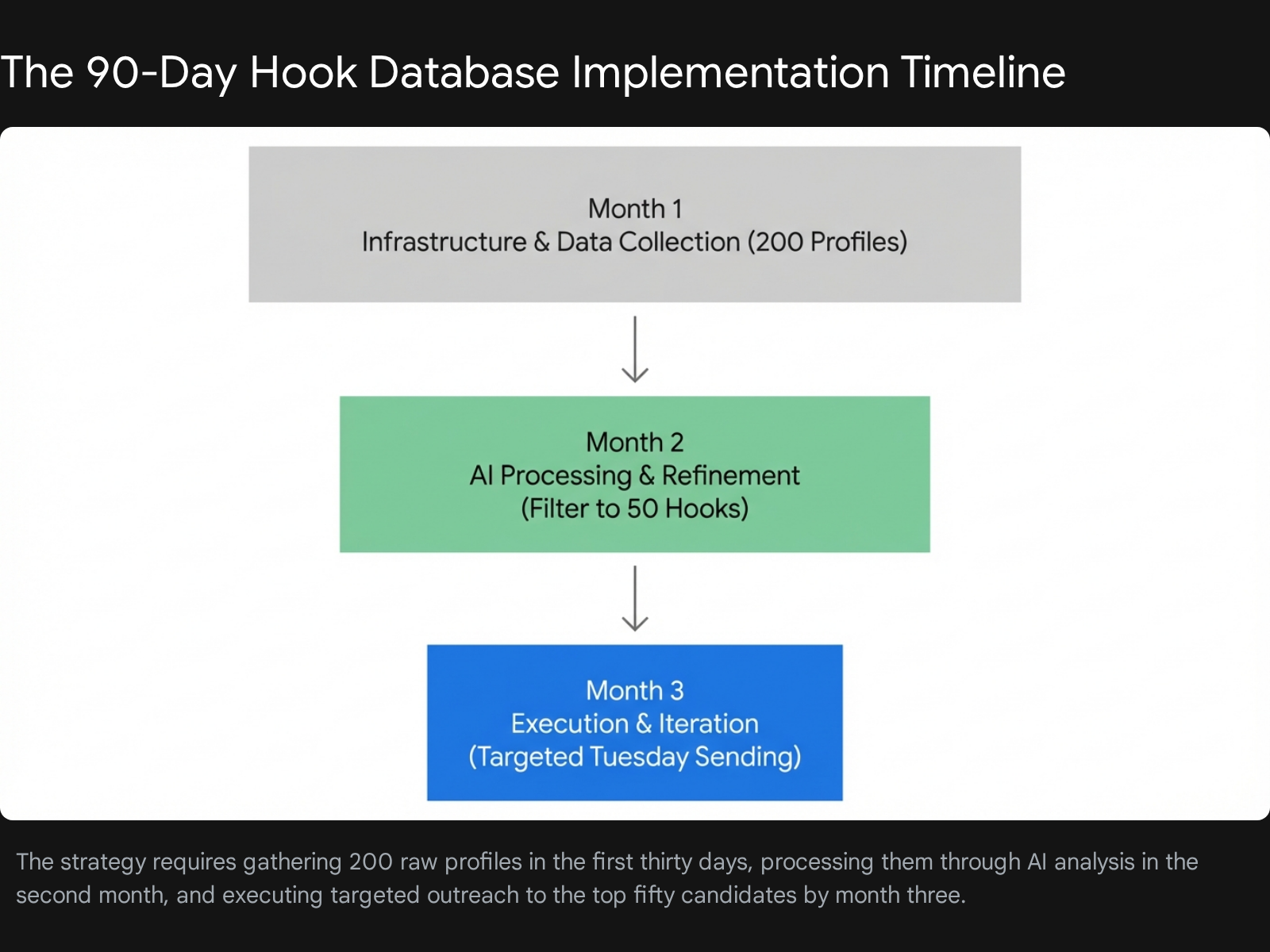
Month 1: Infrastructure and Data Collection (Days 1 to 30)
The first 30 days focus exclusively on setting up the tools and gathering raw data. Outreach does not occur in Month 1. The focus remains strictly on volume and data integrity.
Week 1: Tool Configuration Install the Apollo.io Chrome extension and create a free account. Set up a Notion database titled "LinkedIn Hook Tracker". Create the following columns in Notion: Recruiter Name, Company, Profile URL, Extracted Hook, Date Added, Outreach Status, and Follow-up Date. Install Bardeen or a similar web clipper to push data directly into Notion.
Weeks 2 to 4: The Daily 10-Profile Scan Run a search for technical recruiters at target artificial intelligence companies. Use the r86400 URL trick to find recruiters active in the past 24 hours. Open 10 profiles daily. Use Apollo.io to extract their verified contact data. Transfer the basic profile links and data into the Notion database. By the end of Month 1, the database will contain 200 raw recruiter profiles.
Month 2: Analysis and Hook Refinement (Days 31 to 60)
The second month transitions from data collection to analysis. The objective involves filtering the 200 raw profiles down to the 50 best targets.
Weeks 5 to 6: Filtering and Prompting Review the Notion database and delete recruiters who have not posted or commented in the last 90 days. Inactive profiles yield no hooks. Delete profiles lacking second-degree connections or visible activity. For the remaining profiles, copy their recent activity and summary sections. Run the data through the chat interface using the Hook Extraction Prompt defined previously.
Weeks 7 to 8: Finalizing the 50-Hook Database Review the extraction outputs. Select the single strongest hook for each profile. Prioritize hooks based on strength. Mutual connections rank first. Specific post comments rank second. Direct industry questions rank third. Enter the final, refined hook into the Notion database column. Draft the short, 50-word outreach message for each of the 50 targets. Ensure no message exceeds 400 characters.
Month 3: Execution and Iteration (Days 61 to 90)
The final 30 days involve deploying the messages and managing the responses.
Weeks 9 to 11: The Tuesday Strategy Send the prepared messages as connection requests or InMails. Schedule the outreach for Tuesday mornings between 7:30 AM and 9:00 AM. This targets the highest historical response window. Send a maximum of 10 messages per day to avoid triggering spam filters. Update the Notion database "Outreach Status" column immediately after sending.
Week 12: Follow-up and Analysis For connections who accepted but did not reply, send a one-sentence follow-up message. Keep it extremely brief. "Thanks for connecting. Are you currently taking interviews for the junior engineering role?" Track the final response rate in Notion. A successful campaign will yield between 10 and 15 replies from the 50 targeted hooks.
| Timeline Phase | Primary Action | Metric Goal |
|---|---|---|
| Month 1 (Days 1-30) | Tool setup and data scraping. | 200 Raw Profiles Stored |
| Month 2 (Days 31-60) | AI hook extraction and filtering. | 50 Refined Hooks Selected |
| Month 3 (Days 61-90) | Tuesday morning outreach execution. | 10 to 15 Positive Replies |
Evidence: Navigating the Automated Recruiter Landscape
The underlying dynamics of the recruitment sector explain why these personalized, subtle hooks work. Recruiters now rely on their own automated tools to process candidates. Platforms like SeekOut, AmazingHiring, and HeroHunt.ai automate the sourcing and screening process.
HeroHunt.ai operates as a real-time search engine that automatically finds profiles across professional networks and coding repositories. The algorithms analyze online behavior patterns to predict when a professional might be ready for a career move. These autonomous agents screen profiles, score candidates, and even generate personalized outreach messages automatically.
Because recruiters use automation to generate messages at scale, their inboxes flood with automated noise. A senior recruiter noted that tools cranking up search volume simply make bad behavior faster and easier. The bottleneck for recruiters no longer involves finding candidates. The core problem involves getting the right people to reply.
This creates an environment where authenticity becomes the rarest currency. When an entry-level candidate sends a message containing a highly specific, manually verified hook, it shatters the pattern of automated spam. It proves human effort. An automated agent cannot genuinely relate to a mutual alumni experience or debate the nuances of a specific comment left on a niche industry post.
Recommendations: Optimizing the Profile for Inbound Success
While outbound outreach remains critical, entry-level job seekers must simultaneously optimize their own profiles to catch the attention of recruiter screening tools. These platforms rely heavily on semantic search and keyword density.
A graduate seeking an artificial intelligence role must ensure their headline and summary contain specific, relevant terminology. Headlines must integrate key skills such as "Machine Learning," "Deep Learning," or "Natural Language Processing".
A highly effective optimization strategy involves reverse-engineering job descriptions. Candidates must find five recent job offers matching their desired position and extract the most common keywords. Placing these exact keywords into a separate document creates a targeted terminology chest. Integrating these terms directly into the "Experience" and "Skills" sections ensures the profile ranks highly when a recruiter's tool conducts a semantic search.
Furthermore, maintaining active engagement on the platform signals relevance to the algorithm. Profiles that actively comment, share industry news, and maintain an updated "Services" section appear higher in search results. Engagement variations matter. Posts containing multi-image formats lead with a 6.6 percent engagement rate, while native documents achieve 6.1 percent. Demonstrating active participation in the professional community proves to recruiters that the candidate possesses genuine interest beyond simply securing employment.
Data demonstrates that generic outreach guarantees failure in a tight employment market. Entry-level artificial intelligence job seekers facing 5.6 percent unemployment fears cannot afford to waste 30 minutes manually scanning profiles only to send invisible messages.
Success requires replacing manual effort with systematic data extraction. Utilizing free tools like Apollo.io and tracking progress within Notion transforms a chaotic job search into a structured sales pipeline. The core objective involves bypassing artificial warmth and focusing strictly on direct, verifiable professional hooks. Finding a mutual connection, referencing a specific comment, or asking a direct question regarding hiring strategies produces actual conversations.
By implementing a strict 90-day timeline, graduates build a database of 50 high-quality targets. Executing this outreach on Tuesday mornings with messages under 400 characters maximizes visibility. In a recruitment sector dominated by automated screening and generic spam, the highly specific, concise human hook remains the most effective method for securing an interview.