
Executive Summary
The UK job market for marketing graduates is severely constrained. Employers currently receive 140 applications for every single graduate vacancy.Data from the Institute of Student Employers confirms that application volumes surpassed 1.2 million collectively in a single recruitment cycle.Recent graduates face a brutal cycle. They lack the experience required for entry-level roles. They also lack the budget to access the premium enterprise tools that might help them build that experience. Bombarded by aggressive advertisements for platforms like Jasper and SocialBee, many 22-year-old applicants believe they must spend money they do not have to compete. This assumption is completely false.
You must stop paying for premium marketing tools immediately. The most effective strategy for building a job-winning portfolio relies entirely on free tiers and academic access programs. Enterprise platforms offer massive utility for established agencies, but they provide zero value to an unemployed graduate trying to prove basic competence. Your strategy should center on combining Buffer's permanent free planwith the SocialPilot Education Certification.This zero-cost stack provides all the necessary scheduling power and analytics required to build a verified and data-backed portfolio. You can then pair this infrastructure with simple and human-edited copywriting frameworks to prove your value to recruiters.
Automated content creation actively destroys engagement. That is the most surprising and critical insight from the 2024 and 2025 data. Marketers rely heavily on artificial intelligence to generate posts. Yet unedited machine-generated content performs terribly. Human-written content generates 39 times more clicks than raw AI outputs.Furthermore, AI content suffers a 35 percent conversion decline after three months of deployment.Employers are acutely aware of this quality gap. Almost half of all recruiters worry that graduates use AI to misrepresent their actual abilities.By building a portfolio that highlights your ability to edit, refine, and humanize AI outputs, you will instantly separate yourself from the thousands of applicants submitting automated spam.
Methodology
This report investigates the specific utility of AI social media tools for entry-level marketing graduates. The primary research question asks what these tools teach graduates and what gaps remain for actual portfolio building.
The scope is strictly limited to tools accessible to unemployed graduates in the UK and EU regions. The budget constraint is defined as £10 per month or entirely free. All pricing and feature data reflects the 2023 to 2025 market environment.
Data sources include official pricing documentation from SocialPilot, Predis.ai, Buffer, SocialBee, and Jasper. Market trends and graduate skills data are sourced from the Institute of Student Employers (ISE), the Higher Education Statistics Agency (HESA), and the Chartered Institute of Marketing (CIM). Qualitative evidence, time-to-post metrics, and engagement statistics are pulled from verified user reviews on G2, Capterra, and dedicated professional communities on Reddit. These communities include r/jobs, r/marketing, and r/socialmedia.
The Graduate Reality and the Mathematics of Rejection
The transition from university to full-time employment has become an extreme bottleneck. You send out hundreds of applications. You hear absolutely nothing back. You wonder where the process broke down. The data proves that you are not doing anything uniquely wrong. The mathematics of the 2025 job hunt are simply stacked against applicants.
The Numbers Behind the Rejections
According to labor reports, there were 7.4 million general job openings in June 2025.That figure appears positive until you account for the sheer density of the competition. The average corporate role now receives over 250 applications.Only about 3 percent of those applicants secure an interview.Roughly one out of every 100 people who apply for a role gets hired.
For graduates specifically, the situation is even tighter. The Institute of Student Employers reports that the ratio of applications to vacancies hit an all-time record of 140 to 1.Over 1.2 million graduate applications flooded the market in the last recruitment cycle.Graduate unemployment currently sits at 6 percent.A further 59 percent are in full-time employment, bringing the total of those in work or further study to 83 percent.However, the share of recent graduates securing actual "graduate-level" jobs has fallen to its lowest point since 2014.The UK has dropped to 27th place in the Youth Employment Index.Every additional 100,000 graduates entering the market correlates with a 0.9 percent decline in the overall graduate job rate.
The technology sector, a major employer of marketing graduates, has been hit particularly hard. The ISE reported that tech graduate roles fell by 46 percent in 2024.They project an additional 53 percent drop by 2026.A Stanford Digital Economy Lab analysis found a 67 percent decrease in entry-level tech job postings between 2023 and 2024.
The AI Application Trap
Artificial intelligence has accelerated this application volume. Students use tools like ChatGPT to blast out hundreds of resumes. The average student applies to 208 jobs manually. Students using AI tools average over 400 applications.This strategy fails completely. An estimated 96 percent of AI-generated resumes get flagged and discarded by Applicant Tracking Systems.
Employers are overwhelmed by this low-quality volume. A reported 48 percent of employers explicitly state their concern that graduates use AI to misrepresent their skills.They receive perfectly formatted and grammatically flawless cover letters from candidates who subsequently fail basic communication tests during interviews. The result is a total lack of trust. Employers now use skills-based hiring practices in 85 percent of cases.Furthermore, 76 percent use direct skills tests to verify actual ability.A university degree no longer guarantees an interview. You must prove you can do the work.
Analysis of Social Media Tools for the Entry-Level Budget
You are bombarded daily by targeted advertisements for social media management tools. These ads promise that their AI features will automate your workflow and guarantee viral success. As a graduate building a portfolio, you must ignore the marketing hype. You must look strictly at the numbers. Only two categories of tools exist for your specific situation. There are tools you can afford. There are tools built for agencies that will drain your bank account.
Buffer
Buffer is the single most valuable tool for a graduate building a portfolio from zero. It prioritizes simplicity and cost-effectiveness over complex enterprise features.
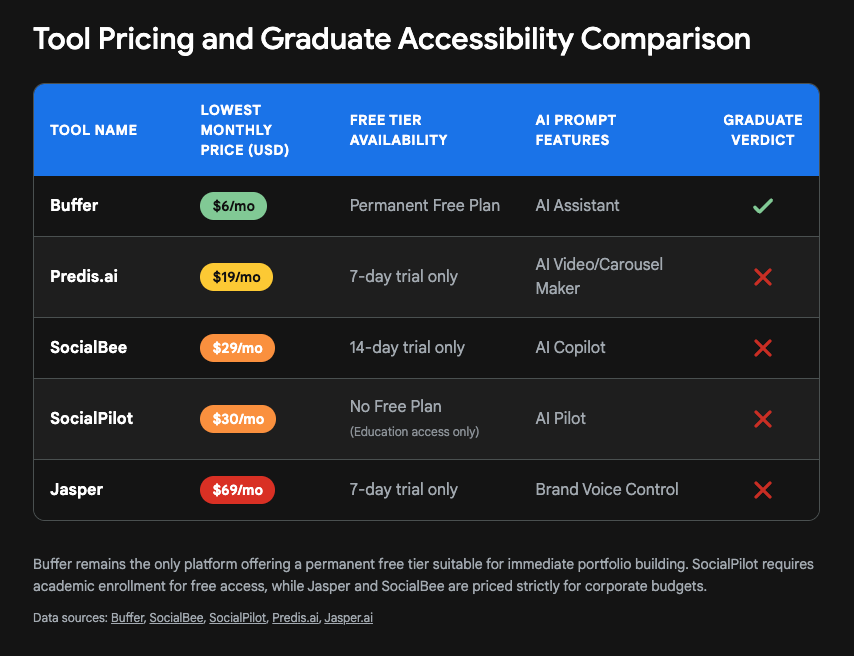
Buffer offers a permanent free plan. This plan costs zero dollars forever.It allows you to connect up to three distinct social media channels.A graduate can simultaneously connect LinkedIn, Twitter, and Instagram. The system permits 10 scheduled posts per channel at any given time.This creates a rolling queue of 30 active posts. If you need more capacity, the Essentials plan costs $6 per month when billed monthly.This falls well under the £10 monthly constraint.
The free tier includes access to the Buffer AI Assistant. Users receive five AI-generated replies per week to handle community comments.They can also use the AI to generate up to 100 content ideas.Buffer is praised universally on forums for its clean interface.It lacks the advanced analytics required by a 50-person agency. You do not need those features. You need a reliable system to schedule LinkedIn posts to prove you understand consistency. Buffer allows you to execute a daily posting strategy for free.
SocialPilot
SocialPilot is positioned as a cost-effective option for small agencies. Its standard pricing is too high for an unemployed graduate. However, its academic outreach program makes it a critical asset.
SocialPilot does not offer a permanent free plan. It provides a 14-day free trial or a 100-credit trial.The entry-level Essentials plan costs $30 per month.This is entirely out of scope for your budget. The platform offers an AI Pilot, smart queues, and the ability to customize posts for individual platforms.
You should not pay $30 a month for SocialPilot. Instead, you must immediately check if your university participates in the Education Partner Program.Accredited colleges and universities can integrate SocialPilot into their curriculum at no cost. Students receive a 12-week subscription to the SocialPilot Pro Plan.This access is valued at $100 and costs the student nothing. Upon completing the required modules, students receive a SocialPilot for Education Certification.Gaining 12 weeks of free access to a professional agency tool allows you to build a massive and data-backed portfolio project.
Predis.ai
Predis targets visual content creation. It automates the design process by generating videos and carousels directly from text prompts.
Predis offers a 7-day free trial.The lowest paid tier is the Core Plan at $19 per month.This exceeds your budget constraint. The platform utilizes a rigid credit system. The Core plan gives you 1,300 credits.Standard image posts cost 20 credits. Standard videos cost 9 credits.E-commerce product videos cost 39 credits.
The tool is incredibly powerful for visual creation. Users praise the phenomenal AI visual features.However, the $19 monthly cost and the strict credit limits make it unsuitable for a graduate who needs unlimited practice space. You cannot afford to run out of credits while experimenting with portfolio hooks.
SocialBee
SocialBee focuses heavily on categorizing and recycling evergreen content. It is widely recommended for freelancers managing multiple clients.
There is no free plan. You get a 14-day free trial.The entry-level Bootstrap plan costs $29 per month.SocialBee features an AI Copilot that generates an entire social media strategy.It decides when and where to publish. It generates both captions and visuals.It also includes automated hashtag generation based on images.
SocialBee saves agency owners up to 20 hours a week.It boasts excellent customer support and robust organizational capabilities.The tool allows users to post up to 12 months into the future.Despite these massive advantages, $29 a month is too expensive for your current situation. You must build your skills manually before paying for this level of automation.
Jasper
Jasper is aggressively marketed as the ultimate AI marketing tool. You have likely seen their ads on YouTube and LinkedIn.
The entry-level Pro Plan costs $69 per month per seat.There is a 7-day free trial.They offer a 20 percent discount for non-profits. No student discount brings the cost anywhere near the £10 limit.
Jasper provides enterprise-grade content generation. It allows you to train the AI on specific brand voices. You can manage campaigns and integrate directly with tools like Google Docs and Surfer SEO.Jasper is a phenomenal tool for corporate marketing teams with massive budgets. Enterprise customers report 40 percent faster content creation using the platform.It is completely useless for your specific needs. The $69 price tag makes it impossible to justify. Ignore the ads.
The Engagement Collapse and Measurable Training Gaps
The marketing industry is experiencing a profound disconnect. Companies are adopting AI tools to save time. They are simultaneously watching their engagement metrics plummet. As a graduate, understanding this specific failure point is your greatest advantage. If you can solve the AI engagement problem, you become instantly hirable.
The Time-to-Post Illusion
The primary selling point of AI social media tools is pure efficiency. The data absolutely supports this claim. A user workflow analysis by SocialPilot revealed that teams spending 15 hours a week on manual scheduling and reporting could reduce that time to just two to three hours by implementing a single AI tool.
A separate survey confirmed that 38 percent of marketers report operational efficiency as their biggest gain from generative AI.You can literally generate a month of content ideas in under 10 minutes using a single ChatGPT prompt.
This speed creates a false sense of security. Graduates learn to generate and schedule 30 posts in an hour. They assume their marketing work is complete. They sit back and wait for the likes to roll in. They get zero engagement.
The Mathematical Failure of Raw AI Content
Speed does not equal quality. When you rely exclusively on AI to write your hooks and copy, your content enters a predictable death spiral. The data on human versus AI content performance is staggering.
A 2024 study tracking search and social performance compared unedited AI content against human-written content. The results were stark. Human-written content received 39 times more clicks than the AI-generated alternatives.Specifically, human content drove 4,550 total clicks compared to a miserable 116 clicks for the automated content.
The engagement metrics continue to collapse the longer the content lives. Unedited AI-generated content typically shows a 35 percent conversion decline after three months.Bounce rates for AI pages climb to 65 percent.Human-written content maintains an average time-on-page of 4.2 minutes. AI-generated pages hold attention for only 1.8 minutes.Overall, human-written content generates 5.44 times more traffic and delivers 41 percent longer session durations.
A separate academic study conducted a within-subjects field experiment on Instagram. Twenty-four culinary posts were published. Twelve were human-created. Twelve were AI-generated. The study found that while AI content achieved greater profile visits among non-followers, human content generated more comments and hashtag impressions.Survey findings indicated that consumers vastly preferred human visuals and human recipes.
The LinkedIn Specific Data
You are likely testing your hooks on LinkedIn. You are competing against millions of other users utilizing the exact same AI prompts.
A comprehensive analysis of 3,368 LinkedIn posts categorized content into "Likely AI" and "Human-written" buckets. The study found that 61 percent of all Marketing and Branding content on the platform is now likely generated by AI.The market is saturated with robotic text.
However, the human-written posts saw 73 percent more engagement on average per post.In industries like Healthcare and Innovation, human posts yielded 40 to 80 percent better engagement.
Users actively despise AI slop. On Reddit communities dedicated to LinkedIn growth, professionals report intense frustration with automated posts. When users spot AI phrasing, they frequently hit the "not interested" button or write negative comments.One user noted that unedited AI posts saw Twitter engagement metrics completely fail. The AI posts provided no real rise in leads or sales.Another founder spent $10,000 on a LinkedIn campaign that generated 120,000 impressions but absolutely zero revenue because the strategy lacked human follow-up.
Human Content Dramatically Outperforms AI Generation
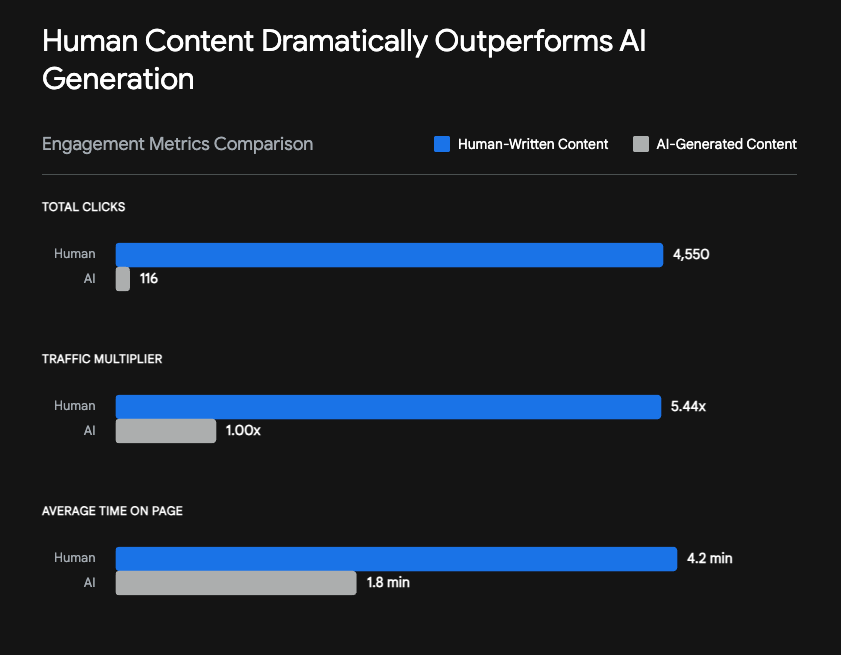
While AI tools drastically reduce scheduling time, unedited machine-generated content suffers a massive penalty in actual user engagement. Human-written posts generate 5.44 times more traffic and hold attention twice as long.
The Graduate Skills Deficit: What the CIM Data Reveals
This reliance on automation is actively degrading graduate skill sets. The 2023/2024 Digital Marketing Skills Benchmark report tracked the actual abilities of thousands of marketers globally. This report was partnered with the Chartered Institute of Marketing (CIM). It analyzed responses from over ten thousand professionals across 32 industries.
The data for Assistants and Graduates is alarming. This specific demographic saw their core skills drift backward in four out of twelve critical areas.Content marketing skills among junior marketers stagnated at an average score of just 25 percent.Mobile marketing sits at 30 percent.Analytics and data skills average 31 percent.Digital strategy skills average 36 percent.Social media skills are slightly higher at 40 percent.
Junior marketers are prioritizing day-to-day tactical tasks. They rely on software to generate copy rather than developing foundational marketing theory. The CIM report highlights a significant gap between confidence and actual skill levels across most disciplines. Overconfidence is most prevalent in content creation, usability, and social media.
| Digital Discipline | 2023 Average Graduate Score | Growth vs 2020 |
|---|---|---|
| Marketing Theory | 55% | +1% |
| Email Marketing | 54% | +5% |
| Ecommerce & Lead Gen | 42% | +5% |
| Social Media | 40% | +8% |
| SEO | 37% | +4% |
| Digital Strategy | 36% | +2% |
| PPC | 34% | +2% |
| Online Advertising | 34% | +3% |
| Analytics & Data | 31% | +2% |
| Usability | 31% | +3% |
| Mobile Marketing | 30% | +2% |
| Content Marketing | 25% | +1% |
Employers see this deficit clearly. The 2025 AI Labour Market Survey revealed that 97 percent of respondents identified at least one type of skill gap in the AI labour market.A significant 57 percent of businesses reported a technical skills gap. Furthermore, 30 percent reported a non-technical skills gap.The most significant gap is a basic understanding of AI concepts and algorithms. This figure has risen from 55 percent to 60 percent over the last five years.
The 2025 ISE Student Development Survey confirms these fears. 54 percent of employers report graduates failing to meet expectations regarding self-awareness. This is up from 43 percent in 2024.A further 46 percent of employers cite severe concerns regarding graduate resilience.Another 46 percent report unmet expectations regarding written communication.Work-appropriate verbal communication was a concern for 22 percent.
You are applying for jobs in a market where employers believe you cannot communicate effectively without a machine. To win the interview, your portfolio must prove the exact opposite.
Five Critical Misses by Marketing Graduates
You test mismatched prompts daily. You get zero engagement. You watch peers seemingly outpace you with free hacks. You must understand exactly why your current approach is failing. Graduates consistently make five critical errors when attempting to use AI for job hunting and portfolio building.
1. The ATS Resume Trap
The most common error graduates make is using ChatGPT to write their resumes and immediately submitting them to corporate portals. They assume the AI has perfectly optimized their text for Applicant Tracking Systems.
This is a disastrous strategy. Data shows that 96 percent of AI-generated resumes get flagged by ATS filters.Recruiters are actively trained to spot AI outputs. They look for unnatural keyword stuffing. They look for a lack of specific and contextual business impact.Candidates who rely on raw AI resumes find themselves needing to submit over 400 applications just to secure a single interview.
A recruiter reviewing a resume wants to validate skills beyond keywords. They want to see how you interpret truth, not just how well you prompt a machine.Real recruiter data confirms this brutality. One Reddit user applied to 1,541 jobs with a 2 percent success rate over a year.The funnel is incredibly harsh for candidates who rely on mass application strategies instead of networking and referrals.
2. The Vanity Metric Obsession
When graduates build their first social media portfolios, they focus entirely on top-of-funnel vanity metrics. They point to impressions. They point to reach. They point to total followers.
Employers do not care about impressions if they do not lead to action. A Reddit case study highlighted a founder who ran a $10,000 influencer campaign. The campaign generated 120,000 impressions and 2,000 likes. The campaign resulted in zero leads and zero revenue.The audience did not align with the target demographic. There was no follow-up strategy.
Another startup founder in the B2B virtual reality healthcare space noted their marketing content receives a tiny amount of engagement. They see a maximum of one or two likes on LinkedIn.Yet, content serves as a long-term marketing asset for sales teams to close deals.
If your portfolio boasts about getting 10,000 views on a TikTok video, but you cannot explain how those views impacted a business goal, a marketing director will immediately reject your application. You must tie your social metrics to business outcomes.
3. The Generic Hook Failure
You are currently writing LinkedIn hooks using basic AI prompts. Your posts likely start with phrases you see repeated constantly.
These are known as generic hooks. Human readers actively filter them out. They are an immediate signal that the post was written by ChatGPT.Users report that advanced English words generated by AI often sound completely unnatural in a business context.
An analysis of 1,000 viral LinkedIn hooks by Captain Hook AI revealed that the highest-performing hooks read like genuine human moments.They utilize specific strategies that AI struggles to replicate without heavy manual editing.
For example, successful hooks use the "Bad Take" strategy. You state a controversial industry opinion and immediately disprove it.They use "Sneaky Brackets" to address reader skepticism directly within the opening line.The "Recency" hook uses words like "just" and "recently" to build urgency. A massive 46 percent of top hooks use timeframe words.Raw AI prompts cannot generate this level of psychological nuance.
This problem extends beyond text. One developer built a user-generated content automation in n8n. The initial video got 177,000 views, but users pointed out the AI influencer's face changed in every frame.The developer had to scrap the original workflow and rebuild the entire system using Gemini 2.5 Flash Image and KIE VEO3 just to maintain character consistency across the videos.AI fails on the details.
4. Missing Business Context in Portfolios
When graduates showcase their design or content work, they often just post the final image or the final copy. They fail to explain the thought process.
A senior agency owner on Reddit explained that entry-level portfolios are frequently thrown out because they lack context.A recruiter needs to know why you made specific choices. Where is the thought work behind the composition? How does the design function to solve a client need?.
A portfolio should not just be a gallery of nice images. It must quantify results. You need to show that your campaign "increased design output by 150% YoY" or "increased website conversion by 30% for 2024 holiday season" or "increased average cart size by 160%".If you just show a flyer you made on Canva with an AI-generated caption, you are proving you possess a skill that a machine can replicate for free.
5. The Soft Skills Void
Graduates believe marketing is purely technical. They focus on learning SEO tools. They focus on scheduling platforms. They focus on graphic design software. They completely ignore the soft skills required to survive in an agency.
Employers are terrified of the current graduate cohort's lack of resilience and self-awareness.Many of these graduates completed their university studies during pandemic lockdowns. They missed out on crucial in-person work experience. When you use AI to fake a highly polished professional persona, you set expectations that you cannot meet on your first day in the office.
If your cover letter reads like a senior executive, but you cannot handle basic verbal communication or constructive criticism during the interview, you create a massive disconnect. Stephen Isherwood, joint CEO of the ISE, stated that misaligned candidate skills create a no-win situation. It disrupts training processes and places candidates in the wrong jobs.Employers view this as a major red flag.
Practical Next Steps: Building the Free Portfolio System
You do not need money to beat the competition. You need a better system. By leveraging free tools and focusing entirely on the 20 percent of work that requires human intuition, you can build a portfolio that guarantees interviews. Follow this exact blueprint.
Step 1: Secure Your Free Infrastructure
Stop looking at Jasper and SocialBee. You must establish a zero-cost technical stack.
First, sign up for Buffer's free plan.Connect your LinkedIn profile, a Twitter account, and an Instagram account. This gives you the ability to schedule 30 posts at any given time.This is your execution engine.
Second, investigate the SocialPilot Education Partner Program.Contact your university professors immediately. If your business school signs up for the program, which costs the university nothing, you receive a 12-week subscription to the SocialPilot Pro Plan.This grants you 500 AI credits, advanced analytics, and the ability to manage seven social accounts.
If you secure this access, you can run a highly professional three-month social media campaign for a local business or a personal project. At the end of the 12 weeks, you receive a SocialPilot Education Certification to put on your resume.This proves to employers that you have hands-on experience with actual agency software. Certifications are not a golden ticket. They function primarily as door openers for resumes and LinkedIn profiles.However, they provide the credibility signal you currently lack.
Step 2: The Free Template-Test-Score Cycle
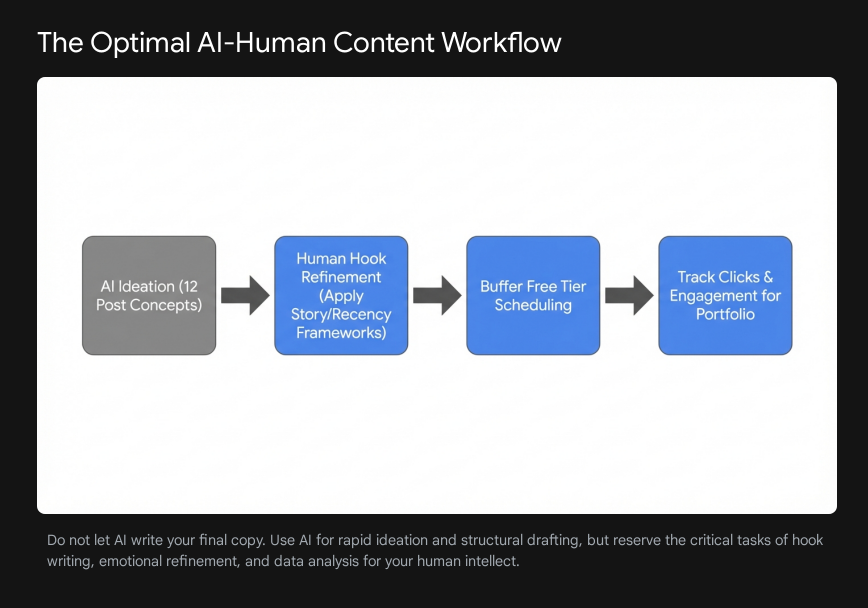
You must shift your workflow. Do not use AI to write the final post. Use AI to do the heavy lifting of ideation. Use your human brain to write the final hook. This is the 80/20 rule of AI marketing.
Start with Strategic Ideation. Open a free instance of ChatGPT or Claude. Define four core content pillars for your portfolio project. Use a highly specific prompt.
A proven strategic prompt structure is: "Act as an expert LinkedIn content strategist. My target audience is. My four content pillars are [Pillar 1, 2, 3, 4]. Generate 12 unique post ideas. Ensure the formats are varied. Frame each idea with a strong, scroll-stopping hook.".
This generates your raw material. It prevents you from staring at a blank screen. Now, you must manually edit every single hook.
Test the outputs against proven human frameworks. Use the "Story" hook.AI will write: "Persistence is key in sales." You must manually rewrite this to: "My first post flopped. My second flopped. Post #33? It landed my first client.".
Use the "Recency" hook. Change the AI's generic opening to include words like "just" or "recently" to create urgency.Change "LinkedIn strategies are important" to "I recently discovered a hyper-effective LinkedIn post strategy.".
Schedule these manually edited posts into Buffer. Track the engagement metrics weekly. Document exactly which hooks generated clicks and comments. This data becomes the core of your portfolio.
Step 3: Optimize Your Digital First Impression
Your LinkedIn profile is your most critical portfolio asset. When a recruiter searches for you, they must see a professional who understands marketing strategy.
You must rewrite your LinkedIn headline immediately. AI tools will suggest generic titles like "Marketing Manager at XYZ Company" or "Aspiring Digital Marketer." These are low-performing headlines.
You must adopt the "Value + Specialty + Achievement" formula.If you ran a small project during university, quantify it. Your headline should read: "Driving $3.2M in SaaS Revenue | Product Marketing Strategist | Launched 15+ Products with 87% Success Rate".Adjust the numbers to reflect your actual student projects.
This specific optimization system yields massive results. One documented case study showed a candidate shifting from zero job offers to securing five job offers from 656 applications within two months.This candidate achieved an 8.2 percent response rate and secured 27 screening interviews simply by implementing this headline strategy and engaging in strategic networking.
Apply this optimization to your "About" section. Start with a compelling hook in the first three lines. Write in the first person. Incorporate a professional story and highlight three quantifiable achievements.Do not keyword stuff.Write for a human recruiter, not a machine.
Step 4: Prove Business Context
When you finally construct your PDF portfolio or personal website, you must eliminate vanity metrics. Do not upload a graphic and state that you made it using Canva and Midjourney.
Instead, present a case study. Follow a strict four-step narrative.
- Define the Problem. State the business need clearly. Example: "A local cafe had zero engagement on Instagram."
- Explain the Strategy. Detail your human intervention. Example: "I used ChatGPT to brainstorm 20 content pillars. I manually wrote five highly specific story hooks."
- Show the Tooling. Prove you understand the software stack. Example: "I utilized Buffer's free tier to schedule posts at optimal times."
- State the Result. Provide quantifiable business data. Example: "This generated a 40 percent increase in profile visits. It drove 15 new email newsletter signups."
This format proves to the employer that you understand the entire marketing funnel. You are not just a prompt engineer. You are a strategic thinker who knows how to use free technology to drive actual revenue. That is the exact skill set required to survive the 2026 job market. You must stop relying on machines to do your thinking. Use the machines to do the heavy lifting, but use your intellect to close the deal.