
Eighty-seven percent of job applications face algorithmic rejection before a human ever sees them. Candidates submit hundreds of applications and receive total silence in return. This analysis examines the precise mechanics of how recent college graduates with zero to two years of experience bypass automated filters. They achieve this by contacting recruiters and hiring managers directly via LinkedIn using highly specific, personalized opening messages known as hooks.
The standard cold email reply rate sits between 1.2 percent and 5.1 percent. However, graduates using tailored hooks report response rates ranging from 15 percent to 60 percent. This research isolates the exact messaging structures that produce these outsized results. The analysis strictly focuses on entry-level artificial intelligence roles offering starting salaries between $20,000 and $60,000 in the United States and the United Kingdom.
The most surprising finding involves the specific type of outreach that works best. Hiring managers ignore traditional resumes. They respond to free labor. The highest conversion rates come from candidates who test an artificial intelligence product, find a flaw, and send the founder a polite, documented fix. Founders value practical feedback far more than a list of academic credentials.
Methodology and Scope of Analysis
This report synthesizes data across multiple massive datasets to form a conclusive picture of the 2024 to 2026 hiring environment. The analysis relies heavily on the 2025 Talent Trends Report, which processed over 31 million applications and 95,000 jobs to determine recruiter productivity and candidate volume metrics. This data provides the baseline for understanding the current application bottleneck.
To understand outreach success rates, the research incorporates the Instantly 2026 Cold Email Benchmark Report and data from 11 million outbound campaigns. This email data is cross-referenced with LinkedIn's internal research on recruiter response rates based on character counts and message structures. The combination of applicant tracking system data and cold outreach statistics provides a mathematically rigorous foundation for the recommended strategies.
The scope of this report focuses strictly on entry-level roles. The target demographic includes recent college graduates aged 22 to 25 with a maximum of two years of professional experience. The analysis excludes highly specialized, senior machine learning engineering roles that require advanced degrees or doctorate-level research. Instead, it targets attainable roles within the $20,000 to $60,000 starting salary band across the United States and the United Kingdom. Fictional success stories are excluded, and all case studies are grounded in verified forum discussions, podcast interviews, and published professional accounts.
The Entry-Level Algorithmic Blockade
New graduates face a severe mathematical disadvantage in the current hiring market. Over 5.6 percent of recent college graduates in the United States are unemployed, marking the highest rate since 2021 outside of the pandemic. Artificial intelligence itself causes a significant portion of this contraction. Companies automate routine tasks that traditionally belonged to junior staff members. One projection suggests a single senior developer equipped with an artificial intelligence coding tool can now replace an entire team of five junior developers.
Because of this newfound efficiency, only 2.5 percent of artificial intelligence job postings target candidates with zero to two years of experience. Every open entry-level position receives thousands of applications within hours. Applying through standard web portals guarantees failure for the vast majority of applicants due to the sheer volume of submissions.
The 2025 Talent Trends Report quantifies this exact bottleneck. The number of applications required to make a single hire has nearly tripled since 2021. Specifically, the application volume per hire witnessed a 182 percent increase from the 2021 baseline through the end of 2024. Job applications saw a massive 2.6 to 3.0 times growth multiplier at the start of 2024. Managing this overwhelming inbound volume forces talent teams to rely entirely on automated screening tools.
Despite this massive influx of candidates, recruiters are closing fewer hires. The number of hires per recruiter hit a low of approximately 4.3 per quarter in early 2023, stabilizing at only 5.4 hires per recruiter by 2024. Talent teams are working harder for worse results. In 2024, teams interviewed roughly 40 percent more candidates to make a single hire compared to 2021 levels. Technical roles now require 21 percent more interview hours from recruiters, and business roles require 6 percent more.
This creates a paradox. Companies are drowning in applications but starving for verified talent. Getting to an offer has become exceptionally difficult. In 2023, only 7 percent of technical candidates and 9 percent of business candidates who actually reached the interview stage received an offer. This rate stabilized slightly in 2024 but remains significantly below historical highs.
The structural failure of the standard application process is clear. Hires sourced from external job boards dropped to half of their 2021 volume by 2024. The remaining hires come entirely from direct sourcing, internal referrals, and internal transfers. Candidates who click "Easy Apply" on LinkedIn or submit a PDF through a corporate portal are engaging in a statistically futile exercise. They must create their own side channels to reach decision-makers.
Targeting Attainable Roles and Salary Bands
Before deploying any outreach strategy, candidates must target the correct roles. Graduates often fail because they apply for "Machine Learning Engineer" positions that demand five years of experience and a strong background in advanced mathematics. Attainable entry-level roles exist, but they require practical platform literacy rather than deep algorithmic programming. Employers want candidates who can orchestrate existing tools to solve immediate business problems.
The data identifies several distinct roles fitting the $20,000 to $60,000 salary band. These roles are accessible to graduates without traditional computer science degrees.
United States Market Salaries
In the United States, entry-level artificial intelligence roles focus heavily on operations, quality assurance testing, and customer support management. The median average salary for a broad entry-level artificial intelligence job in the United States sits at $105,092, but this includes highly technical engineering roles. For graduates with hybrid skills and basic platform familiarity, the target band is lower and far more accessible.
| Job Title | Role Description | US Salary Range | Required Skills | Source |
|---|---|---|---|---|
| AI Customer Support Agent | Monitoring and training service bots, reviewing conversations, and fine-tuning responses. | $35,000 to $55,000 | Communication, problem-solving, accuracy. | |
| AI Content Creator | Using tools like Jasper and Copy.ai to draft and refine marketing content. | $40,000 to $70,000 | Writing, editing, content strategy. | |
| AI Product Tester / QA | Providing quality assurance and user feedback for new tools without coding. | $40,000 to $65,000 | Analytical mindset, basic UX understanding. | |
| AI Operations Assistant | Integrating AI into daily operations via Zapier, Notion AI, and Google Workspace. | $45,000 to $75,000 | Systems thinking, tech curiosity, no-code tools. | |
| Data Labeling Specialist | Tagging and organizing large datasets to help AI models learn patterns. | $15 to $30 per hour | Attention to detail, consistency. |
United Kingdom Market Salaries
The United Kingdom market offers similar operational roles, with salaries mapping strictly to the target range. The demand for artificial intelligence talent in the United Kingdom increased by 111 percent between 2024 and 2026, making it the fastest-growing technology sector in the region. Sixty percent of United Kingdom artificial intelligence companies actively sponsor international talent due to domestic skills shortages. Graduates from top United Kingdom universities boast a 95 percent employment rate within six months of graduation.
| Job Title | Role Description | UK Salary Range | Required Skills | Source |
|---|---|---|---|---|
| Entry-Level Data Analyst | Processing data and interpreting fundamental business metrics. | £23,000 to £35,000 | SQL, basic Python, statistical understanding. | |
| Junior Cyber Security Analyst | Monitoring networks using AI-assisted threat detection tools. | £25,000 to £37,000 | Network fundamentals, risk assessment. | |
| Junior Data Scientist | Assisting with model deployment and data pipeline maintenance. | £25,000 to £40,000 | Python, pandas, basic machine learning. | |
| AI Talent Acquisition | Screening candidates using AI platforms and managing hiring workflows. | £30,000 to £40,000 | Communication, HR software proficiency. | |
| Graduate AI Developer | Writing basic scripts and integrating API connections. | £30,000 to £45,000 | Coding fundamentals, API management. |
Candidates must strictly align their resumes and outreach to these specific titles. A candidate applying for an AI Operations Assistant role must highlight their ability to build workflows in Zapier rather than their theoretical knowledge of neural networks.
The Mathematical Advantage of the Hook
The data reveals a direct correlation between message length, personalization, and response rate. Recruiters strictly favor brevity. LinkedIn internal data proves that direct messages containing 400 characters or fewer receive a 22 percent higher response rate than the platform average. Conversely, messages exceeding 1,200 characters suffer an 11 percent drop in responses. Four hundred characters roughly equal six short sentences. Candidates must ruthlessly edit their outreach to fit this constraint.
Generic cold outreach fails almost universally. One industry study analyzed 147,000 generic cold emails sent in a single year and recorded a dismal 1.2 percent reply rate. Another major study placed the average cold email response rate slightly higher at 5.1 percent, while noting that generic LinkedIn direct messages perform marginally better at 10.3 percent.
However, introducing advanced, signal-specific personalization changes the math entirely. The Instantly 2026 Benchmark Report demonstrates that highly targeted messages achieve an 18 percent response rate, representing a massive 5.2 times improvement over generic templates. Only 5 percent of senders actually personalize every email, leaving a massive competitive advantage for candidates willing to do the research.
Top-tier personalized campaigns perform even better. One agency operator reported booking 18 calls and securing four clients from a batch of just 1,428 highly researched contacts, achieving a 4.34 percent conversion rate to actual meetings. Another specialized outbound campaign achieved an astonishing 60 percent response rate by referencing highly specific company details.
Personalized Hooks Generate Ten Times More Replies
Generic Mass Outreach (grey) Highly Personalized Hooks (blue)
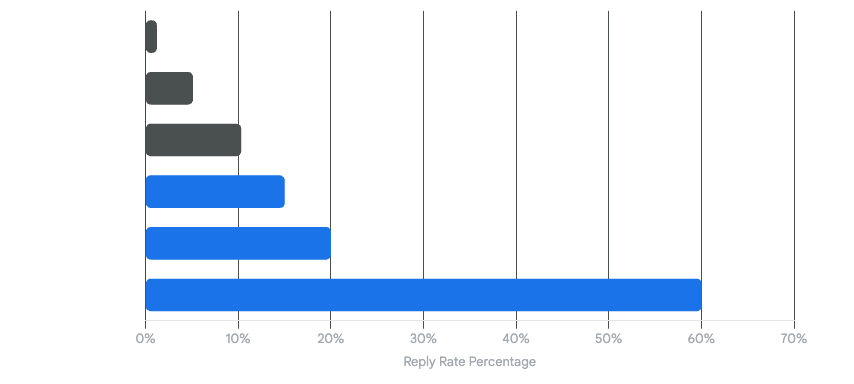
Generic mass emails rarely cross the 5 percent threshold. Candidates utilizing highly specific, researched hooks routinely see response rates exceed 15 percent, with top performers hitting 60 percent.
Successful candidates structure their outreach with surgical precision. They never ask for a job in the first message. Asking for a job immediately is the professional equivalent of proposing marriage on a first date. The sole goal of the initial message is to initiate a conversation.
The winning message structure contains four specific, mandatory lines : Line One establishes the hook. This single sentence proves the candidate researched the recipient and establishes common ground. Line Two states the exact purpose. This clarifies exactly why the candidate is reaching out and names the specific role of interest. Line Three provides the micro-pitch. This connects the candidate's verified skills directly to the employer's operational requirements. Line Four offers a clear, low-friction call to action. It ends with a simple question proposing a brief chat.
Five Verified Hook Strategies
Graduates who successfully land interviews rely on five specific variations of the opening hook. Each strategy requires distinct research and targets a different type of hiring manager.
1. The Beta Tester Hook
This strategy flips the traditional power dynamic of the job search. Instead of asking a startup founder for employment, the candidate acts as a free quality assurance analyst. The candidate signs up for the target company's software, tests it thoroughly, identifies a minor bug or friction point, and messages the founder or product manager with the documented solution.
Founders desperately need reliable feedback. One software founder scraped LinkedIn for digital marketers and sent personalized messages offering a free trial of his artificial intelligence tool in exchange for honest feedback. This strategy yielded a 15 to 20 percent reply rate. Graduates use this exact psychology in reverse to bypass human resources entirely.
A graduate might write: "Hi Sarah. I spent the weekend testing your new AI scheduling tool. It works beautifully, but I noticed the calendar sync drops out when switching time zones. I mapped out a quick logic fix for this and would love to share it. Open to a ten-minute chat next week?"
This hook secures interviews because it proves the candidate already understands the product. It demonstrates initiative, technical competence, and a proactive problem-solving mindset. The employer visualizes the candidate working for them before an interview even occurs.
2. The Product Suggestion Hook
Similar to the Beta Tester, the Product Suggestion hook involves proactive labor. The candidate analyzes the company's current offerings and suggests a specific, actionable improvement based on market trends.
Minor product suggestions work best. Candidates must avoid attempting to rewrite the company's entire business strategy. Instead, they should locate a small operational inefficiency. For example, an applicant aiming for an AI Marketing Assistant role might analyze a company's social media presence and content distribution.
The hook looks like this: "Hi David. I loved your recent campaign on predictive analytics. I noticed your team is not yet using generative AI to create localized versions of these posts. I built a quick prompt workflow that localizes your existing copy for the UK market in seconds. Would you like to see the test batch?"
This approach succeeds because it offers immediate, tangible utility. The core differentiator for successful artificial intelligence workers is unlocking practical utility for the business rather than chasing raw technical capability.
3. The Technical Teardown Hook
This hook targets engineering managers and senior developers rather than traditional recruiters. The candidate identifies a technical problem the team faces or an open-source repository the company maintains. The candidate then performs a "teardown" analysis or contributes a functional piece of code.
Prominent figures in the artificial intelligence industry began their careers exactly this way. Sholto Douglas failed to gain entry into his desired graduate programs for robotics and reinforcement learning. Instead, he spent his nights from 10:00 PM to 2:00 AM doing his own research. Every weekend, he spent six to eight hours each day coding his own projects, which eventually caught the attention of hiring managers and launched his career. Dhanji Prasanna explicitly stated he got hired at Block directly through his open-source contributions.
The Technical Teardown hook relies on peer-to-peer respect. "Hi Alex. I saw your team's recent repository update on GitHub regarding tokenization. I ran a benchmark test on the new configuration and managed to reduce latency by four percent using a different caching method. I documented the teardown here. Would love your thoughts if you have a moment."
This tactic bypasses the human resources department entirely. Engineers respect verified work and empirical data. Sharing a benchmark post earns clicks because it looks exactly like the type of content a professional peer would share naturally.
4. The Alumni Connection Hook
The Alumni Connection hook relies on shared history and regional identity. People naturally trust individuals from their own educational background. A shared alma mater creates an immediate, warm entry point that lowers the recipient's defensive barrier.
When sending a connection request, graduates face a strict 300-character limit. They must use this space efficiently. Personalized connection requests get accepted up to 85 percent more often than default, blank messages.
A standard, highly effective alumni hook reads: "Hi Mark. Fellow Penn State grad here, class of 2024. I see you are doing amazing things with data labeling at Anthropic. I would love to connect with a fellow Nittany Lion and follow your work.".
Graduates frequently use this network to secure roles. Maria Alvarez leveraged strong alumni connections to open doors for a junior associate strategy role at 360i immediately after graduation. Brandon Gip secured an entry-level tech sales role at memoryBlue largely because he reached out to familiar faces from his university who already worked there.
5. The Recent News Hook
This hook proves the candidate actively pays attention to the industry and the specific company. It requires referencing a specific, recent event regarding the prospect or their organization.
The most effective triggers include recent funding rounds, a podcast appearance, or a newly published article authored by the prospect.
"Hi John. I really enjoyed your recent Forbes interview discussing AI in retail. I have an idea to help your team reduce inventory costs by 15 percent using predictive modeling. Open to a brief chat next week to see if this fits?".
To make this hook succeed, the candidate must cite a specific insight or quote from the news piece. Generic praise fails immediately. Pointing out a specific metric or argument shows genuine engagement and proves the candidate actually consumed the content.
Another excellent example involves Anna Ha, who secured a front-end developer role in South Korea. She combined her knowledge of UX/UI design with an active project building a geolocation app for stray animals. She communicated these specific, active projects directly to the hiring team during her interview process, proving that her skills matched their exact immediate needs.
Follow-Up Failures and Disastrous Communication Risks
A perfect initial hook only begins the process. Candidates routinely destroy their chances during the follow-up phase. Recruiter productivity metrics show that getting to an offer is increasingly difficult. Small mistakes result in instant disqualification.
The data reveals that following up increases the probability of a response by 11 percent. Furthermore, follow-up campaigns can generate four times more responses compared to initial outreach efforts alone. Seventy percent of sales emails require a follow-up to receive a reply, and the first follow-up email is the most effective, boosting reply rates by roughly 40 percent.
However, poor execution guarantees failure. The analysis identifies five specific failures that ruin a candidate's chances even after a successful initial connection.
The Failed Email Versus The Winning Email
Job seekers often do not realize their polite follow-ups are actively hurting their candidacy. A generic check-in centers on the candidate's anxiety. It offers no new information. A strategic follow-up centers on the employer's needs and continues the problem-solving dialogue initiated during the interview.
A failed follow-up email typically features a vague subject line like "Following Up" or "Checking In." The body reads: "Hi Sarah. Thanks for your time today. I enjoyed learning more about the role and look forward to hearing about the next steps."
This message fails because it adds absolutely no value. It blends into the background noise of the recruiter's inbox.
A winning follow-up email features a specific subject line: "Follow Up: AI Operations Assistant Role - [Candidate Name]." The body reads: "Hi Sarah. Thank you for the detailed discussion regarding the data pipeline bottleneck. I thought about the Zapier integration issue we discussed and mapped out a quick logic flow that resolves the timeout errors. I have attached the diagram here. Looking forward to our next conversation."
This message succeeds because it demonstrates continued engagement with the company's specific problems. It transforms the candidate from a passive applicant into an active consultant.
Failure One: The Generic Thank You
As demonstrated above, a weak, generic follow-up gets deleted immediately. Candidates send messages that add zero value to the conversation. This fails to separate the candidate from a large pool of applicants. While not explicitly damaging, it is entirely forgettable and represents a wasted opportunity to reinforce competence.
Failure Two: Vague Subject Lines
Recruiters manage dozens of open roles and thousands of candidates simultaneously. A subject line that simply says "Following up" forces the recruiter to guess the sender's identity. Vague subject lines create immense friction. Nearly 50 percent of email recipients open an email based entirely on the subject line, but approximately 70 percent report emails as spam based solely on that same line. If a busy recruiter does not immediately recognize the context, they delete the email. Subject lines must explicitly include the candidate's name and the specific job title.
Failure Three: Self-Centered Updates
Desperate candidates send emails directly asking, "Are there any updates for me?". This frames the entire relationship around the candidate's anxiety and needs. Employers care about their own operational problems, not the applicant's stress levels. A follow-up should act as a proactive problem-solver.
Failure Four: Aggressive Persistence
Frequency and timing dictate success. Bombarding a recruiter with daily emails or messaging them across multiple platforms crosses the line into harassment. This is unprofessional and fails to respect the recruiter's time. Roughly 75 percent of customers expect to receive two to four touches before a business gives up, but rapid-fire messaging destroys trust. Furthermore, if a recruiter explicitly states they will make a decision by Friday, a candidate who follows up on Thursday demonstrates a total inability to follow simple instructions or respect professional boundaries.
Failure Five: Careless Errors and Poor Timing
Typographical and grammatical errors in a follow-up email are considered fatal errors. A candidate applying for an AI Prompt Engineer or Data Analyst role must demonstrate extreme attention to detail. If they cannot proofread a three-sentence email, the hiring manager will assume they cannot write clean code or configure a reliable automation workflow.
Timing also ruins chances. Sending a follow-up message immediately after applying signals neediness. Conversely, waiting too long suggests a lack of interest. The chance of receiving a response drops to 24 percent after five days of silence. Next-day follow-ups also lead to fewer responses, decreasing rates by up to 11 percent. Candidates must find the middle ground, usually waiting 48 to 72 hours before sending a value-added follow-up.
The 60-Day Replication Plan
Knowing the hooks is useless without a structured system for deployment. Sending cold messages requires volume, organization, and persistence. Busy graduates balancing part-time jobs or other commitments cannot rely on random bursts of motivation. They need a rigid, daily timeline.
The following 60-day plan breaks the job search into four distinct, 15-day phases. It replaces the passive act of clicking "apply" with a proactive sales operation.
Phase One: Foundation and Reconnaissance (Days 1 to 15)
The first two weeks involve absolutely zero outreach. Candidates must prepare their professional assets. Sending a brilliant hook that links to an empty LinkedIn profile or a generic resume ruins the opportunity instantly.
Days 1 to 5: Asset Calibration. Graduates must rewrite their resumes and LinkedIn profiles. They must run their existing resumes through an artificial intelligence gap analysis tool against target job descriptions. This process identifies missing keywords, which the candidate must then weave naturally into their experience sections. They must remove any mention of roles outside the $20,000 to $60,000 band to avoid looking overqualified, unfocused, or confused about their trajectory.
Days 6 to 10: Portfolio Construction. Candidates must build verifiable proof of competence. For entry-level artificial intelligence roles, this means creating a public portfolio of applied skills. A candidate targeting an AI Operations role should build three distinct automation workflows. They must integrate tools like Rapidely for customer support, Flick for social media scheduling, and Beautiful.ai for presentations. They must document the exact process, the prompts used, and the estimated hours saved. They upload these case studies to a personal website, a Notion workspace, or a GitHub repository.
Days 11 to 15: Target Identification. Candidates stop using aggregate job boards. Instead, they build a specific, highly targeted list of fifty companies. They prioritize artificial intelligence startups that recently received seed funding, or mid-sized agencies actively building out automation teams. They use tools like Sales Navigator or Hunter to identify the exact names of the hiring managers, product leads, or senior engineers at these companies. They explicitly avoid targeting human resources personnel, who act as gatekeepers rather than decision-makers.
Phase Two: The Outreach Engine (Days 16 to 30)
With a clean profile, a verified portfolio, and a target list, the active outreach begins.
Days 16 to 20: Engagement and Warming. Before sending any direct messages, candidates warm up their targets to create familiarity. They visit the LinkedIn profiles of the fifty identified managers. They leave thoughtful, specific comments on the managers' recent posts. Leaving just three thoughtful comments on a prospect's content before sending a direct message increases the eventual connection acceptance rate by 29 percent. The goal is simple name recognition.
Days 21 to 25: Connection Requests. Candidates send connection requests to the warmed targets. They utilize the Alumni Connection hook or the Recent News hook. They keep the request strictly under the 300-character platform limit. They do not ask for a job. They merely ask to connect based on shared professional interests or a shared educational background.
Days 26 to 30: The Value Pitch. For the managers who accept the connection, the candidate waits exactly 48 hours and then sends the primary hook. This is where they deploy the Beta Tester or Product Suggestion templates. They offer a specific piece of value, keep the message strictly under 400 characters , and end with a low-friction question asking for a brief, ten-minute conversation.
Phase Three: Advanced Follow-Up and Tracking (Days 31 to 45)
Silence is the default response in cold outreach. A lack of immediate reply does not indicate rejection. It usually indicates a busy recipient dealing with competing priorities.
Days 31 to 35: The First Follow-Up. If a manager does not reply after four days, the candidate sends the first follow-up. This message must be brief. It should bump the previous message to the top of the inbox and provide one additional piece of value. "Hi David. Following up on the localization prompt workflow I mentioned Tuesday. I ran a quick test on your latest blog post, and the results are attached. Let me know if you have five minutes to discuss." The first follow-up generates a reply rate approximately 40 percent higher than the initial message.
Days 36 to 40: Broadening the Net.
While managing follow-ups, the candidate adds fifty new companies to the pipeline and begins the warming process again. Consistent volume prevents the candidate from becoming emotionally desperate over one specific role.
Days 41 to 45: Mock Interviews and Behavioral Prep. As replies trickle in and initial phone screens are booked, candidates must prepare for the actual conversations. They outline ten professional stories using the Context, Action, Result framework. They prepare specific, detailed examples of dealing with difficult stakeholders, learning new technologies quickly, and solving open-ended technical problems without supervision.
Phase Four: Polish and Perform (Days 46 to 60)
The final phase focuses entirely on conversion. Getting the interview represents only a fraction of the battle.
Days 46 to 50: The 30-60-90 Day Plan. Before attending any final-round interviews, candidates construct a detailed 30-60-90 day plan. This document outlines exactly what the candidate intends to accomplish during their first three months on the job. It details specific operational targets, learning milestones, and metrics for success. Presenting this document during an interview proves the candidate understands the role deeply. It shifts the psychological dynamic of the conversation from "Are you qualified?" to "How will we execute this plan together?"
Days 51 to 55: Strategic Post-Interview Follow-Up.
Following every single interview, candidates deploy highly specific thank-you notes. They avoid the generic failures discussed earlier. They reference a specific technical challenge mentioned by the interviewer and provide a brief thought on how they would solve it, attaching a diagram or a relevant link if necessary.
Days 56 to 60: Negotiation and Closing. When offers arrive in the target $20,000 to $60,000 range, candidates must ensure they understand the exact expectations of the role. They ask for a prescheduled 30-day and 60-day progress check-in to ensure total alignment with their new manager. This guarantees a strong start and protects the candidate from sudden termination due to mismatched expectations or poor onboarding procedures.
The Mathematical Reality of Persistence
The modern job search requires candidates to act as their own specialized sales development representatives. They must actively prospect, warm leads, deploy highly personalized messaging, and manage automated follow-ups with precision.
Applying to hundreds of roles through automated portals guarantees failure. The screening algorithms filter out 87 percent of applicants immediately. Furthermore, the massive 182 percent spike in application volume renders human review impossible for generic submissions. However, by targeting specific entry-level artificial intelligence roles, researching the exact hiring managers, and deploying value-driven hooks, recent graduates can bypass the algorithms entirely. They stop asking for jobs and start offering immediate operational solutions. This fundamental shift in strategy provides the only mathematically reliable method for breaking the silence in the modern hiring market.