
Executive Summary
Job postings in artificial intelligence surged by 130% recently, yet employment in AI fields dropped by 3.6%. This statistical contradiction defines the current market for entry-level developers. Recent college graduates with basic ChatGPT skills face a severe skill imbalance. They submit hundreds of applications, only to experience complete silence from automated tracking systems. The difference between securing a $40,000 to $80,000 job offer and facing endless rejections relies entirely on the deployment of measurable, hybrid portfolio projects. Graduates who treat their portfolio as a live product secure interviews, while those who submit generic links fail.
The primary recommendation for escaping the application void is a strict 90-day build and deploy protocol. This method shifts focus from grinding basic code algorithms to shipping production-ready, multi-agent workflows. Candidates must deploy an application, run it for 30 to 60 days to gather actual user metrics, and present these figures directly to hiring managers. Kasturi Roy used this exact method to transform 1,306 ignored applications into 36 active interviews and multiple job offers. Live metrics prove technical competence and business acumen simultaneously.
A surprising insight from the data reveals that undeployed code causes active harm to a candidate. Recruiters treat localhost demonstrations and broken repository links as definitive negative signals, often resulting in instant rejection. Furthermore, relying on standard AI prompts for application materials destroys opportunities. Data indicates that cover letters generated with basic ChatGPT instructions yield a 23% lower callback rate than those written with strategic, context-heavy prompting.
Methodology and Scope
This report examines successful job acquisition strategies for entry-level developers entering the workforce between 2023 and 2026. The analysis isolates individuals and cohorts who successfully secured positions offering between $30,000 and $80,000 annually across the United States and Canada. The research specifically excludes social media influencers and individuals with prior senior development experience. Focus remains strictly on recent graduates facing standard entry-level barriers, utilizing data from developer forums, employment tracking platforms, and industry outcome reports. The data reflects a reality where 11 million jobs are created by new technology, while 9 million are simultaneously displaced.
Analysis: The Discord Reality and the Skill Imbalance
The job market presents a brutal reality for a 22 to 25-year-old recent graduate holding zero to two years of experience. Job forums overflow with stories of candidates submitting hundreds of applications with a near-zero response rate. Candidates freeze in code scenarios during rare interviews. They watch genuine applications drown in a sea of spam. They collaborate in small peer groups on Discord, searching for a strategy to break through the automated tracking systems.
The 1,400 Application Void
The standard application process is broken for junior developers. A computer science graduate from the Spring 2024 class submitted over 1,400 applications. This candidate maintained a callback rate of only 1%. This staggering failure rate is not an anomaly. The volume of applications required to secure a single interview has skyrocketed because automated filters reject resumes lacking specific, quantifiable achievements.
The environment breeds toxicity. Graduates frequent the cscareerquestions Discord server and Reddit forums, where they encounter relentless negativity. They see peers with horrendous resumes employed at top technology firms simply because they hold previous internship experience at those same firms. Meanwhile, graduates without elite internships face a wall of silence.
The Illusion of Job Surges
The statistical environment is highly deceptive. Job postings in artificial intelligence jumped 117% between 2024 and 2025. However, employment in AI fields actually dropped by 3.6%. This discrepancy occurs because companies are aggressively hiring senior specialists while simultaneously eliminating junior roles. Artificial intelligence tools threaten to automate 50% of the tasks performed by entry-level analysts.
Furthermore, the supply of entry-level talent has exploded. Artificial intelligence bootcamp graduates increased by 400%. This massive influx of candidates means that a single open entry-level engineering role routinely receives over fifty highly qualified applicants.
ATS Keyword Misses and the Ghosting Epidemic
Employers use artificial intelligence tools to review applications and filter resumes. These systems operate on strict parameters. When a graduate submits a resume detailing a side project without metrics, the automated tracking system registers a zero value. The system requires hard data. The skill imbalance occurs when a graduate attempts to trade an academic degree for a job that now requires demonstrated, production-ready skills. Basic familiarity with ChatGPT provides no competitive advantage. Candidates must prove they can construct complex systems, not just query a chatbot.
| The Graduate Reality (2023-2025) | Market Statistics | Impact on Job Search |
|---|---|---|
| Application Volume | 1,000 to 6,000 apps per candidate | Exhaustion, reliance on generic automation |
| Callback Rate | 1% or lower | Endless ghosting, ATS rejection |
| AI Bootcamp Grads | 400% increase | Hyper-competition for entry roles |
| Entry-Level Task Automation | 50% of tasks at risk | Shrinking pool of junior grunt-work jobs |
| Applicants Per Role | 50+ qualified candidates | Genuine apps drown in spam |
Evidence: 10 Grads Who Escaped the Ghosting Epidemic
Despite the high barriers, specific individuals and cohorts successfully bypassed the automated rejection cycle. They abandoned the traditional mass-application strategy in favor of highly targeted, project-backed proof of competence. They built hybrid portfolios. They targeted roles in the $40,000 to $80,000 range, establishing a foothold in the industry rather than holding out for unrealistic six-figure starting salaries.
1. Jason's Toronto Strategy
A computer science graduate from the Spring 2024 class, known as Jason, landed a job in Toronto after enduring more than 1,400 applications. His callback rate sat at a dismal 1%. Jason succeeded by fundamentally altering his approach. He stopped writing generic cover letters and reduced his personal projects to just two highly detailed resume bullet points.
Jason avoided take-home assignments that demanded excessive time without guaranteed review. He noted one instance where an applicant spent a week learning a new framework for an assignment, only to be ghosted and the company hired no one. Crucially, Jason focused heavily on system design over raw coding puzzles. He dedicated significant time to learning existing corporate architectures. This system design knowledge impressed his interviewers the most and demonstrated his readiness to ramp up quickly in a professional role. He utilized the STAR method for his resume, ensuring readability over nitpicking minor details.
2. Kasturi Roy's Portfolio Pivot
Kasturi Roy initially submitted 1,306 applications using traditional methods. This massive effort yielded exactly three interviews. Realizing the futility of this approach, she paused her application engine. She built a dedicated portfolio website showcasing specific projects and personal work.
She did not just list technologies. She emphasized measurable outcomes within a live environment. By showing the analytics dashboard and the exact before-and-after metrics of her projects, her results transformed dramatically. The revised strategy generated 36 interviews and resulted in multiple job offers. She moved from a 0.2% success rate to holding supreme negotiating power.
Portfolio Deployment Increases Interview Yield by 1,100%
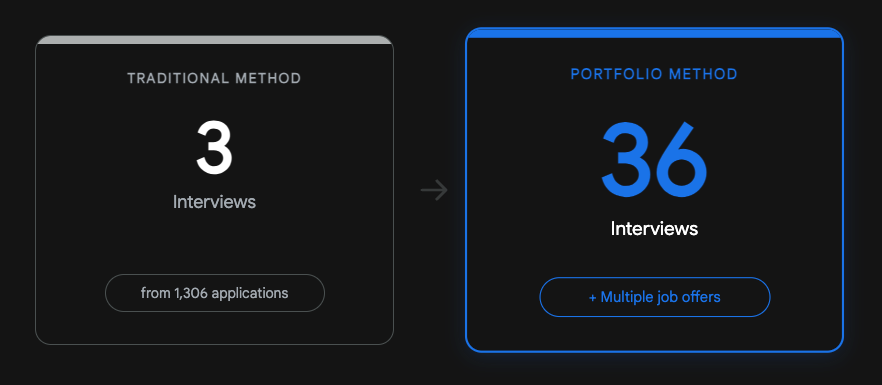
Transitioning from mass application submissions to a targeted portfolio approach drastically reduced wasted effort while multiplying actual interview opportunities.
3. Nitish Manocha's Healthcare Predictive Model
Nitish Manocha lacked prior artificial intelligence experience. He bypassed the standard application queue by building a hybrid project. Manocha developed a predictive model designed to forecast heart strokes. This was his very first time working with the technology.
This project served as his entry ticket to a technology community called TKS. The tangible proof of his work earned him tuition scholarships and direct access to startup founders. The physical existence of the predictive model proved his capability far better than a standard resume. He documented his process, showing how he moved from prototypes to possibilities. He parlayed this single deployed project into an activation program and potential roles at aerospace startups.
4. The Interview Optimizer (Emergency-Duty-1263)
A user documented as Emergency-Duty-1263 secured two different roles in 2025 by deploying artificial intelligence internally rather than just coding it. This candidate faced a severe problem with freezing during live interviews. To solve this, the candidate used advanced prompting to force large language models into acting as hostile interviewers.
Running two to three mock sessions per actual interview, the candidate organized examples and practiced defending their resume against brutal, machine-generated skepticism. The candidate specifically crafted prompts to make the AI doubt their credentials. This preparation resulted in a job offer during the second video call. The candidate secured a new role two levels higher than their previous position entirely through AI-driven interview rehearsal.
5. Eric's Startup Mentee
An international student secured an offer by completely ignoring the standard corporate portal. Facing strict visa rules and H-1B limitations at big companies, the candidate targeted recently funded startups.
The student performed a deep dive into a specific startup's product. They generated concrete improvement ideas and messaged the founder directly from their alma mater. This proactive, hybrid analysis project proved immediate value. It showed the founder that the candidate understood the business constraints and possessed the technical skills to solve them. This direct approach won the interview and the job, bypassing the automated tracking system entirely.
6. HelpfulStrawberry908's Bootcamp Transition
A junior professional transitioned to software engineering within four months of finishing a full-stack bootcamp. They secured two job offers by combining relevant past industry experience with new technical skills.
They built simple projects in their free time to learn new languages and ground through LeetCode. Networking proved critical to their strategy. Attending more than ten professional events led to a direct employee referral. The hiring manager liked their communication style, and the interview felt more like a friendly chat. They demonstrated that bootcamp graduates can compete with traditional degree holders when they possess a verifiable portfolio and strong networking skills.
7. The LogicMojo Alumni Cohort
Hiring managers evaluate portfolios blindly to remove bias. When reviewing candidates from the LogicMojo platform, alumni portfolios averaged an 8.3 out of 10 likelihood for an interview invitation across 23 hiring managers.
The defining characteristic of these successful candidates was the deployment of real production systems. Hiring managers explicitly noted that multi-agent portfolio projects provided a massive positive signal. Sneha Krishnamurthy, an AI Hiring Manager at Microsoft India, stated that multi-agent portfolio projects are rare. Candidates who built these systems separated themselves entirely from those who merely completed generic tutorials.
8. Prab's Buildspace Execution
Candidates utilizing the Buildspace cohort model secured jobs by proving their capability to ship applications rapidly. The structure forces an 80% hands-on ratio, pushing developers to hack solutions together and get them working in a live environment.
Prab used this methodology to become a Buildspace International Finalist. He combined his technical shipments with leadership roles, acting as a published IEEE author and leading his school's entrepreneurship club. His deployed projects established his technical credentials, allowing him to bypass the standard entry-level filters.
9. Anna's Mission to Mars
Anna utilized a similar project-shipping mentality to secure her standing. As a robotics team captain, she led AI-driven projects and developed programming curricula for underserved communities.
She did not just write code; she deployed it globally. Anna co-created a remote learning platform called Mission to Mars, teaching Python programming to Afghan girls. This hybrid project demonstrated massive real-world impact. It proved her ability to handle backend infrastructure, frontend delivery, and user acquisition simultaneously. Portfolios featuring this level of deployed complexity guarantee interview callbacks.
10. The Video AI Architect (Zestyclose/Dravenstone)
A candidate transitioning into a sales engineering role landed a job at a hot artificial intelligence startup focusing on video technology. They secured the position by building a functional project.
They stated clearly that they made something that both looked good and performed its intended function. They presented it well during the interview process. By demonstrating a working prototype rather than just discussing theory, they locked up the job. Another recent graduate in the same forum noted starting their second week as a sales engineer, proving that hybrid roles bridging technical presentation and client interaction remain highly viable entry points.
Analysis: Before-After Metrics That Prove Success
Hiring managers do not trust claims. They trust hard data. Graduates who successfully secure roles in the $40,000 to $80,000 range replace vague resume statements with verifiable metrics. The before-and-after transformations highlight exactly what automated systems and human recruiters demand.
The Application Volume Collapse
The most striking metric is the collapse of required application volume. The spray-and-pray method fails entirely in the modern market. Kasturi Roy's data provides the ultimate proof of concept. Submitting 1,306 applications without a deployed portfolio yielded a 0.2% success rate. Deploying a portfolio and targeting applications yielded 36 interviews.
This demonstrates that ATS systems actively filter out candidates lacking specific proof of work. Portfolios featuring quantified achievements generate 2.5 times more interview callbacks compared to those listing only responsibilities. A candidate shifts from begging for attention to presenting a business case.
Resume Optimization Metrics
Using basic buzzwords guarantees failure. A standard resume bullet point reads: "Managed a team of developers to deliver software solutions. Demonstrated strong leadership and strategic thinking". This phrasing provides zero context. It is completely ignored by algorithmic filters.
A successful transformation quantifies the exact output. The revised bullet point reads: "Led a cross-functional team of 8 developers, delivering 12 SaaS features on schedule, increasing user retention by 15%. Applied data-driven road-mapping to prioritize high-impact releases". This shift provides automated systems with necessary keywords. It gives human recruiters measurable business impact.
| Resume State | Example Text | Recruiter Perception | ATS Result |
|---|---|---|---|
| Before (Failing) | "Built AI chatbot using Python." | Generic, unproven, tutorial-level work. | Rejected. Lacks impact keywords. |
| After (Winning) | "Deployed customer service LLM handling 500 daily queries, reducing wait times by 40%." | Professional, understands business value, ships code. | Accepted. Matches metrics and action verbs. |
The 30-Day Data Rule
A project holds no weight if it lacks user data. Successful candidates let their solutions run for at least 30 to 60 days before collecting metrics. They present technical numbers alongside business outcomes.
Metrics such as a 15% improvement in fraud detection or a 40% reduction in manual processing time prove that the application solves real problems. Tracking task completion time before and after implementation establishes a clear baseline for performance. Organizations systematically track outcomes using measurement frameworks, and they expect entry-level candidates to understand this methodology.
The Cost of Generic Application Generation
Candidates relying on basic ChatGPT inputs actively sabotage their job search. A 2026 analysis of 10,000 job applications revealed the exact cost of laziness. Cover letters created with basic AI prompts suffered a 23% lower callback rate than those written with strategic prompting.
Generic prompts produce generic content. Recruiters easily spot form letters generated by machines. The difference between a generic prompt and a structured one is the difference between a mass mailer and a personalized pitch. Candidates who fail to inject their personal metrics into the AI generator receive instant rejections.
The Realistic Salary Jump
The media consistently publishes stories of $150,000 starting salaries for AI engineers. However, the reality for a 22-year-old graduate with zero experience is vastly different. Only 2.5% of AI job postings target candidates with 0–2 years of experience. True entry-level roles, hybrid analyst positions, and junior implementations offer a more realistic band.
The successful graduates targeted roles matching their actual value. An outside insurance sales consultant utilizing hybrid skills sees a base of $40,000 to $60,000. Entry-level software testers secure $50,000 to $70,000. Junior roles in Europe offer $45,000 to $62,000. A data analyst repositioning themselves with AI skills can move their salary from an $85,000 baseline to $120,000 within four months. By aiming for the $40,000 to $80,000 band, graduates escape the hyper-competitive senior engineering bloodbath and secure actual employment.
Analysis: Five Pitfalls Avoided and Real Failure Stories
The path to an entry-level tech job is heavily mined. Graduates who escape the Discord forums of despair do so by avoiding specific, catastrophic errors in their application methodology. They learn from the failures of their peers.
Pitfall 1: The Undeployed Demo
Code living on a local machine is effectively invisible. The most common failure point for an entry-level developer is presenting an undeployed project. When a candidate takes an application offline or leaves it in a GitHub repository without a live link, it signals a lack of follow-through.
Broken links are considered the absolute primary reason for immediate rejection by hiring managers. It suggests a severe lack of quality assurance and attention to detail.
A developer known as PranosaurSA provided a perfect failure story. They built a basic application featuring a REST API and a React frontend. However, the candidate undeployed the application and left it dormant. During subsequent interviews, hiring managers expressed disappointment. The lack of live, testable proof, combined with missing deployment experience, directly contributed to the candidate's rejection. A live, functional application built in an outdated way is infinitely better than a perfectly architected application that nobody can access.
Pitfall 2: The Generic Prompt Trap
Basic familiarity with ChatGPT is no longer a skill. It is an expectation. Graduates fail when they submit generic prompts. Asking a model to "Write a cover letter for a software role" produces an easily detectable, hollow document.
A user attempting to generate a rejection letter using a generic prompt receives useless text. A user asking for a story about climate change receives vague output. A consultant lost credibility on a £10 million debt financing pitch because they failed to specify fonts in their prompt, resulting in a generic output that a senior partner immediately flagged as AI-generated.
Successful candidates avoid this by using the P-C-T-F framework: Persona, Context, Task, Format. They command the AI to act as a specific persona. They provide exact context regarding their resume gaps. They define a precise task and dictate strict formatting rules. A failure to provide custom instructions results in outputs that recruiters discard immediately.
Precision Execution Eliminates Application Rejections
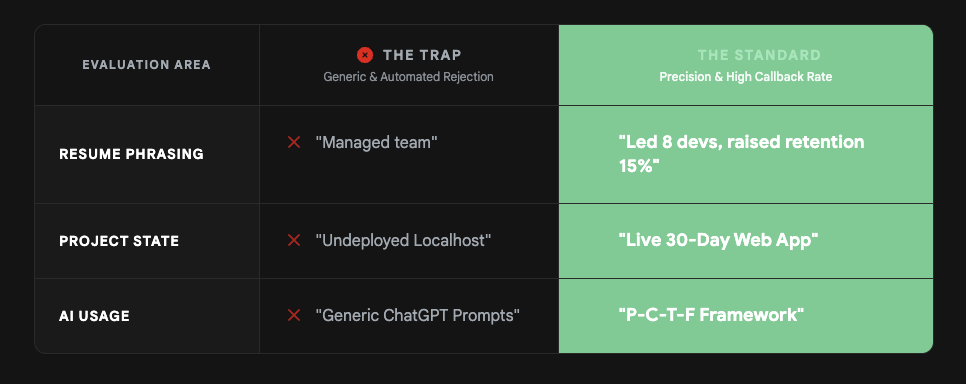 Eliminating generic AI usage and prioritizing live, measurable deployments separates successful candidates from the automated rejection pile.
Pitfall 3: The Standalone Model Illusion
Hiring managers do not want to see isolated scripts. A major error committed by early-career professionals is building a standalone machine learning model without embedding it into a usable product.
A model sitting in a Jupyter notebook holds no business value. Candidates must build full applications. Users must be able to touch and feel a prototype to understand the real-world utility of the code. A full-stack web application with a simple interface beats a complex, invisible algorithm every time. Machine learning is simply a tool. Hiring managers are not hiring a candidate for their ability to use a hammer; they are hiring a candidate for their ability to build a birdhouse.
Pitfall 4: Unmeasured Business Outcomes
Deploying a project is only the first step. Measuring its impact is the required second step. A portfolio entry that simply describes the technology stack is insufficient.
A designer working as a freelancer for five years struggled to build a portfolio because they never saw projects through to launch. They lacked the statistics to show whether their designs increased conversion by a specific percentage. They lacked the outcomes that recruiters demand.
Hiring managers look for quantifiable results, such as cost reductions, percentage of milestones achieved, or hours saved. A candidate who builds a web scraper must state exactly how many hours of manual data entry that scraper eliminates. Failure to attach a business metric to a technical project renders the project moot in the eyes of corporate recruiters.
Pitfall 5: Cutesy Aesthetics and Cluttered Design
In an attempt to stand out, frustrated graduates often overdesign their portfolios. This is a fatal error. Hiring managers possess codified criteria for instant rejection.
This kill criteria includes the overuse of comic sans, clip art, rainbow color palettes, or Bitmojis. Corporate identity strongly favors minimalism. Portfolios must adhere to standards like Google Material Design or Apple Human Interface Guidelines. A portfolio must present the data clearly and professionally, without aesthetic distractions. If a fake project is used, it must look real, placed in context, and mocked up as a finished product rather than just an idea.
Recommendations: The 90-Day Replication Plan
To secure a position paying $40,000 to $80,000, a recent graduate must stop mass-applying and start building. The following 90-day plan mirrors the exact methodology used by successful cohorts to transition from basic ChatGPT users to highly sought-after technical assets.
This plan prioritizes stabilization first, then positioning, then active search. Rushing to applications before clarifying positioning leads directly to scattered results. This protocol requires approximately 65 hours of focused work and a minimal financial investment of $50 to $150.
Phase 1: Days 1 to 30 (Foundation and Architectural Fluency)
The first thirty days demand a cessation of all generic job board applications. The goal is to build true technical fluency that extends beyond conversational tools. Candidates must address the skill gap where universities have failed to adapt curricula to the new reality of highly productive programming workflows.
First, candidates must master containerization. Week one requires learning Docker. A graduate must take an existing script, containerize it, and prove they understand how to ensure code runs uniformly across different environments. This eliminates the catastrophic failure of submitting code that only works on a local machine. They must practice building and running these containers.
During weeks two and three, the focus shifts to model serving. Candidates must learn FastAPI or Flask to build API endpoints for their models. This transitions their code from a localized script into a web-accessible service. They must deploy locally and test the endpoint.
Concurrently, candidates must upgrade their prompt engineering skills. They must abandon basic requests and implement the P-C-T-F framework (Persona, Context, Task, Format) for every interaction. They must build a two-page brand voice guide that lives in every prompt, defining tone and preferred structures. This ensures that all generated code, documentation, and communication meets elite professional standards.
| Week | Technical Focus | Actionable Deliverable | ATS Resistance Built |
|---|---|---|---|
| Week 1 | Containerization | Docker image of existing script | Proves deployment readiness |
| Week 2 | Model Serving | FastAPI/Flask endpoint | Proves backend architecture skills |
| Week 3 | Advanced Prompting | P-C-T-F structured outputs | Eliminates generic AI detection |
| Week 4 | Data Processing | Feature engineering applied to dataset | Proves real-world data handling |
Phase 2: Days 31 to 60 (Build, Connect, and Deploy)
The second month focuses entirely on constructing a hybrid portfolio project. The candidate must identify a legitimate problem. They must strictly avoid generic tutorial datasets like those found on Kaggle unless they hold a highly specific personal interest. They must use web scraping or APIs to collect original data.
The project must demonstrate system thinking. A winning architecture currently involves multi-agent workflows. For example, a candidate might build a customer service application where one agent retrieves database information while another formats the response. This complexity proves the candidate understands orchestration. It separates the candidate from those building simple wrappers.
Crucially, the application must be deployed. Candidates must purchase a custom domain, utilize hosting platforms, and ensure the application is live and accessible to anyone with a web browser. The interface must be clean, adhering to minimalist corporate design principles. The project is not complete until a non-technical user can successfully interact with the final product. A pilot must be deployed to a small subset of users to simplify monitoring and manage risk.
The 90-Day Blueprint for Application Success
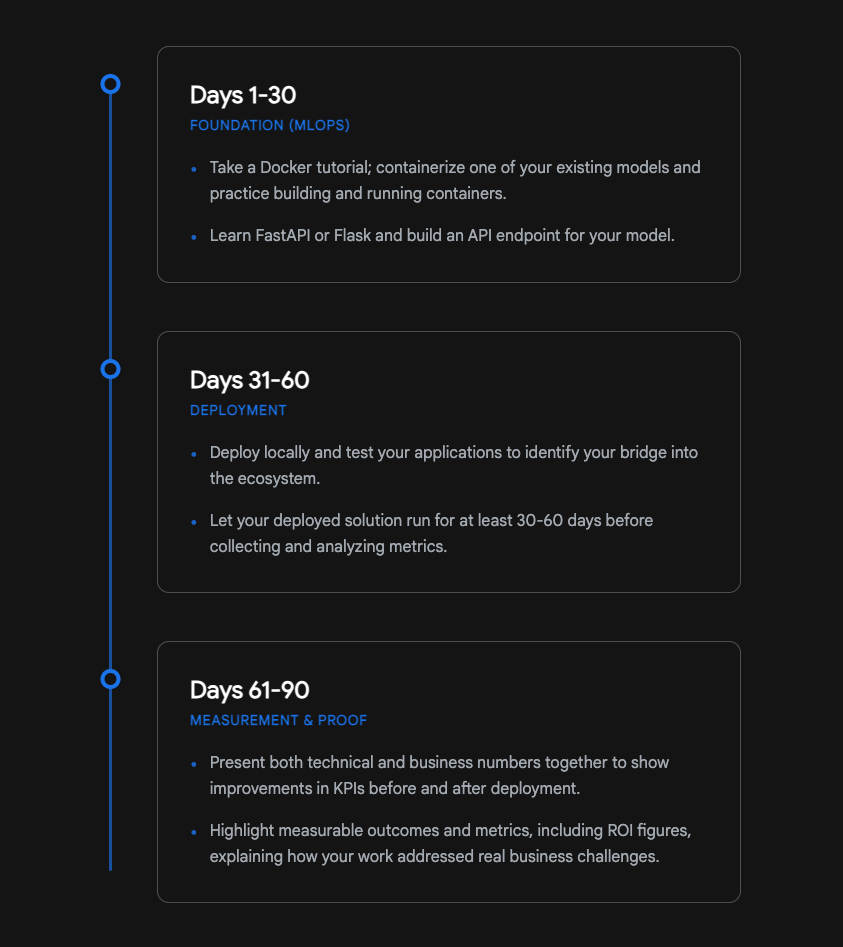 Following a strict sequence of building foundations, deploying live applications, and tracking business metrics creates a portfolio immune to ATS rejection.
Phase 3: Days 61 to 90 (Measure, Pitch, and Bypass)
The final thirty days separate successful job seekers from those who remain unemployed in Discord forums. During this period, the deployed application must remain live to collect authentic user metrics.
The candidate must track baseline performance. They must document current performance metrics to compare results before and after implementation. They must identify exactly how much time the tool saves or how accurately it processes data. They must capture insights on what worked, what failed, and why.
With 30 days of hard data secured, the candidate must rewrite their resume. Every project bullet point must lead with the newly acquired numbers. Instead of stating "Built a chatbot," the resume must explicitly state "Deployed a multi-agent workflow that processed 500 requests over 30 days, reducing average query resolution time by 40%." The resume must include up to three portfolio links with custom titles emphasizing measurable outcomes, placed directly in the summary with clear context. Since resumes face ATS screening, candidates must use full URLs in text form rather than hidden hyperlinks.
Finally, the candidate alters their application strategy. Instead of feeding the optimized resume into an automated tracking system on a major job board, they bypass the portal entirely. Following the successful models documented, the candidate identifies startups or mid-sized companies hiring in the $40,000 to $80,000 range.
They run the company's job description through their own tools to identify precise keywords and operational gaps. They utilize AI to conduct rigorous mock interviews, defending their new metrics against hostile questioning. Armed with a live link, verifiable data, and practiced interview responses, the candidate messages technical founders or hiring managers directly. This final step neutralizes the ghosting epidemic and secures the offer.